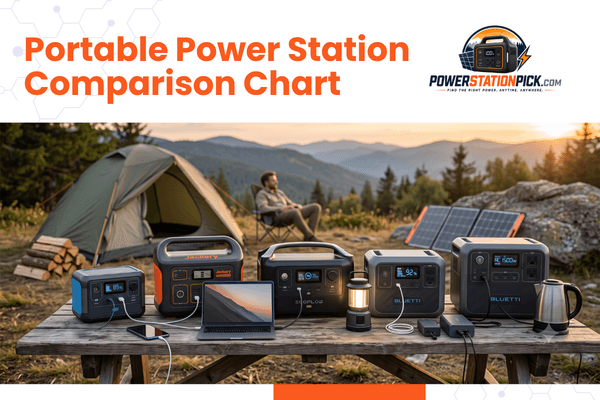
Portable Power Station Comparison Chart 2026: Every Model We’ve Tested, Side by Side
🔍 Quick Answer
The right portable power station depends entirely on what you’re powering. For CPAP machines and weekend trips, a 500–800Wh unit like the Bluetti AC70 or EcoFlow RIVER 2 Max is plenty. For camping, overlanding, or a small apartment backup, the 1,000–2,000Wh class — Jackery Explorer 1000 V2, OUPES Mega 1, or Anker SOLIX F2000 — hits the sweet spot of price and capacity. For whole-home backup, you need 3,000Wh+ systems like the Pecron E3800LFP or EcoFlow DELTA Pro 3. The chart below breaks down exact specs so you can match capacity, output, and price to your actual use case instead of guessing.
The Full Comparison Chart
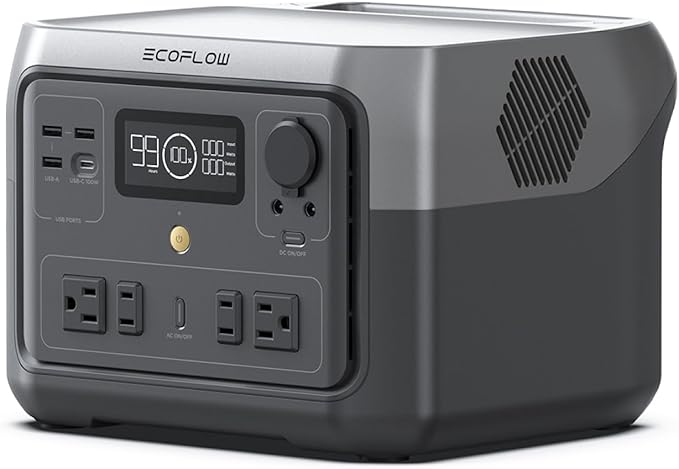
EF ECOFLOW Portable Power Station River 2 Max 500, 499Wh LiFePO4 Battery/ 1 Hour Fast Charging, Up to 1000W Output Solar Generator (Solar Panel Optional) for Outdoor Camping/RVs/Home Use
The EF ECOFLOW Portable Power Station River 2 Max 500 is a versatile and powerful energy solution, ideal for outdoor adventures, home use, and RV trips. With a robust 499Wh LiFePO4 battery and rapid charging capabilities, it ensures you stay powered wherever you go.
Check Price on Amazon
BLUETTI AC70 Portable Power Station, 768Wh Solar Generator w/ 2 1000W AC Outlets (Power Lifting 2000W), 100W Type-C, LiFePO4 Battery Backup for Road Trip, Off-Grid, Power Outage (Solar Panel Optional)
The BLUETTI AC70 Portable Power Station is a versatile solar generator designed to provide reliable power for your road trips, off-grid adventures, and during power outages. With a robust 768Wh capacity and multiple output options, it ensures you stay connected wherever you go.
Check Price on Amazon
Jackery Explorer 1000 v2 Portable Power Station,1070Wh LiFePO4 Battery,1500W AC/100W USB-C Output, 1 Hr Fast Charge, Solar Generator for Camping,Emergency, RV, Off-Grid Living(Solar Panel Optional)
The Jackery Explorer 1000 v2 Portable Power Station is a versatile and powerful energy solution, perfect for camping, emergencies, RV trips, and off-grid living. With a robust 1070Wh LiFePO4 battery, it offers reliable power wherever you go.
Check Price on Amazon
OUPES Mega 1 Portable Power Station 2000W (Surge 4500W), 1024Wh LiFePO4 Battery Generator, Expandable to 5kWh, UPS, for Home Backup Power, Camping, Road Trips
The OUPES Mega 1 Portable Power Station is a powerful and versatile energy solution, ideal for home backup, camping, and road trips. With a robust 2000W output and a 1024Wh LiFePO4 battery, it ensures reliable power wherever you go.
Check Price on Amazon
Anker SOLIX F2000 Solar Generator, 2048Wh Portable Power Station with LiFePO4 Batteries and 400W Solar Panel, GaNPrime Technology, 4 AC Outlets Up to 2400W for Home, Power Outages, Camping, and RVs
The Anker SOLIX F2000 Solar Generator is a powerful and portable power station designed to provide reliable energy for home use, camping, and RV adventures. With a robust 2048Wh capacity and advanced GaNPrime technology, it ensures you stay powered during outages or on the go.
Check Price on Amazon
BLUETTI Elite 200 V2 Portable Power Station, 2073.6Wh LFP Battery Backup w/ 4 2600W AC Outlets (3900W Power Lifting), 0-80% Fast Charging in 50 Min, Solar Generator for Camping, Off-grid and Emergency
The BLUETTI Elite 200 V2 Portable Power Station is a powerful and versatile energy solution, perfect for camping, off-grid living, or emergency situations. With a massive 2073.6Wh capacity and rapid charging capabilities, it ensures you stay powered wherever you go.
Check Price on Amazon| Model | Capacity | AC Output (Surge) | Battery / Cycle Life | Full AC Charge | Price (MSRP*) | Best For |
|---|---|---|---|---|---|---|
| EcoFlow RIVER 2 Max | 499Wh | 500W (X-Boost 1,000W) | LiFePO4 / 3,000 cycles | ~1 hr | ~$499 | Ultra-light day trips, backpacks |
| Bluetti AC70 | 768Wh | 1,000W (Power Lifting 2,000W) | LiFePO4 / 3,000+ cycles | ~45 mins (80%) | ~$599 | CPAP machines, quiet short trips |
| Jackery Explorer 1000 V2 | 1,070Wh | 1,500W (3,000W surge) | LiFePO4 / 4,000 cycles | 1–1.7 hrs | ~$799 | All-round camping & emergency backup |
| OUPES Mega 1 | 1,024Wh (exp. to 5,120Wh) | 2,000W (4,500W surge) | LiFePO4 / 3,500+ cycles | 36 mins | ~$699 | Power tools, best value-per-watt |
| Anker SOLIX F2000 | 2,048Wh (exp. to 4,096Wh) | 2,400W (4,000W peak) | LiFePO4 / 4,000 cycles | 58 mins | ~$1,399 | Mid-size home backup, RVs |
| Bluetti Elite 200 V2 | 2,073.6Wh | 2,600W (5,200W surge) | LiFePO4 / 6,000+ cycles | ~1.3 hrs | $899–$1,499 | Longevity-focused home backup |
*Prices fluctuate constantly with flash sales — we’ve seen every model above dip 20–40% below MSRP at different points in 2026. Always check the current listing before buying.
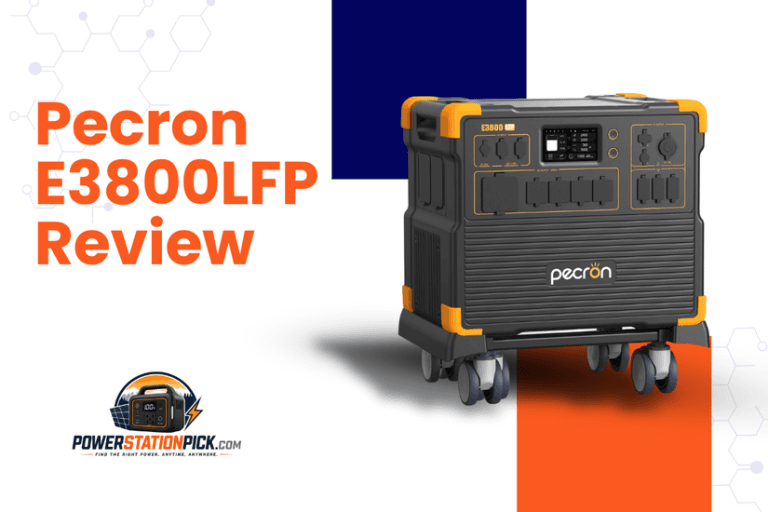
For the 3,000Wh+ whole-home tier (Pecron E3800LFP, EcoFlow DELTA Pro 3, and similar), the spread in inverter output, expansion options, and 240V capability is wide enough that a table cell can’t do it justice — we break that matchup down in full detail in our Pecron E3800LFP vs. EcoFlow DELTA Pro 3 comparison.
How to Read This Chart (Match Capacity to Your Actual Use Case)
The single biggest mistake buyers make is comparing power stations purely by price instead of by what they need to run. A few reference points:
- Under 800Wh — phones, laptops, a CPAP machine for 2–3 nights, small lights. If this is you, don’t overspend on a 2,000Wh unit. See our dedicated best silent power station for CPAP machine guide and our medical equipment power backup guide.
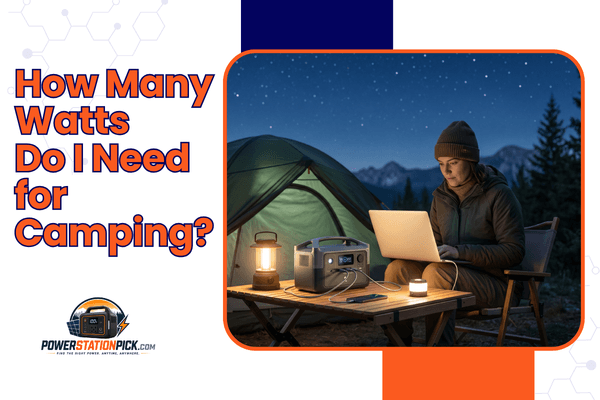
- 1,000–1,500Wh — the weekend camping sweet spot. We break down exact wattage math in How Many Watts Do I Need for Camping? and rank the top picks in Best Portable Power Station for Camping.
- 2,000Wh+ — short home outages, running a fridge, or powering a Starlink dish for days at a time. See Best Portable Power Station for Home and Best Portable Power Station for Starlink.
- Still not sure? Run your device list through our Power Station Sizing Calculator — it does the wattage math for you.
Model-by-Model Breakdown
EcoFlow RIVER 2 Max — Best for Ultra-Light Portability
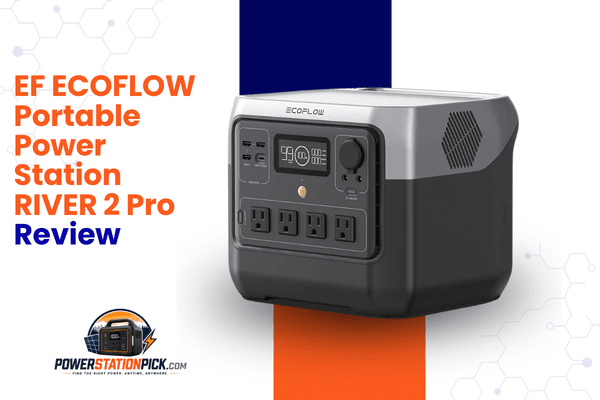
At 499Wh and roughly 13–14 lbs, this is the grab-and-go option for day hikes, photography shoots, or keeping a laptop and phone alive during a short outage. It won’t run a fridge or a microwave — for that, jump to the 1,000Wh+ tier. We compared it directly against Bluetti’s flagship in Bluetti vs. EcoFlow: Which One Is Better?
Bluetti AC70P — Best for CPAP & Quiet Nights
768Wh, 1,000W continuous output, and a full charge in about an hour. We tested this one ourselves over six weeks — full writeup in our Bluetti AC70P Review. If silent operation is your top priority, also check Why Does My Portable Power Station Fan Make Noise? before buying — fan behavior varies a lot between brands under load.
Jackery Explorer 1000 V2 — Best All-Rounder
1,070Wh, 1,500W continuous (3,000W surge), and a 4,000-cycle LiFePO4 battery. This is the model we’d point most first-time buyers toward — enough headroom for a mini-fridge or coffee maker, still portable at under 24 lbs. Full test results in our Jackery Explorer 1000 V2 Review. It’s also the unit we used to test Can Jackery 1000 Power a Refrigerator? if you want real runtime numbers.
OUPES Mega 1 — Best Value Per Watt
1,024Wh with a genuine 2,000W continuous output (4,500W surge) — punching well above its $699 price point, and it charges 0–100% in just 36 minutes. It’s expandable up to 5,120Wh with add-on batteries. Full breakdown of the entire OUPES lineup in our OUPES Portable Power Station Review & Buying Guide.
Anker SOLIX C2000 Gen 2 — Best Mid-Size Home Backup
2,048Wh, 2,400W rated (4,000W peak), and one of the fastest AC charge times in its class at 58 minutes. Expandable to 4,096Wh with a single add-on battery. We go deep on real-world performance in our Anker SOLIX C2000 Review.
Bluetti Elite 200 V2 — Best for Longevity
2,073.6Wh with a 6,000+ cycle rating — meaningfully higher than most competitors in this capacity class, which matters if you’ll be cycling the battery daily for years. See how it stacks up against EcoFlow’s equivalent tier in Bluetti vs. EcoFlow: Which One Is Better?
Pecron E3800LFP & EcoFlow DELTA Pro 3 — Whole-Home Tier
Once you’re looking at 3,000Wh+ systems, the decision gets more nuanced — inverter output, 240V support, and expansion ceiling all diverge sharply between brands. We cover this matchup in complete detail, including pricing and expansion math, in Pecron E3800LFP vs. EcoFlow DELTA Pro 3.
Specs That Matter More Than the Headline Number
A bigger Wh number isn’t automatically the better buy. Before you decide, it’s worth understanding what’s actually driving these numbers:
- Battery chemistry — nearly every model above uses LiFePO4 (LFP), which is why cycle counts are in the thousands rather than the hundreds. If you’re comparing against an older or cheaper NMC unit, read Lithium-ion vs. LiFePO4: Which Is the Ultimate Winner in 2026? first.
- What Wh actually means — if capacity numbers still feel abstract, our plain-English explainer What Does Wh Mean on a Battery? covers it in two minutes.
- Charging methods — every model in this chart supports solar input, but panel compatibility (MC4 vs. MC3 vs. Anderson) and MPPT efficiency vary. Start with What Is MPPT Charging in Power Station? and How to Connect Solar Panel to Power Station.
- Real-world lifespan — cycle counts on a spec sheet translate to years differently depending on how hard you use the unit. See How Long Does a Portable Power Station Last?
- Cold weather derating — every battery in this chart loses some usable capacity below freezing. Details in How Cold Weather Affects Portable Power Station Performance
Is a Portable Power Station Even the Right Tool?
Before you commit to a model, it’s worth confirming a power station is actually the better fit for your situation compared to the alternatives:
- Power station vs. gas generator — see Portable Power Station vs. Gas Generator
- Power station vs. a standalone inverter — see Power Inverter vs. Portable Power Station
- Indoor safety — see Are Portable Power Stations Safe Indoors?
- Is it worth it at all? — our honest breakdown: Are Portable Power Stations Worth It? and Portable Power Station Pros and Cons
- Traveling with one? — see Portable Power Station on Airplane: Is It Allowed?
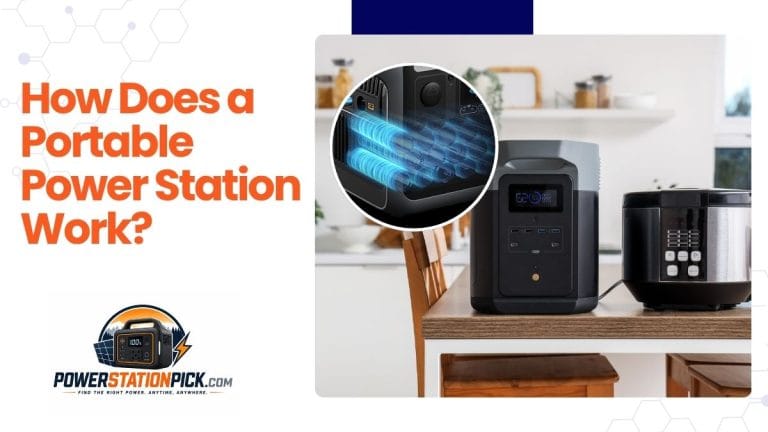
- New to the tech entirely? — start with How Does a Portable Power Station Work? and How to Charge a Portable Power Station (RV owners: see the RV-specific charging guide and best time of day to charge with solar)
- Running specific appliances? — Can a Portable Power Station Run a Microwave?
FAQ
What’s the best portable power station overall in 2026?
There’s no single “best” — the Jackery Explorer 1000 V2 is the best all-rounder for camping and emergencies, the OUPES Mega 1 wins on value per watt, and the Bluetti Elite 200 V2 wins on long-term durability. Match the capacity tier to your actual devices using our sizing calculator rather than picking by brand name alone.
How much should I actually spend?
Under 800Wh units run $400–$600, the 1,000–2,000Wh sweet spot runs $700–$900, and whole-home 3,000Wh+ systems start around $1,300 and climb quickly with expansion batteries. Watch for sales — every model in this chart has been seen 20–40% below MSRP at some point in 2026.
Do higher-priced models always have better batteries?
Not necessarily. Nearly every model here uses LiFePO4 chemistry, so cycle life differences come down to specific engineering rather than price alone — the Bluetti Elite 200 V2’s 6,000+ cycle rating beats some pricier units.
Can I upgrade capacity later instead of buying bigger now?
Yes — the OUPES Mega 1, Anker SOLIX C2000 Gen 2, and Pecron E3800LFP all support expansion batteries, so you can start smaller and scale up as your needs grow instead of overbuying up front.
This chart is updated as we complete new reviews. Bookmark this page for the current side-by-side view of every model we’ve tested.

Hi, I’m Andrew Richards. I created PowerStationPick to share what I’ve learned about portable power through real-world use—what actually works, what doesn’t, and what makes sense for different situations. I focus on helping you choose the right setup for home backup, camping, and everyday needs without overcomplicating things.