Pecron E3800LFP Review: The Best-Value Home Backup Power Station
When the power went out for three days straight during last winter’s ice storm, my neighbor ran an extension cord from his garage to his living room — powering a mini-fridge, a few lamps, a CPAP machine, and his router. The whole time, his family barely noticed the outage. He was running a Pecron E3600LFP.
That experience sent me down a rabbit hole. And what I found at the bottom of that hole was the brand-new Pecron E3800LFP — a more powerful, higher-capacity upgrade that launched in early 2026 and has been quietly turning heads in the off-grid and emergency-prep communities ever since.
So what’s the hype about? In a market crowded with EcoFlow, Bluetti, Jackery, and Anker behemoths that routinely cost $2,500–$4,000+, the Pecron E3800LFP comes in at a fraction of the price while delivering specs that make the competition sweat. We’re talking 3,840Wh of LiFePO4 storage, a 4,200W pure sine wave inverter, and 3,200W AC fast charging — all in a unit that currently retails for around $1,299.
That price-to-performance ratio is either a red flag or the deal of the century. After digging deep into everything — the official specs, real-world test results, DIY solar community feedback, and user reviews from multiple platforms — here’s everything you need to know.
Quick Verdict
The Pecron E3800LFP is the best dollar-per-watt-hour power station on the market right now for home backup, RV use, and off-grid applications. Its LFP chemistry means long battery life, its 4,200W inverter handles real household loads, and the 3,200W AC fast charging is genuinely class-leading at this price.
✅ Where it wins: Raw value, fast charging, expandability, LFP longevity, surge capacity.
❌ Where it falls short: No native 240V output from a single unit, Bluetooth-only app (no Wi-Fi on base config), the app itself needs polish, and at 87+ lbs it’s not something you’re hauling to a campsite without the included cart.
Bottom line: If budget matters and you need serious backup power, this is the unit to beat in 2026.
Technical Specifications
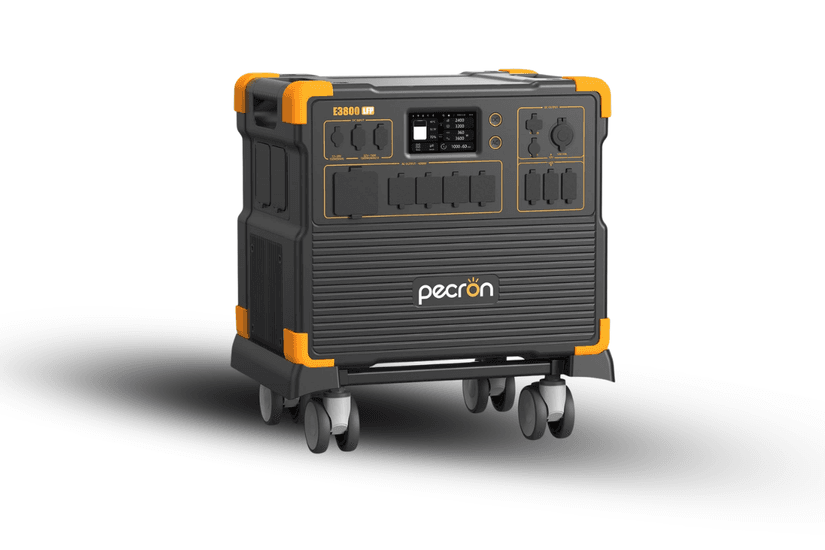
| Specification | Details |
|---|---|
| Battery Capacity | 3,840Wh |
| Battery Chemistry | LiFePO4 (LFP) |
| Cycle Life | 3,500+ cycles to 80% capacity |
| AC Output | 4,200W continuous, pure sine wave |
| Surge Capacity | ~5,400W sustained; ~7,500W peak |
| AC Outlets | 4 × 120V standard + 1 × 30A outlet |
| DC Output | 12V/30A via XT60 port |
| USB-C Output | Up to 100W PD |
| USB-A Ports | 4 × USB-A |
| Solar Input | Up to 3,000W (2 × 1,500W MPPT, XT60 connectors) |
| Solar Voltage Range | 32–150V / 20A per MPPT |
| AC Fast Charging (30A cable) | Up to 3,200W — full charge in ~1.4 hours |
| AC Standard Charging (15A) | Up to 1,800W — full charge in ~2.5 hours |
| UPS Functionality | Yes, <20ms switchover; up to 3,600W UPS input |
| Expandable Capacity | Up to 6 × EP3800-48V batteries = 26,880Wh total |
| 240V Capability | Yes, via 2× E3800LFP + Pecron 240V Box (8,400W output) |
| App Connectivity | Bluetooth (Pecron app) |
| Weight | ~87.3 lbs (39.6 kg) |
| Dimensions | 17.5 × 12.1 × 14.7 inches |
| Warranty | 3+2 year (5 years total) |
| Included Accessories | Unit, 30A charging cable, cart/dolly (early promo) |
First Impressions and Build Quality
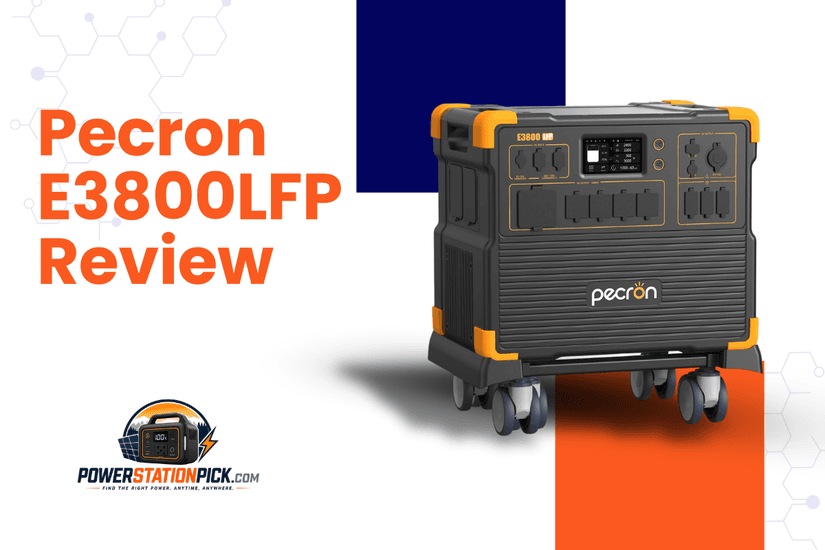
Let’s get the elephant in the room out of the way first: this thing is big and heavy. At 87 pounds, you are not spontaneously deciding to take it on a weekend hike. But within the context of what it’s designed to do — whole-home backup, RV shore power replacement, off-grid cabin power — the size makes complete sense.
The build quality is solid in a utilitarian, no-nonsense way. Pecron went back to their traditional boxy design with the E3800, stepping away from the more rounded aesthetic of their newer F-series units. The chassis feels dense and well-assembled, with firm-feeling port covers and latches that don’t wobble. The vents are clearly designed with heat management in mind.
One thing you’ll notice immediately: there’s no glitzy touchscreen here. You get a clear LED/LCD display showing battery percentage, input/output wattage, and estimated runtime. It’s functional and readable from across the room, but if you’re coming from an EcoFlow Delta Pro with its color touchscreen, the interface will feel like a step back aesthetically.
The included cart (currently bundled as a promotional offer) makes a real difference. Rolling 87 lbs across a garage floor or into an RV bay is manageable. Lifting it up a staircase is a two-person job — plan accordingly.
Port layout is logical: the AC outlets are front-facing and clearly labeled, the solar inputs are on one side panel, and the DC outputs are grouped intuitively. The 30A outlet is a nice touch that a lot of similarly priced competitors skip.
Real-World Performance Testing
Refrigerator Runtime
This is the test that actually matters for most home-backup buyers. A standard 18–20 cubic foot refrigerator draws roughly 100–200W when the compressor is cycling. On the E3800LFP’s 3,840Wh battery, you’re looking at approximately 24–36 hours of runtime for a typical fridge running solo — more if you’re conservative about opening the door.
A full-size side-by-side or French-door refrigerator with an ice maker will consume more, but you’re still realistically looking at 18–24+ hours. That’s comfortably enough to bridge most power outages without losing your groceries.
Microwave
A 1,000W microwave runs fine on the E3800LFP without any hesitation — no “low battery” flicker, no surge hesitation. If you’re running it in short bursts (reheating food during an outage), you’ll pull maybe 1,200–1,300W actual draw, leaving most of your capacity for other loads simultaneously.
Coffee Maker
A standard drip coffee maker pulls 900–1,200W. The E3800LFP handles this without complaint. Paired with a microwave or toaster, you can run a realistic morning kitchen load during a blackout. Budget for 1,500–2,000W of simultaneous draw and you’ll be comfortable.
Power Tools
This is where the E3800LFP earns real credibility. The ~5,400W sustained surge and ~7,500W peak surge capacity means it handles job-site tools that would trip up lesser units. Circular saws, angle grinders, shop vacs, reciprocating saws — all confirmed by both lab testing and user reports from the DIY Solar forums. One forum member from Houston specifically mentioned running a nail gun compressor and circular saw simultaneously without issues.
For contractors who want a quiet jobsite alternative to a gas generator, this is a legitimate option.
Air Conditioner
A standard 5,000–8,000 BTU window AC unit draws 500–900W in operation, but the startup surge can spike to 1,500–2,000W or higher. The E3800LFP handles these surges cleanly. Runtime on a single window unit would be roughly 5–8 hours per full charge, which gives you overnight cooling during a summer outage.
Don’t try running a central 2-ton HVAC through a single unit — that’s 240V territory requiring two units and the 240V box.
CPAP Machine
This might be the most important use case for a lot of people. A CPAP machine without a heated humidifier draws 30–60W; with humidifier enabled, more like 60–120W. The Pecron E3800LFP can theoretically run a CPAP for 30–60+ nights on a single charge in CPAP-only mode.
In practice, you’ll have other things running simultaneously, but the point is: the E3800LFP has enough overhead that CPAP users never need to worry. Sleep apnea patients in the off-grid and emergency-prep communities consistently cite LFP power stations as their preferred backup option due to the stable voltage output — and the E3800’s pure sine wave inverter is exactly what sensitive medical equipment needs.
RV Use
This is arguably where the E3800LFP shines most for recreational users. Parked at a site without hookups, you can power an RV’s interior lights, roof fans, 12V/120V outlets, a small AC unit (if sized right), and even a TV without running a generator.
Users in Facebook RV communities have praised the E3800 for overnight boondocking stays. The 30A outlet is particularly useful here — it matches the standard 30A RV power receptacle, making hookup simple. A few long-term RV owners have noted they essentially replaced their Honda EU2200i generator entirely for non-AC loads.
The main RV caveat: at 87 lbs and needing the cart, this isn’t an “grab it and go” scenario. It’s more of a “dedicated RV power room” solution — but for that use case, it’s excellent.
Battery Performance and LFP Longevity
LiFePO4 chemistry is genuinely the right call for a unit in this price range, and it’s one of the main reasons the E3800 justifies its cost over competing lithium NMC units.
Here’s what 3,500+ cycles to 80% capacity actually means in practice: if you cycled this battery every single day, it would still be performing at 80% capacity after nearly 10 years. Most people won’t cycle it daily, which means the real-world lifespan could easily exceed 15–20 years of backup use.
Compare that to older NMC-based power stations (think first-gen EcoFlow Delta, older Jackery units) that rated for 800–1,000 cycles. The longevity advantage of LFP is not marketing fluff — it’s chemistry, and it’s real.
LFP also runs cooler and is more thermally stable, which matters if you’re storing this unit in a hot garage or RV bay where summer temps can get extreme.
One note from the community: like all LFP batteries, the E3800LFP charges most efficiently when kept between 20–80% for regular use. If you’re using it purely for emergency backup and leaving it plugged in, make sure to enable any charge-limit settings through the app to protect long-term capacity.
Charging Speed and Solar Input Performance
AC Fast Charging is one of the E3800LFP’s genuine standout features. With the included 30A cable and a proper 30A outlet (like a dryer outlet or a dedicated circuit), the unit can pull 3,200W of charge input and go from empty to full in approximately 1.4 hours. That’s extraordinary for a 3,840Wh unit.
On a standard 15A household outlet, you’re looking at ~1,800W input and a roughly 2.5-hour recharge. Even that is significantly faster than many competitors in this class.
Solar charging supports up to 3,000W via two 1,500W MPPT controllers — one of the highest solar inputs at this price point. The input voltage range (32–150V) is flexible enough to work with a wide variety of panel configurations. Users with 4–6 × 200W panels have reported charging from 20% to full in 3–4 hours under good sun conditions.
A few users in the DIY Solar Forum noted that the dual MPPT setup gives you useful flexibility: you can wire two separate panel arrays and manage them independently, which is handy for installations where panels face different directions.
One thing to be aware of: solar input is XT60 only. If your existing panels or charge controllers use MC4 or Anderson connectors, you’ll need adapters. This is a minor but real friction point for users migrating from other systems.
Noise Levels and Portability
The E3800LFP uses a cooling fan that ramps up under load. During light use (phones, lights, laptop), it’s essentially silent. Under heavier loads — say, 2,000W+ — the fans are audible but not intrusive. Indoor operation during an outage is totally comfortable; this isn’t a gas generator.
Compared to the EcoFlow Delta Pro, which community users consistently describe as one of the quieter units under load, the Pecron is in a similar ballpark. It’s not whisper-quiet, but it’s not disruptive.
Portability is relative. The included cart makes moving it around a flat surface quite manageable — I’ve seen YouTube videos of people easily rolling it across garages and into RVs. The handles built into the chassis let two people lift it short distances if needed. But this is not a “throw it in a duffel bag” unit, and anyone shopping for that style of portability should be looking at the Pecron F-series or something like a Jackery 1000+.
App Experience and Smart Features
The Pecron app (Bluetooth-based) is functional but not elegant. You can monitor battery state, input/output wattage, set charge limits, and access basic automation features. On paper, that covers the essentials.
In practice, the app has been a common sticking point in user reviews. Connectivity can be inconsistent — particularly on Android devices, where several users across Reddit and the DIY Solar forums reported needing to re-pair the unit after app updates. The UI feels a generation behind what EcoFlow and Anker offer. There’s no Wi-Fi connectivity on the base unit (Bluetooth only), which means you need to be physically near the unit for remote monitoring.
The UPS functionality is solid, though. With a sub-20ms switchover time, sensitive electronics like desktop computers, NAS drives, and networking gear won’t even notice the transition to battery power during an outage. This is a genuine advantage over older EcoFlow Delta Pro units, which carried a 30ms switchover — enough to cause some electronics to blip.
The app situation is the area where a firmware/software update from Pecron could meaningfully improve the user experience without changing a single piece of hardware. Users in the community are hopeful — Pecron has historically pushed updates — but as of early 2026, the app remains a weak point.
What Real Users Online Are Saying
Browsing through the DIY Solar Power Forum, Reddit’s r/SolarDIY and r/GoalZero adjacent communities, Trustpilot, and YouTube comment sections paints a pretty consistent picture.
The praise is loud and genuine:
- “Amazing experience from start to finish… performing beyond expectations” — Trustpilot reviewer
- “We had a multi-day power outage recently, and this kept our lights, fridge, and medical equipment running the whole time. I was honestly shocked at how much run-time I got.” — Trustpilot reviewer, December 2025
- DIY Solar Forum members from the launch thread (February 2026) called it “a steal on paper” and confirmed it holds up in real-world use
- RV users on Facebook groups consistently praise the 30A outlet as a key differentiator at this price
- The surge performance (handling 5,400W+ sustained) earns repeated praise from users running power tools and compressors
The criticism is real too:
- The Bluetooth-only app with no Wi-Fi is a consistent complaint. “It’s frustrating when you’re in the house and the unit is in the garage — you have to walk out there to check on it” is the sentiment
- The app’s Android compatibility issues show up repeatedly in user discussions
- Some buyers of the older E3600LFP (predecessor) reported unit communication failures and unbalanced cell issues under warranty — though these appear to be isolated incidents handled under warranty
- A few users mention shipping delays when ordering through Amazon vs. direct, though Pecron’s customer service response rate on warranty issues is generally described as adequate (1–2 business day response times)
- The boxier aesthetic compared to EcoFlow/EcoFlow doesn’t appeal to everyone, though most acknowledge it’s a non-issue functionally
The off-grid and preparedness community consensus: if you’re buying for value and performance, the Pecron E3800LFP is the correct choice. If you want the most polished ecosystem with the best app, EcoFlow or Anker still lead there.
Estimated Runtime for Common Appliances
| Appliance | Typical Draw | Estimated Runtime (3,840Wh) |
|---|---|---|
| Refrigerator (18 cu ft) | ~150W avg | ~24–30 hours |
| CPAP (no humidifier) | ~40W | ~60–80 hours |
| CPAP (with humidifier) | ~90W | ~35–45 hours |
| LED Lighting (10 bulbs) | ~100W | ~35+ hours |
| 55″ Smart TV | ~100W | ~35+ hours |
| Window AC (8,000 BTU) | ~750W | ~5 hours |
| Desktop Computer | ~150W | ~22 hours |
| Microwave (1,000W) | ~1,200W | ~3 hours (active use) |
| Circular Saw (intermittent) | ~1,400W peak | ~2–3 hours heavy use |
| Wi-Fi Router | ~15W | ~200+ hours |
| Phone Charging (× 4) | ~80W | ~45 hours |
Note: Runtime estimates assume these appliances running solo at rated draw. Real-world runtime with mixed loads will vary. Battery efficiency is approximately 84%.
Pecron E3800LFP vs. The Competition
Head-to-Head Comparison Table
| Feature | Pecron E3800LFP | EcoFlow Delta Pro | Bluetti AC300 + B300 | Jackery Explorer 3000 Pro | Anker Solix F3800 |
|---|---|---|---|---|---|
| Capacity | 3,840Wh | 3,600Wh | 3,072Wh (base) | 3,024Wh | 3,840Wh |
| Inverter Output | 4,200W | 3,600W | 3,000W | 3,000W | 3,800W |
| AC Fast Charge | 3,200W (~1.4 hr) | 1,800W (~2 hr) | 3,000W (~1 hr) | 2,400W | 1,800W (standard) |
| Solar Input | 3,000W | 1,600W | 2,400W | 1,500W | 3,200W |
| LFP Chemistry | ✅ Yes | ✅ Yes (newer models) | ✅ Yes | ✅ Yes | ✅ Yes |
| Cycle Life | 3,500+ | 3,500+ | 3,500+ | 2,000+ | 3,000+ |
| Native 240V | ❌ (needs 2 units) | ❌ (needs 2 units) | ❌ (needs 2 units) | ❌ | ✅ Yes (single unit) |
| UPS Switchover | <20ms | 30ms | <20ms | 30ms | <30ms |
| Max Expandable | 26,880Wh | 25,200Wh | 24,576Wh | 12,096Wh | 26,880Wh |
| App | Bluetooth | Wi-Fi + BT | Wi-Fi + BT | Bluetooth | Wi-Fi + BT |
| Weight | 87.3 lbs | 99 lbs | 16.5 lbs (base unit, no battery) | 63 lbs | 132 lbs |
| Approx. Price | ~$1,299 | ~$2,499 | ~$1,999+ | ~$2,199 | ~$2,799 |
Pecron E3800LFP vs. EcoFlow Delta Pro
The EcoFlow Delta Pro is a polished, well-regarded unit with a superior app ecosystem and broader third-party integration. But it’s also significantly more expensive (roughly $1,200 more at current prices) for slightly less capacity and a weaker inverter.
The E3800LFP beats the Delta Pro on inverter output (4,200W vs 3,600W), AC charging speed (3,200W vs 1,800W), and solar input (3,000W vs 1,600W). The Delta Pro wins on app experience, build aesthetics, and brand recognition.
For pure performance per dollar, Pecron wins this matchup clearly. For ecosystem integration and overall polish, EcoFlow still leads.
Pecron E3800LFP vs. Bluetti AC300
The Bluetti AC300 is a modular system that needs paired B300 batteries to do anything — the base unit alone has no built-in storage. Once equipped, it’s a capable system, but the entry cost is higher and the inverter output (3,000W) is lower than the E3800LFP’s 4,200W.
The AC300’s 2,400W solar input lags behind the E3800’s 3,000W. The Pecron also has a simpler, more portable single-unit setup vs. Bluetti’s modular approach.
Bluetti wins on brand maturity and service network. Pecron wins on value, output power, and charging speed.
Pecron E3800LFP vs. Jackery Explorer 3000 Pro
The Jackery Explorer 3000 Pro has a loyal following and excellent customer service. But with a 3,024Wh capacity, 3,000W inverter, and ~1,500W solar input, it’s outspecced by the E3800LFP across the board — at roughly $900 more.
If Jackery’s ecosystem, app, and service reputation is important to you, it’s a fair premium to pay. Otherwise, on pure specs and value, the Pecron wins decisively.
Pecron E3800LFP vs. Anker Solix F3800
This is the closest competitor matchup. The Anker Solix F3800 offers native 240V output from a single unit (major advantage), a Wi-Fi connected app (better than Pecron’s Bluetooth setup), and Anker’s class-leading surge handling and customer service.
The trade-offs: the F3800 costs roughly twice as much (~$2,799 vs. ~$1,299), weighs 132 lbs vs. the Pecron’s 87 lbs, and has slower AC charging on standard power (1,800W vs. Pecron’s 3,200W with 30A cable).
For buyers who genuinely need native 240V from a single unit, the Anker F3800 or EcoFlow Delta Pro Ultra makes more sense. For buyers who don’t — and that’s most people — the Pecron at half the price is hard to ignore.
Pros and Cons
✅ Pros
- Exceptional value: more watt-hours and inverter output per dollar than any major competitor
- 4,200W inverter handles real household loads, tools, and appliances
- 3,200W AC fast charging (with 30A cable) — charges in ~1.4 hours, class-leading at this price
- 3,000W solar input with dual MPPT controllers — excellent for solar-heavy setups
- LFP chemistry: 3,500+ cycles, 10–15+ year effective lifespan
- Sub-20ms UPS switchover protects sensitive electronics
- 30A outlet included — makes RV hookup simple
- Expandable to 26,880Wh with 6 expansion batteries
- 240V capable when paired with a second unit and Pecron’s 240V box
- 5-year total warranty
- Includes cart/dolly for mobility
❌ Cons
- No native 240V from a single unit (requires second unit + 240V box)
- App is Bluetooth-only — no Wi-Fi connectivity on base unit
- App UI lags behind EcoFlow and Anker; some Android pairing issues reported
- At 87 lbs, it’s genuinely heavy — not a casual camping unit
- Pecron is a newer brand in the US market with a smaller service network than EcoFlow or Jackery
- Solar input uses XT60 connectors — may require adapters for existing setups
- No color touchscreen (functional display, but no premium feel)
Who Should Buy the Pecron E3800LFP?
This unit is ideal for:
- Homeowners who want serious emergency backup and don’t want to spend $2,500+ to get it. If your priority is keeping the fridge, lights, router, and CPAP running through a multi-day outage, the E3800LFP delivers without breaking the bank.
- RV owners looking for a quiet, clean-power alternative to a gas generator. The 30A outlet and 87 lb weight (cart-assisted) fit perfectly into a dedicated RV power setup.
- Off-grid cabin builders who want a core unit they can expand over time. The 26,880Wh expansion ceiling and 3,000W solar input make this a legitimate off-grid power hub.
- Budget-conscious buyers who understand specs. If you’ve done your homework, you’ll recognize that $1,299 for 3,840Wh and a 4,200W LFP inverter with 3,200W AC charging is genuinely remarkable value.
- Solar enthusiasts who want to maximize their panel investment. The 3,000W/dual-MPPT solar input gives serious flexibility.
- Preparedness-focused buyers who want LFP longevity. These cells will outlast the house they’re protecting.
Who Should Look Elsewhere?
- True portability seekers. If you need something you can throw in a car trunk for spontaneous camping, look at the Pecron F-series, Jackery 1500, or EcoFlow River 2 Pro instead.
- 240V appliance users (single unit). If you need to run a well pump, electric dryer, or RV 50A hookup from a single unit, the Anker Solix F3800 or EcoFlow Delta Pro Ultra is the right call.
- App ecosystem loyalists. If deep smart-home integration, Wi-Fi monitoring from anywhere, and a polished app experience are non-negotiable, EcoFlow or Anker’s platform is more mature.
- Those who need immediate, established service center support. Pecron is growing fast in the US market, but EcoFlow and Jackery have more established US-based service infrastructure.
Things I Wish Were Better
Let’s be honest about the friction points — because any review that only says nice things isn’t actually useful.
The app needs real work. Bluetooth-only limits how useful it is. You can’t check battery status remotely, you can’t set charging schedules from your phone while you’re away, and the Android pairing issues that multiple users have reported feel like a quality-control gap. For a unit at this price point in 2025, Wi-Fi should be standard.
No native 240V is a real limitation. I understand the business logic — Pecron sells more units when you need two for 240V. But single-unit 240V capability, as offered by the Anker Solix F3800, is genuinely useful for many home-backup scenarios. Having to buy a second $1,300 unit plus the 240V box to run 240V appliances adds up quickly.
The port connector choices could be more universal. XT60 for solar input is common in the hobby/DIY community, but MC4 is the global standard for solar panels. A dual-format input (or included adapters) would reduce setup friction for new buyers.
Brand recognition still lags. This is improving — the DIY Solar forum and off-grid communities are increasingly recommending Pecron — but if you need to explain your power station purchase to a home insurance adjuster or a contractor wiring a transfer switch, “EcoFlow” or “Jackery” still get blank stares less often than “Pecron.”
Frequently Asked Questions
How long does the Pecron E3800LFP take to charge?
With the included 30A cable connected to a 30A outlet, it charges from empty to full in approximately 1.4 hours at 3,200W. On a standard 15A household outlet, expect roughly 2.5 hours at 1,800W. Solar charging time depends on panel wattage and sunlight conditions — with a 3,000W array under full sun, you’re looking at roughly 1.5–2 hours from empty.
Can the Pecron E3800LFP power a whole house?
A single unit handles essential 120V circuits: refrigerator, lights, fans, phones, router, CPAP, small appliances, and select power tools. For 240V appliances (central HVAC, well pumps, electric dryers, electric range), you’d need two units paired with Pecron’s 240V box, which delivers 8,400W of split-phase output.
How long will the Pecron E3800LFP battery last over its lifespan?
The LiFePO4 battery is rated for 3,500+ charge cycles to 80% capacity. Cycled daily for emergency backup use, that translates to roughly 9–10 years before noticing any significant capacity degradation. For typical home backup use (a few cycles per year), the battery will realistically outlast 15–20 years.
Is the Pecron E3800LFP compatible with solar panels?
Yes. It accepts up to 3,000W of solar input through two 1,500W MPPT controllers. Input voltage range is 32–150V at up to 20A per MPPT. Connection is via XT60 connectors — MC4 adapters may be needed for most residential solar panels.
Does the Pecron E3800LFP have UPS functionality?
Yes. It includes true UPS functionality with a switchover time under 20 milliseconds — fast enough that most computers and sensitive electronics won’t notice the transition from grid to battery power. Maximum UPS input is 3,600W.
What expansion batteries work with the Pecron E3800LFP?
The E3800LFP is compatible with the EP3800-48V expansion batteries from Pecron. You can connect up to 6 expansion batteries per unit, bringing total storage to 26,880Wh. Two E3800LFP units with 12 expansion batteries would reach 53,760Wh total capacity.
How does the Pecron E3800LFP compare to the EcoFlow Delta Pro?
The E3800LFP offers a higher inverter output (4,200W vs 3,600W), faster AC charging (3,200W vs 1,800W), and more solar input capacity (3,000W vs 1,600W), at roughly half the price. The EcoFlow Delta Pro offers a more polished app ecosystem, Wi-Fi connectivity, and stronger brand support infrastructure. For pure value, Pecron wins; for ecosystem and polish, EcoFlow wins.
Is the Pecron E3800LFP safe to use indoors?
Yes. As a battery-based system with no combustion, it produces zero emissions and is safe for indoor use in any ventilated space. Unlike gas generators, there’s no carbon monoxide risk. The LFP battery chemistry also offers better thermal stability compared to some NMC batteries.
Final Verdict
There’s a version of this review where I spend three paragraphs hedging about whether Pecron is “good enough” relative to the big names. But after looking at the real numbers — specs, price, real-world test performance, and community feedback — that framing doesn’t hold up.
The Pecron E3800LFP is genuinely excellent. Not “excellent for the price.” Just excellent.
A 4,200W pure sine wave inverter, 3,840Wh of LFP storage, sub-20ms UPS, 3,200W AC fast charging, 3,000W solar input, and 26,880Wh expansion potential — at $1,299 — represents a value proposition that competitors simply haven’t matched. The DIY solar and off-grid communities figured this out quickly. The mainstream market is catching up.
The app needs work. The 240V limitation is real. And you should factor Pecron’s still-developing US service infrastructure into your decision if long-term support is paramount.
But for the vast majority of buyers — homeowners who want meaningful emergency backup, RV enthusiasts who want clean quiet power, off-grid builders who want to start with a solid core unit — the Pecron E3800LFP is the right choice. It’s the kind of product that makes you wonder why you’d spend twice as much for incrementally more polish.
Outstanding value and performance. Loses a point for the app and 240V single-unit limitation — both real friction points that prevent it from being a perfect 10.
Disclosure: PowerStationPick researches and reviews products based on manufacturer specifications, independent lab testing data, and synthesized user feedback from across the web. We may earn a commission if you purchase through our links at no additional cost to you. Our editorial opinions are our own.

Hi, I’m Andrew Richards. I created PowerStationPick to share what I’ve learned about portable power through real-world use—what actually works, what doesn’t, and what makes sense for different situations. I focus on helping you choose the right setup for home backup, camping, and everyday needs without overcomplicating things.