How to Charge a Portable Power Station (Fast, Safe & Real-World Methods)
🔍 QUICK ANSWER
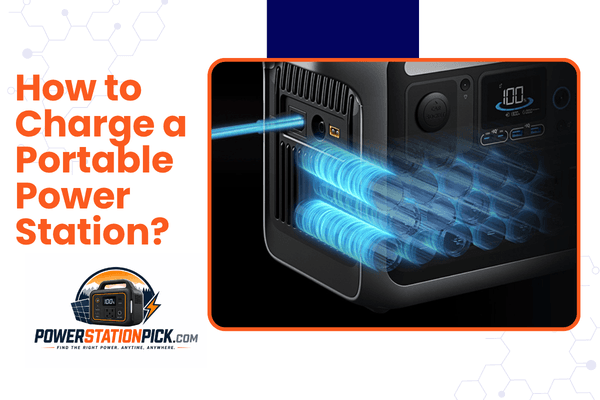
To charge a portable power station, use an AC outlet for speed (0-80% in <60 mins) or Solar Panels for off-grid independence (typically 4-8 hours). For maximum efficiency, use an MPPT controller and solar panels rated at 1.25x your desired intake to account for real-world losses. Always choose LiFePO4 (LFP) chemistry for 10+ years of safety and longevity, and maintain a 20-80% charge range to double your battery’s cycle life.
Why Charging Method Matters?
Choosing the right charging method is about more than just convenience. In 2026, with the dominance of LiFePO4 (LFP) batteries, how you charge directly affects:
- ⏱️ Charging speed: From 1 hour to 15+ hours.
- 🔋 Battery lifespan: Fast charging generates heat; slow charging preserves cells.
- 🌍 Practicality: Matching your energy intake to your environment (home vs. off-grid).
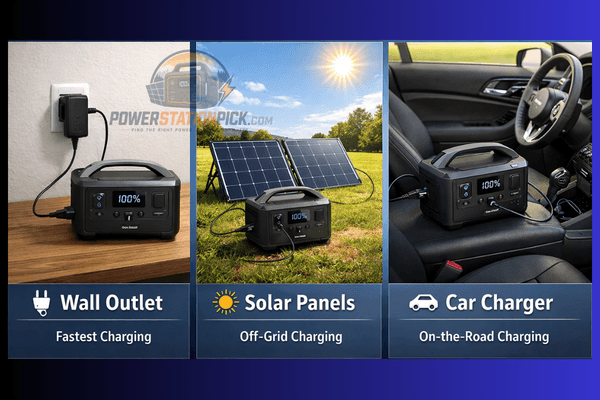
1. Charging with a Wall Outlet (AC Charging)
✅ Best for: Home preparation & emergency speed.
This is the most common and reliable method. Modern units have moved away from bulky “power bricks” to integrated charging cables.
- How it works: Plug directly into a standard 110V/220V wall socket.
- 2026 Performance: * Standard Models: 3–5 hours.
- Fast-Charge Models (EcoFlow/Jackery/Bluetti): 0–80% in 45–60 minutes.
- 💡 Pro Tip (The 20/80 Rule): For daily use, don’t charge to 100%. Most apps now let you set a “Charging Limit.” Keeping it at 80% can double your battery’s cycle life from 3,000 to 6,000+ cycles.
2. Charging with Solar Panels (Off-Grid Independence)
✅ Best for: Camping, vanlife, and long-term emergencies.
This method turns your battery into a Solar Generator.
- The Tech: Most units use MPPT (Maximum Power Point Tracking) controllers to squeeze every watt out of the sun.
- 🌞 Real-world Insight: A “200W panel” is a lab rating. In reality, expect 140W–160W due to heat and atmospheric haze.
- ⏱️ Estimated Time:
- 200W Panel on 1000Wh Station: 7–9 hours (Ideal sun).
- 400W Panel on 1000Wh Station: 3–4 hours.
- ⚠️ Avoid Shade: Even a small shadow from a tree branch covering 10% of the panel can drop output by 50% or more.
Solar Charging: Mastering Off-Grid Energy
Harnessing the sun is what transforms a simple battery into a Solar Generator. However, achieving peak efficiency requires understanding the math behind the sunlight.
The Physics of Solar Intake: STC vs. Real-World
Solar panels are rated under Standard Test Conditions (STC): 1,000 Watts per square meter of sunlight at 25°C (77°F). In the real world, you will rarely see the rated wattage due to:
- Inverter Efficiency: Most stations lose 10-15% of energy during the conversion from DC to battery storage.
- Heat Coefficient: As panels get hotter than 25°C, their efficiency drops by about 0.3% to 0.5% per degree.
- Atmospheric Haze: Dust and humidity scatter photons.
🧮 How to Calculate Your Solar Charging Time
To get a realistic estimate, use the 80% Efficiency Rule.
The Formula:
$$\text{Charging Time (hours)} = \frac{\text{Battery Capacity (Wh)} \times \text{Desired Charge \%}}{\text{Panel Wattage} \times 0.80}$$
Example: Charging a 1000Wh station from 20% to 100% (800Wh needed) with a 200W panel:
$$\frac{1000 \times 0.80}{200 \times 0.80} = \frac{800}{160} = \mathbf{5 \text{ hours of peak sun}}$$
MPPT vs. PWM Controllers
In 2026, almost all premium brands (EcoFlow, Bluetti, Jackery) use MPPT (Maximum Power Point Tracking).
- PWM (Pulse Width Modulation): Older, cheaper technology. It acts like a switch, dragging the panel voltage down to the battery voltage, wasting up to 30% of potential energy.
- MPPT: Acts like a smart DC-to-DC converter. It “tracks” the optimal voltage and current to ensure the battery receives the maximum wattage possible, even in fluctuating light.
3. Charging with a Car (12V/24V DC Charging)
✅ Best for: Road trips & maintaining charge between locations.
- How it works: Plug into the 12V cigarette lighter port.
- ⏱️ The Reality Check: Car charging is slow (typically 96W–120W).
- 1000Wh Station: 10–12+ hours to full.
- 🧠 Expert Insight: Many vanlifers use a DC-to-DC charger instead of the cigarette port to pull 300W–500W directly from the alternator, cutting charge time by 70%.
4. USB-C Power Delivery (PD) Charging
✅ Best for: Minimalist travelers and small power stations (under 500Wh).
- The Setup: Use a high-quality 100W or 140W Gan charger (like your MacBook charger).
- Benefit: You don’t need to carry the proprietary AC cable.
- Dual Charging: Some units allow you to plug in AC and USB-C simultaneously to “Boost” the charging speed.
Deep Dive: Battery Chemistry (LFP vs. NMC)
Understanding what’s inside your power station is the difference between a device that lasts 3 years and one that lasts 15 years.
LiFePO4 (Lithium Iron Phosphate) – The 2026 Standard
Most modern units have moved to LFP for one primary reason: Safety and Longevity.
- Cycle Life: LFP batteries typically offer 3,000 to 6,000+ cycles before dropping to 80% capacity.
- Thermal Stability: LFP has a much higher “thermal runaway” threshold. Even if punctured, LFP cells are significantly less likely to catch fire compared to traditional lithium.
- Weight Trade-off: The only downside is energy density. LFP batteries are roughly 20-30% heavier than NMC for the same amount of power.
NMC (Nickel Manganese Cobalt) – The Lightweight Alternative
You will still find NMC in ultra-portable “mini” stations or older models.
- Advantage: Extremely high energy density (more power in a smaller, lighter package). Perfect for backpacking.
- Disadvantage: Shorter lifespan, usually 500 to 800 cycles. They also run hotter during fast-charging sessions.
🧬 Comparison Table: Battery Chemistry
| Feature | LiFePO4 (LFP) | Lithium-Ion (NMC) |
| Lifespan (80% Capacity) | 10 – 15 Years | 2 – 4 Years |
| Total Cycles | 3,000 – 6,000+ | 500 – 800 |
| Safety Profile | Extremely Stable (Non-combustible) | Moderate (Higher fire risk) |
| Optimal Storage Temp | Wide Range (-20°C to 60°C) | Narrow (0°C to 45°C) |
| Best For | Home Backup, Vanlife, Daily Use | Ultra-light Hiking, Occasional Use |
5. Charging Time Comparison Table (1000Wh Unit)
| Method | Avg. Wattage | Time to 80% | Reliability |
| AC Wall (Fast Mode) | 1000W – 1200W | ~50 Mins | High |
| Solar (200W Panel) | 140W (Real) | 6 – 8 Hours | Weather Dependent |
| Car Port (12V) | 96W | 10+ Hours | Low (Engine must run) |
| USB-C PD (100W) | 90W | 9 – 10 Hours | Moderate |
🛠️ 6. Common Charging Mistakes to Avoid
- Charging in the Heat: Never charge your station if the internal temp is over 113°F (45°C). The BMS will throttle speed or stop entirely to prevent a fire.
- Cheap Extension Cords: Fast-charging pulls a lot of amps. Use a heavy-duty cord to avoid melting the plug.
- Leaving it at 0%: If you drain it to 0% and store it, the battery may “sleep” forever (undervoltage). Always charge to at least 50% before storage.
🔄 7. Pass-Through Charging: Use While Charging
Most 2026 models support pass-through charging. This is a life-saver for Home Backup.
- How to use it: Plug the station into the wall, and your fridge into the station.
- The Benefit: It acts like a UPS (Uninterruptible Power Supply). If the power goes out, the station takes over in <20ms.
❓ FAQ (Schema Optimized)
Q: Can I use any solar panel brand with my Jackery or EcoFlow?
A: Yes, as long as you have the correct adapter (MC4 to XT60/DC8) and the panel’s voltage (Voc) matches the station’s input range.
Q: Is solar charging worth it?
A: Absolutely. It’s the only way to achieve true energy independence during a long-term grid failure.
Q: Does fast charging damage the battery?
A: Modern LiFePO4 batteries are designed for it, but using “Standard” speed when you aren’t in a rush will always be better for the chemistry in the long run.
🏆 Final Thoughts
The best charging strategy is a hybrid approach:
- Prep at home using AC Fast Charging.
- Sustain off-grid using Solar.
- Top up via USB-C or Car while moving.
Ready to find the fastest-charging station for your needs?

Hi, I’m Andrew Richards. I created PowerStationPick to share what I’ve learned about portable power through real-world use—what actually works, what doesn’t, and what makes sense for different situations. I focus on helping you choose the right setup for home backup, camping, and everyday needs without overcomplicating things.