What Is MPPT Charging in Power Station?
What is MPPT Charging?
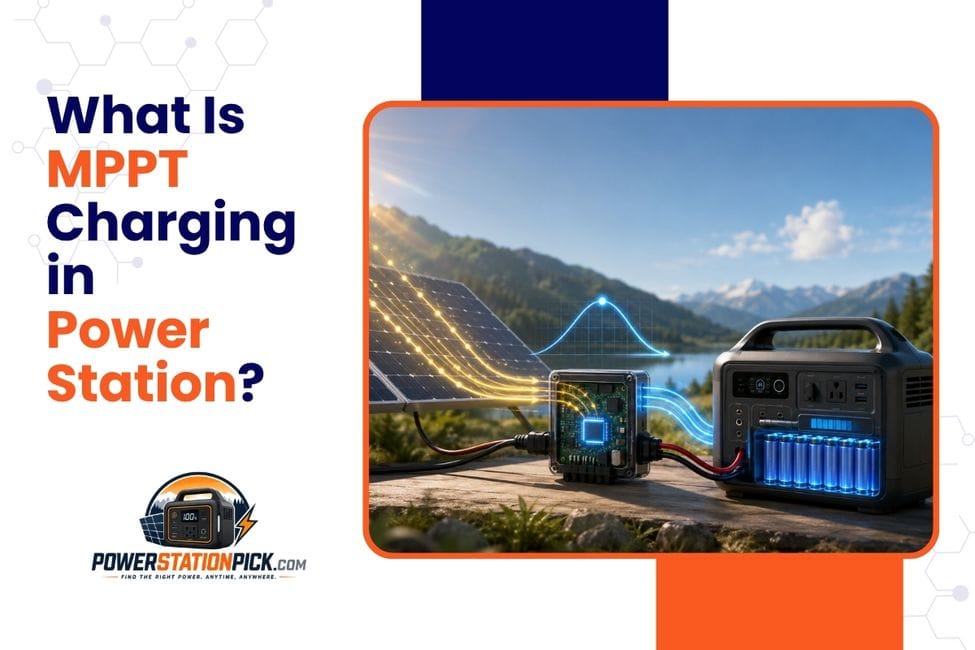
MPPT stands for Maximum Power Point Tracking. It is an advanced electronic solar charge controller built into modern portable power stations that continuously monitors and adjusts voltage and current from connected solar panels. By dynamically matching the solar panel’s fluctuating output to the specific charging needs of the internal battery, an MPPT controller increases solar charging efficiency by 20% to 40% compared to older PWM controllers, especially in cloudy, cold, or changing weather conditions.
What Does MPPT Mean?
To understand Maximum Power Point Tracking, we first have to establish how basic solar panel charging works. A solar panel does not output a fixed, stable stream of electricity like a standard household wall outlet. Instead, it is a dynamic, highly volatile device.
The amount of electricity a solar panel generates changes second by second based on a wide array of environmental variables:
- The angle of the sun relative to the solar cells
- Passing clouds, overhead tree branches, or ambient haze
- The physical temperature of the panel itself (solar panels actually become less efficient as they get scorching hot)
Because of this constant volatility, a solar panel’s output voltage (V) and current (Amps) are always shifting. If you were to wire a solar panel directly to a lithium battery pack without any intermediary brain, one of two things would happen: either the panel’s high voltage would destroy the battery cells entirely, or the battery’s fixed internal voltage would force the solar panel to operate at an incredibly low, inefficient level, wasting the vast majority of the available solar energy.
This is where a charge controller comes into play. It acts as the intelligent bridge between the sun and your battery cells. MPPT is simply the most sophisticated, highly optimized method of controlling that electrical transmission.
How MPPT Charging Works in a Portable Power Station
To grasp the underlying mechanics of how MPPT works, we have to look at the golden rule of electrical power physics:
A solar panel produces a specific combination of voltage and current. If you map these combinations out on a graph under varying conditions, you get what solar engineers call an I-V Curve (Current vs. Voltage Curve).
Somewhere along that curve sits a magical, hyper-specific sweet spot where the multiplication of Volts $\times$ Amps yields the absolute highest possible number of Watts. This sweet spot is known as the Maximum Power Point (MPP).
The Dynamic Tracking Process
The “Tracking” portion of MPPT is literal. An MPPT controller features an internal microprocessor that scans the output of your solar panels thousands of times per second. It intentionally creates tiny adjustments in the electrical resistance of the circuit to see if it can coax more total wattage out of the panels.
If a cloud passes over your camping setup, the maximum power point drops instantly. The MPPT controller senses this dip, re-calculates the matrix, and alters its settings within milliseconds to find the new optimal operating point. When the cloud clears, the controller shifts gears instantly to ride the wave of peak sunshine.
The Voltage Conversion Trick
Finding the sweet spot is only half the battle. The real magic of an MPPT controller in portable power station hardware is its ability to act like a highly efficient, infinitely adjustable DC-to-DC transmission system.
Let’s look at a realistic, real-world example:
Imagine you have a solar panel operating in peak sunlight. The MPPT controller scans the panel and determines that its Maximum Power Point is currently sitting at 18 Volts and 10 Amps.
However, the internal LiFePO4 battery pack inside your portable power station is currently half-empty and sitting at a resting voltage of exactly 12 Volts.
If you had a primitive controller, it would force the solar panel to drop down to match the battery’s 12V level, completely throwing away those extra 6 Volts. Your 180W panel would suddenly only output 120W ($12\text{V} \times 10\text{A}$), wasting 60 Watts as useless heat.
An MPPT controller handles this dilemma intelligently. It functions like an electronic step-down transformer:
- It accepts the full, highly efficient 18V and 10A (180W) from the solar panel.
- It steps down the voltage to precisely match the battery’s required 12V charging input.
- To keep the mathematical equation balanced ($P = V \times A$), it simultaneously boosts the current (Amps) going into the battery.
Instead of sending 12V and 10A to the battery, the MPPT converter shifts the power matrix:
The MPPT controller delivers a scaled-down voltage but a scaled-up current of 15 Amps directly to your battery. You get the full 180 Watts of solar harvesting capacity minus a microscopic 2% internal conversion loss. This ability to convert excess voltage into bonus charging current is what makes MPPT indispensable.
Why MPPT Is Important for Solar Charging
When you are living off the grid, power management is a game of margins. Pushing your solar efficiency to the limit completely alters your camping or emergency survival experience. Here is why prioritizing MPPT solar charging matters practically.
1. Significantly Faster Charging Speeds
Because an MPPT controller refuses to leave unused voltage on the table, it forces your power station to charge at its maximum chemical threshold. On average, an MPPT system will fully replenish a depleted solar generator significantly faster than an identical system using an older charge controller layout.
2. Superior Low-Light and Overcast Performance
On a perfectly clear, blazing summer day in the desert, almost any basic solar controller will perform decently. But weather is rarely perfect. MPPT controllers display their true superiority during early mornings, late evenings, overcast days, or when partial shadows from tree canopy flicker across your solar panels.
By constantly adjusting to micro-fluctuations in light, MPPT extracts usable energy from poor environmental conditions that would cause older systems to stop charging entirely.
3. Maximizing the Return on Investment of High-End Panels
High-quality, portable monocrystalline solar panels are expensive. If you spend $400 on a high-efficiency 200W folding solar panel array, but plug it into a power station without a true MPPT controller, you are effectively handicapping your gear. You will likely only ever see 130W to 140W of actual performance. MPPT ensures that every dollar you invest in solar panel hardware translates directly into stored amp-hours in your battery.
4. Better Adaptability to Long Cable Runs
When camping or boondocking, you often want to park your vehicle or place your power station in the shade while placing your solar panels out in the direct, unshaded sun. This requires running long extension cables (often 25 to 50 feet).
Long cables cause electrical voltage to drop over distance. Because MPPT systems can handle much higher input voltages, you can wire multiple solar panels in a series configuration (creating a high-voltage, low-current stream). This high-voltage stream travels down long wires with minimal energy loss, allowing your MPPT controller to safely step it back down at the battery intake.
MPPT vs PWM: What’s the Difference?
To truly appreciate the value of an MPPT controller, we must contrast it with the older, legacy technology still floating around the market: PWM (Pulse Width Modulation).
A PWM controller is essentially an automated electronic switch. When plugged in, it forces the solar panel’s operating voltage down to match the battery voltage. It then rapidly turns the connection on and off (modulating the pulse width) to prevent the battery from overcharging.
Think of a PWM controller like a rigid, single-speed bicycle. It works fine if you are riding on a flat road at the exact speed the gear was designed for, but as soon as you hit a steep hill (changing weather/varying voltage), you lose all efficiency. An MPPT controller is like a modern 21-speed mountain bike—it shifts gears automatically to ensure your legs (the solar panel) are always spinning at the perfect cadence for maximum energy transfer.

Hi, I’m Andrew Richards. I created PowerStationPick to share what I’ve learned about portable power through real-world use—what actually works, what doesn’t, and what makes sense for different situations. I focus on helping you choose the right setup for home backup, camping, and everyday needs without overcomplicating things.