Can a Portable Power Station Run a Microwave? (Yes — Here’s What You Need)
✈️ Quick Answer
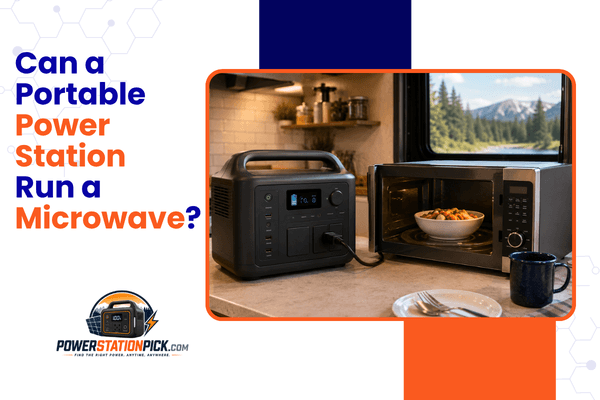
Yes — a portable power station can run a microwave, as long as it delivers at least 1,000 to 1,500 Watts of continuous AC output and features a pure sine wave inverter. Most standard kitchen microwaves draw 1,100W to 1,500W of actual input power while running. A 1,500Wh+ power station will give you roughly 1 to 1.5 hours of continuous cooking time, while compact 600W travel microwaves can run on smaller stations down to 500Wh.
Why Microwaves Are Tricky for Power Stations
Microwaves are among the most power-hungry small appliances you will ever run off-grid. Unlike an overland fridge or a laptop charger that sips electricity incrementally, a microwave demands a massive, instantaneous rush of power the exact second you press the start button.
This creates two primary bottlenecks that trip up smaller portable generators:
The Continuous Power Draw: Generating high-frequency radio waves to heat food causes heavy internal energy losses. A microwave always demands significantly more electricity than its advertised cooking power.
The Startup Surge: When initializing the internal magnetron tube, a microwave creates a brief power spike known as inrush current, which can exceed its steady-state running wattage by 20% to 50% for a few moments.
Furthermore, microwaves require high-quality electrical currents to operate. A power station with a cheap, modified sine wave inverter will cause the microwave’s magnetron to vibrate aggressively, generate intense waste heat, or simply refuse to initialize. Fortunately, major tier-1 brands (like EcoFlow, Jackery, Bluetti, and Anker SOLIX) now ship with Pure Sine Wave inverters as a factory standard.
How Much Power Does a Microwave Actually Use?
Microwave wattage is listed in two distinct metrics that frequently confuse buyers:
Cooking Wattage: The front-facing marketing number printed on the box (e.g., “700W microwave”). This measures the cooking power beamed into your food, not what the machine pulls from the wall.
Actual Input Draw: The real volume of electricity consumed from the outlet. This is always 30% to 50% higher than the cooking wattage due to heat and mechanical conversion inefficiencies.
| Microwave Type | Advertised Cooking Power (Watts) | Average Input Power Draw (Watts) | Amperage Draw (At 120V AC) |
|---|---|---|---|
| Compact / Travel Microwave | 500W – 600W | 750W – 900W | 6.2A – 7.5A |
| Standard Mid-Size Unit | 700W – 800W | 1,050W – 1,300W | 8.7A – 10.8A |
| Large Family / Countertop Unit | 900W – 1,000W | 1,400W – 1,600W | 11.6A – 13.3A |
| Over-the-Range / Commercial | 1,100W – 1,200W | 1,650W – 1,800W+ | 13.8A – 15.0A+ |
| Inverter-Style Microwave | 900W (Variable) | Variable (300W – 1,400W) | Variable based on settings |
Which Power Stations Can Run a Microwave?
Not every portable generator is engineered to support heavy heating cycles. Mobile power hubs generally fall into three distinct performance tiers:
✅ Tier 1: 2,000W+ Continuous Output — Runs Any Standard Microwave
Power stations in this premium class handle standard family-sized countertop microwaves effortlessly. They possess heavy-duty internal inverters that absorb startup surges without tripping internal circuit breakers.
- EcoFlow Delta 3 Plus (2,400W AC Output / 1,024Wh capacity)
- Jackery Explorer 2000 Plus (3,000W AC Output / 2,042Wh capacity)
- Bluetti AC200L (2,400W AC Output / 2,048Wh capacity)
⚠️ Tier 2: 1,000W – 2,000W Continuous Output — Works With Caveats
This mid-tier performance range is the practical sweet spot for most van lifers and overlanders. A 1,500W-output station will comfortably run compact 600W to 700W cooking microwaves. However, it will instantly overload if hooked up to a heavy 1,200W over-the-range appliance.
- Anker SOLIX C1000 (1,800W AC Output / 1,056Wh capacity)
- Jackery Explorer 1000 Plus (2,000W AC Output / 1,264Wh capacity)
❌ Tier 3: Under 1,000W Continuous Output — Only for Micro Travel Microwaves
Small, compact travel generators can only power niche, low-wattage RV-spec cooking appliances (rated at 500W–600W cooking power max). Attempting to run a standard household kitchen microwave on these modules will trigger an immediate protection system error code.
While features like EcoFlow’s X-Boost or Anker’s Power Lift claim to drive high-wattage loads on small inverters, they accomplish this by dropping the output voltage. While this works for simple resistive items like travel kettles, it can stall or damage inductive components like a microwave’s high-voltage transformer.
Runtime Calculator: How Long Will Your Battery Last?
To determine how long a power station’s battery capacity can sustain a running microwave, you must factor in the real-world efficiency losses generated by the internal AC inverter. On average, converting low-voltage DC cell power into 120V household AC electricity wastes roughly 15% of your total energy as heat.
The Real-World Runtime Formula
The conversion matrix below charts realistic continuous cooking operational limits across common power bank sizes based on true physical efficiency curves.
Table 2: Quick-Reference Continuous Runtime Matrix
| Microwave Rated Size | Minimum Continuous Inverter Size | Recommended Surge Rating | Ideal Battery Capacity | Practical Performance Expectations |
|---|---|---|---|---|
| 500W – 600W | 1,000 Watts | 2,000 Watts | 500Wh or larger | Works safely on mid-size gear; slower cooking speeds. |
| 700W | 1,500 Watts | 3,000 Watts | 700Wh – 1,000Wh | The sweet spot for camping and off-grid van life. |
| 900W | 1,800 Watts | 3,600 Watts | 1,000Wh – 1,500Wh | Runs comfortably on most premium solar generators. |
| 1,000W | 2,000 Watts | 4,000 Watts | 1,500Wh – 2,000Wh | Demands high-end, pro-grade mobile power hubs. |
| 1,200W | 2,400 Watts | 4,800 Watts | 2,000Wh+ | Requires heavy-duty home backup power architectures. |
Note: In normal off-grid conditions, a microwave is only operated in short 2-to-3 minute cycles. A 1,000Wh battery station easily delivers enough capacity to manage 12 to 18 meal heating cycles per charge.
How the Math Works: Real-World Examples
To put these numbers into practical context, let’s look at three common off-grid setups using the formula above (accounting for the standard 15% inverter heat loss):
- Example 1: Compact Setup (EcoFlow RIVER 2 Pro + 700W Microwave)
• Battery Capacity: 768Wh | Microwave Actual Input Draw: 1,100W
• Math:(768Wh × 0.85) / 1,100W = 0.59 Hours
• Total Runtime: ~35.4 Minutes of continuous power.
👉 Practical Context: Since a typical reheat session only takes 2 to 3 minutes, this compact setup allows you to warm up roughly 12 to 15 meals per full charge. - Example 2: Overlander Choice (Anker SOLIX C1000 + 900W Microwave)
• Battery Capacity: 1,056Wh | Microwave Actual Input Draw: 1,400W
• Math:(1,056Wh × 0.85) / 1,400W = 0.64 Hours
• Total Runtime: ~38.4 Minutes of continuous power.
👉 Practical Context: This provides plenty of energy headroom for van life, handling multiple extensive cooking sessions while leaving enough juice to run a 12V portable fridge overnight. - Example 3: Emergency Home Backup (Bluetti AC200L + 1,000W Microwave)
• Battery Capacity: 2,048Wh | Microwave Actual Input Draw: 1,500W
• Math:(2,048Wh × 0.85) / 1,500W = 1.16 Hours
• Total Runtime: ~69.6 Minutes of continuous power.
👉 Practical Context: A heavy-duty safety net for home blackouts, allowing a family to heat food freely across 3 to 4 days of a power outage alongside other critical electronics.
Our Top Recommendations
Best Overall: EcoFlow Delta 3 Plus
The Delta 3 Plus balances heavy output capacity with fast recharge rates. Its 2,400W continuous Pure Sine Wave inverter handles any standard household countertop microwave effortlessly. Additionally, its X-Stream wall-charging profile refills the battery from 0% to 80% in under 30 minutes between road trips.
- Learn more via our comprehensive /how-many-charge-cycles-does-a-power-station-last/ guide to evaluate its long-term battery cell lifetime performance.
Best for Camping & Van Life: Jackery Explorer 1000 Plus
The Explorer 1000 Plus provides 2,000W of stable continuous output in a carry-friendly footprint. This setup runs compact 700W travel camping microwaves smoothly with plenty of extra energy headroom to run portable Overlander 12V fridges, ventilation fans, and electronic communication equipment simultaneously.
Best Budget Option: Anker SOLIX C1000
If you need high-wattage microwave capabilities without crossing a premium price threshold, the SOLIX C1000 delivers. Equipped with an 1,800W pure sine wave inverter and ultra-durable LiFePO4 chemistry, it easily handles standard compact kitchen appliances while surviving years of frequent outdoor travel use.
5 Pro Tips for Running a Microwave Off-Grid
- Use Short, Pulsed Heating Bursts: Running a microwave continuously for 6 minutes straight strains internal battery chemistry. Running it in 2-minute intervals with a brief 20-second pause protects the internal cells from experiencing high thermal drops.
- Pre-Thaw Frozen Meals: Heating frozen food demands prolonged, heavy-duty electrical loads. Defrost your meals in an unpowered cooler or under ambient daylight prior to cooking to conserve valuable watt-hour capacity.
- Protect Your Gear From Sub-Zero Exposures: High-amperage current draws can trigger severe internal battery voltage sag when lithium cells get too cold. Keep your portable power bank insulated within your camp vehicle or living cabin to preserve its operational capacity. For more winter guidelines, see how /does-cold-weather-affect-portable-power-station/.
- Deploy Dedicated Inverter Microwaves: Standard microwaves pulse their high-draw magnetron on and off at 100% capacity. Modern inverter microwaves can smoothly scale down their real-time input power draw, making them far friendlier for mid-sized battery packs.
- Never Carry Power Stations on Commercial Flights: High-output power stations required to drive microwaves are strictly prohibited in passenger airplane cabins and checked luggage compartments due to global TSA regulations. Review our comprehensive compliance breakdown over at /portable-power-station-on-airplane-is-it-allowed/.
Frequently Asked Questions
Can a 1,000Wh power station run a microwave?
Yes, but only if its internal AC inverter is rated for at least 1,500W of continuous output. A standard 700W cooking microwave draws roughly 1,100W of true input power from the outlet. If your 1,000Wh power station only features an 800W inverter, it will experience an immediate safety overload shutdown.
What size power station do I need to run a microwave for camping?
For mobile car camping paired with a small 600W travel microwave, a 700Wh to 1,000Wh power station with at least 1,200W of continuous output is sufficient. For full-size kitchen countertop microwaves during home blackouts, prioritize a 1,500Wh+ capacity station with a 2,000W+ inverter.
Do I need a pure sine wave inverter to run a microwave?
Yes, absolutely. Microwaves utilize delicate digital control boards and high-voltage inductive transformers that require clean, alternating current curves. A modified sine wave inverter will cause extreme humming noise, generate destructive waste heat, and eventually damage the microwave’s magnetron tube.
Can you run a microwave and a fridge at the same time on a power station?
Yes, provided their combined real-time input power draw does not exceed your station’s continuous output limits. A compact travel fridge draws about 100W–150W, and a small microwave draws 1,100W input (totaling ~1,250W). A standard 1,500W to 2,000W output power station will handle this load simultaneously with ease.
Is it safe to use a portable power station with a microwave indoors?
Yes. Unlike legacy combustion-powered gas generators, portable power stations operate with absolute silence, release zero carbon monoxide gases, and produce no emissions, making them 100% safe to operate inside closed residential homes, tents, or camper vans.
Can you leave a portable power station plugged into the wall all the time?
Modern power stations allow continuous wall connection because their advanced internal safety hardware stops charging once the cells reach 100%. However, keeping lithium cells at maximum voltage saturation permanently can accelerate long-term chemical wear. For optimal standby health, consult our guide on /can-you-leave-portable-power-station-plugged-in-all-the-time/.
The Bottom Line
A portable power station can absolutely run a microwave oven, provided you match the continuous watt-hour and inverter specifications to your appliance’s real-world input draw rather than the cooking power advertised on the packaging box.
For most off-grid users, investing in a solar generator equipped with a 2,000W continuous Pure Sine Wave inverter and a 1,000Wh+ battery capacity hits the ideal sweet spot for reliable performance and mobility.
If you are interested in trying emerging, eco-friendly alternatives that can safely recharge in sub-freezing winter environments without needing internal heating pads, check out our expert evaluation on /what-is-sodium-ion-battery-power-station/.

Hi, I’m Andrew Richards. I created PowerStationPick to share what I’ve learned about portable power through real-world use—what actually works, what doesn’t, and what makes sense for different situations. I focus on helping you choose the right setup for home backup, camping, and everyday needs without overcomplicating things.