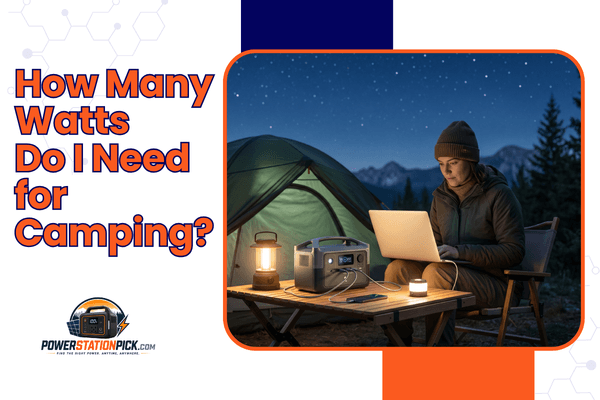
How Many Watts Do I Need for Camping? (The Definitive 2026 Sizing Guide)
Quick Answer: How Many Watts for Camping?
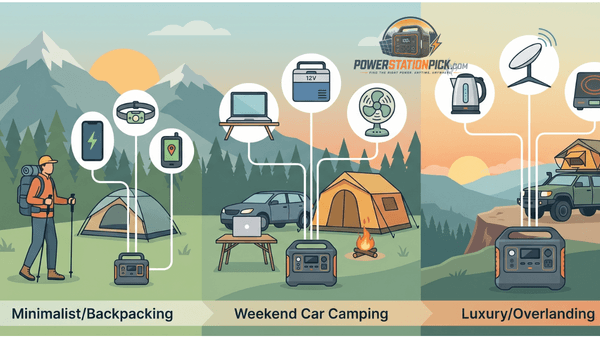
Most campers fall into three categories:
- Minimalist (Phone/Lights): 100W – 200W Output / 250Wh Capacity.
- Weekend Camper (Laptop/Fan/Small Fridge): 500W – 1000W Output / 500Wh – 700Wh Capacity.
- Luxury/Overlander (Heater/Coffee/Starlink): 2000W+ Output / 1500Wh+ Capacity.
Crucial Tip: Always ensure the “Running Watts” of your station exceeds the sum of your devices, and the “Surge Watts” covers motor-driven appliances (like fridges).
The magic of camping in 2026 lies in the balance between the wild outdoors and the convenience of modern technology. Whether you are a minimalist hiker needing to keep a GPS charged or a “glamper” running a portable espresso machine and a Starlink dish, the question remains the same: “How many watts do I actually need?”
Underestimating your power needs leads to “range anxiety” in the middle of the woods, while overestimating means carrying a heavy, expensive battery you don’t fully utilize. In this expert deep dive, we’ll help you calculate your exact requirements and explain why the “Watt” number on the box is only half the story.
1. Watts vs. Watt-Hours: Don’t Buy the Wrong Unit
The biggest mistake we see at PowerStationPick is confusing Watts (W) with Watt-hours (Wh).
- Watts (W) = Power (Speed): This is the rate at which energy flows. It determines what devices you can plug in. If you have a 1000W heater, you need a station that can output at least 1000W.
- Watt-hours (Wh) = Energy (Capacity): This is the total amount of energy in the tank. It determines how long your devices will run.
Imagine a garden hose. The Watts are the pressure of the water (how fast it comes out), and the Watt-hours are the total gallons in the bucket. To have a successful trip, you need a station that has enough pressure to run your gear and enough volume to last the night.
2. Common Camping Gear: The Wattage Cheat Sheet
Before calculating your total, you need to know the “burn rate” of your equipment. In 2026, electronics have become more efficient thanks to GaN technology, but heating elements remain power-hungry.
| Device | Typical Watts (W) | Estimated Use (Hrs) | Total Energy (Wh) |
|---|---|---|---|
| Smartphone (Fast Charge) | 20W | 1.5 | 30Wh |
| LED Camping Lights | 10W | 5.0 | 50Wh |
| Starlink Mini (2026 model) | 25W | 4.0 | 100Wh |
| 12V Portable Fridge | 45W (avg. 15W) | 24.0 | 360Wh |
| Electric Travel Kettle | 800W | 0.2 (12 min) | 160Wh |
3. The 3-Step Power Sizing Formula
To avoid guessing, we use the “PowerStationPick Method” for our field trials. Follow these steps:
Step 1: List Your “Running Watts”
Add up the wattage of every device you plan to run at the same time.
Example: Laptop (60W) + Fridge (45W) + Phone (20W) = 125W Continuous Load.
Recommendation: Look for a station with at least 300W continuous output to stay safe.
Step 2: Account for “Surge Watts” (The Startup Kick)
Any device with a compressor (like a fridge or portable AC) requires a massive burst of energy for the first 2 seconds to start the motor. This can be 3x higher than the running watts. If your fridge runs at 45W, it might surge to 150W. Ensure your power station’s “Peak” or “Surge” rating can handle this.
Step 3: Calculate the “Inverter Tax” (The 15% Rule)
As we discussed in our technical deep dive on fan noise, converting battery power (DC) to wall-plug power (AC) is only about 85-90% efficient.
Formula: $(Total Wh Needed) \times 1.2 = Ideal Battery Capacity$
If you need 500Wh of energy, buy a 600Wh unit to account for the energy lost as heat.
4. User Profiles: Which Camper Are You?
The Weekend Warrior (250Wh – 500Wh)
Best for: Car camping, charging drones, keeping phones alive, and running LED strings.
- Target Output: 300W Continuous / 600W Surge.
- Why: It’s lightweight and usually fits in a backpack or small trunk.
The Digital Nomad / Van-Lifer (750Wh – 1500Wh)
Best for: Working from the woods. You need to run a laptop, Starlink, a 12V fridge, and maybe a small fan for 2–3 days without recharging.
- Target Output: 1000W Continuous / 2000W Surge.
- Why: This size allows for “Multi-day” autonomy and usually features LiFePO4 chemistry for daily use.
The Off-Grid Survivalist (2000Wh+)
Best for: Overlanding, running coffee makers, induction cooktops, or even a small space heater.
- Target Output: 2400W+ Continuous.
- Why: You are basically bringing your home kitchen to the campsite. These units are heavy but can power almost anything.
5. Pro Tips for 2026: Get More Watts for Less Weight
- Prioritize USB-C PD 3.1: In 2026, most laptops and even some power tools can charge via USB-C. Using the DC ports (USB) instead of the AC outlets saves you the 15% “Inverter Tax” and keeps your unit cooler (and quieter!).
- Look for GaN Inverters: If you want a station that can handle high watts without a massive fan, look for units labeled with GaN (Gallium Nitride). They are more efficient and allow for a smaller physical footprint.
- Solar Pairing: Don’t just buy a battery; buy a system. If you use 500Wh a day, a 200W solar panel can technically provide “infinite” runtime, provided you have 4–5 hours of peak sun.
- Temperature Matters: Batteries hate extreme cold. If you are winter camping, your “1000Wh” station might only give you 700Wh. Keep your station inside your insulated sleeping area to maintain capacity.
Conclusion: Start Small, Think Smart
Choosing how many watts you need for camping doesn’t have to be a guessing game. Start by auditing your most essential device (usually a phone or a CPAP machine) and work your way up.
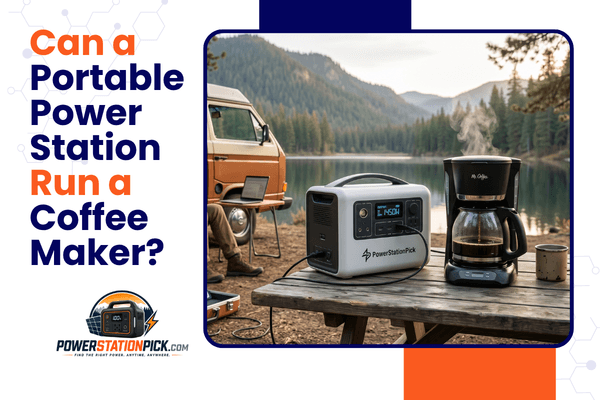
Our #1 Recommendation for 2026: Most versatile campers are best served by a 700Wh / 1000W unit. It strikes the perfect balance between being portable enough to carry and powerful enough to run a morning coffee maker or a fridge.

Hi, I’m Andrew Richards. I created PowerStationPick to share what I’ve learned about portable power through real-world use—what actually works, what doesn’t, and what makes sense for different situations. I focus on helping you choose the right setup for home backup, camping, and everyday needs without overcomplicating things.