What Does Wh Mean on a Battery? The 2026 Consumer Energy Guide
Quick Answer: What Does Wh Mean on a Battery?
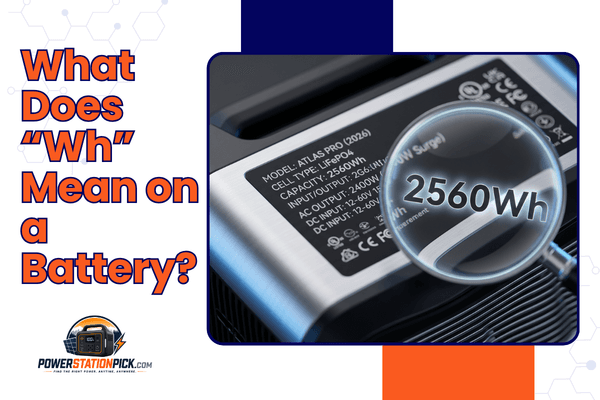
Wh stands for Watt-hour. It is a unit of energy capacity that measures the total amount of electricity a battery can hold. Think of it as the size of a battery’s “fuel tank.”
- ✅ The Basic Rule: A 100Wh battery can power a 100-Watt device for 1 hour, or a 1-Watt device for 100 hours.
- ✅ Calculation Formula: Watt-hours (Wh) = Volts (V) × Amp-hours (Ah).
- ✅ Travel Limit: Most airlines (TSA/FAA) limit portable batteries to 100Wh or less in carry-on luggage.
- ✅ Real-World Tip: Higher Wh means longer runtime, but also typically results in a heavier and larger battery.
If you are shopping for a new smartphone, a portable power station for camping, or even an electric vehicle, you have likely run into the term “Wh.” While most people are familiar with “Volts” or “Amps,” the Watt-hour (Wh) is actually the most critical number to look for. It is the only true way to measure the “size” of a battery’s energy tank.
In this guide, we will break down exactly what Wh means, how to calculate it, and why it has become the global standard for battery capacity in 2026.
👉 If you’re choosing a power station, check our detailed guide on:
what size portable power station you need?
1. Power vs. Energy: Understanding the Difference
To understand Watt-hours, you must first understand the relationship between Watts and Hours. Many people confuse “Power” with “Energy,” but in the world of batteries, they are very different things.
- Watts (W) = Power (The “Speed”): Watts measure how much energy is flowing at this very second. Think of this as the speed of a car (e.g., 60 mph).
- Watt-hours (Wh) = Energy (The “Distance”): Watt-hours measure the total amount of energy used over time. Think of this as the total distance the car can travel before it runs out of gas.
The “Garden Hose” Analogy:
Imagine you are filling a pool with a hose.
- The Watts represent the pressure and speed of the water coming out of the nozzle.
- The Watt-hours represent the total number of gallons currently sitting in the pool.
2. Why “Wh” is Better Than “Ah” (Amp-hours)
You might see some batteries labeled in Ah (Amp-hours) or mAh (milliamp-hours). While common, these units are actually incomplete without knowing the voltage.
In 2026, the industry has shifted toward Wh because it is a universal measurement. Here is why:
- A 100Ah battery at 12V holds 1,200Wh of energy.
- A 100Ah battery at 48V holds 4,800Wh of energy.
If you only looked at the “100Ah” label, you would think these batteries were the same. But the 48V battery actually holds four times as much energy. By using Wh, you are comparing “apples to apples” regardless of the battery’s voltage.
3. The Math: How to Calculate Wh Yourself
If you have a battery that only lists Volts (V) and Amp-hours (Ah), you can find the Wh using this simple 2026 standard formula:
Formula: Volts (V) × Amp-hours (Ah) = Watt-hours (Wh)
Example 1: A Standard Car Battery
- Most car batteries are 12V and roughly 100Ah.
- 12V × 100Ah = 1,200 Wh
Example 2: A Smartphone Power Bank
Most power banks are labeled in mAh. To convert:
- Divide mAh by 1,000 to get Ah (e.g., 20,000mAh = 20Ah).
- Multiply by the internal voltage (usually 3.7V for Lithium).
- 20Ah × 3.7V = 74 Wh
4. Real-World Use Cases: What Can You Run with 1,000Wh?
When people shop at PowerStationPick, the #1 question is: “How long will this battery last?” Let’s look at a typical 1,000Wh (1kWh) portable power station and what it can power:
| Device | Average Wattage | Runtime on 1,000Wh Station |
| iPhone 15/16 | 5 Watts | ~180 Full Charges |
| Laptop (Workload) | 60 Watts | ~14-16 Hours |
| CPAP Machine (No heat) | 30 Watts | ~28-30 Hours |
| Mini-Fridge | 40 Watts | ~20-25 Hours |
| Coffee Maker | 1,000 Watts | ~50-60 Minutes |
Note: We calculate “Real-world” runtime by accounting for a 15% energy loss due to inverter heat.
5. TSA and FAA Regulations: The “100Wh Rule”
If you are a traveler, the Watt-hour rating is the difference between keeping your gear or having it confiscated at security.
In 2026, international aviation safety standards (FAA/TSA) are very strict regarding Lithium batteries:
- Under 100Wh: You can carry as many as you want in your carry-on (e.g., laptops, tablets, most power banks).
- 101Wh – 160Wh: You usually need airline approval, and you are limited to two batteries.
- Over 160Wh: Banned from passenger aircraft. You must ship these via ground freight.
Pro Tip: Always check the fine print on your battery. If the “Wh” isn’t clearly visible, security may not let you fly with it.
6. Depth of Discharge (DoD): The “Hidden” Capacity
One thing manufacturers won’t tell you in big bold letters is that you cannot use all of your Watt-hours.
- Lead-Acid Batteries: You can only safely use about 50% of the Wh before you damage the battery.
- LiFePO4 Batteries (Standard in 2026): You can safely use 80% to 90% of the Wh.
Why this matters: If you need 500Wh of energy for a camping trip, don’t buy a 500Wh battery. Buy a 600Wh or 700Wh unit to ensure you have enough “usable” energy without killing your battery’s lifespan.
7. Energy Density: Wh vs. Weight
As a consumer, you are often choosing between two types of chemistry: NMC and LiFePO4.
- NMC (Nickel Manganese Cobalt): High energy density. You get more Wh per pound. This is why your phone and Tesla are lightweight.
- LiFePO4 (Lithium Iron Phosphate): Lower energy density. The battery is heavier, but it is safer and lasts for 10 years instead of 2.
When choosing a power station, ask yourself: “Do I need to carry this in a backpack (NMC), or will it sit in my truck/home (LiFePO4)?”
8. Summary Checklist for Buyers
When you see Wh on a battery spec sheet, remember these four points:
- Wh = Capacity. It’s how long the battery stays alive.
- Calculate it: If it only says Ah, multiply by the Voltage.
- The 100Wh Limit: Stay under 100Wh if you plan to fly.
- Buy 20% Extra: Always buy a slightly higher Wh rating than you think you need to account for efficiency losses.
Frequently Asked Questions (FAQ)
Q: Is 1,000Wh the same as 1kWh?
A: Yes. Just like 1,000 meters is 1 kilometer, 1,000 Watt-hours is 1 kilowatt-hour (kWh). This is the unit you see on your home electricity bill.
Q: Does a higher Wh make my device faster?
A: No. Wh is capacity (gas tank). It does not affect the “speed” or “power” of your device. That is determined by the Watts (W) output.
Q: Why is my 100Wh battery only giving me 80Wh?
A: This is due to Inverter Efficiency. Converting battery power to “Wall plug” power (AC) generates heat, which “eats” about 15-20% of your energy.
Authored by the Energy Experts at PowerStationPick. Leading the way in portable power education for 2026.

Hi, I’m Andrew Richards. I created PowerStationPick to share what I’ve learned about portable power through real-world use—what actually works, what doesn’t, and what makes sense for different situations. I focus on helping you choose the right setup for home backup, camping, and everyday needs without overcomplicating things.