Power Inverter vs Portable Power Station (2026): Which Is Better for Your Needs?
🔍 THE QUICK VERDICT
Choose a Power Inverter if you are a DIY enthusiast building a permanent van or boat system and want the lowest cost per watt. Choose a Portable Power Station (PPS) if you want a safe, silent, “plug-and-play” solution that can be used indoors, charged via solar, and carried anywhere. For most modern users, the PPS is the superior, headache-free choice.
Introduction: The Battle for Off-Grid Energy
In the world of mobile energy, there has always been a divide between the DIY purists and the convenience seekers. Historically, if you wanted power in your truck or cabin, you bought a heavy lead-acid battery and wired it to a standalone power inverter.
However, as of 2026, Portable Power Stations (PPS)—often called Solar Generators—have disrupted the market. Major players like EcoFlow and Bluetti have made these units so efficient that the old-school inverter setup is facing an existential crisis. But is the extra cost of a power station truly worth it? Let’s break down the mechanics, the math, and the real-world utility.
⚙️ 1. What Exactly is the Difference?
To understand the choice, you have to understand the anatomy of these devices.
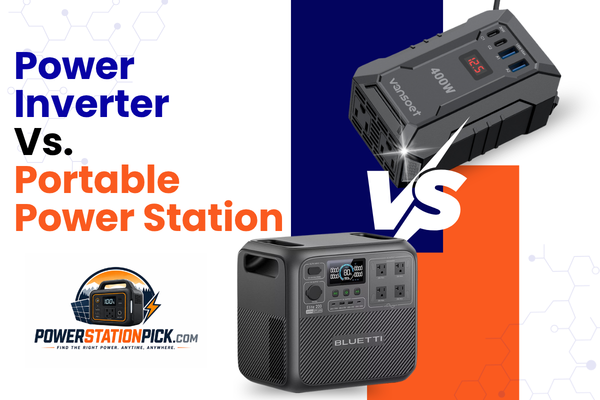
The Power Inverter: The “Brain” Without a Body
A power inverter is a single-purpose device. Its only job is to convert DC (Direct Current) power from a battery (like your car battery) into AC (Alternating Current) power (like your home wall outlet).
- Component: Just the inverter.
- Requirements: You must provide the battery, the fuses, the heavy-gauge wiring, and a way to charge the battery (alternator or solar controller).
The Portable Power Station: The “All-in-One” Suitcase
A Portable Power Station is a complete ecosystem in one box. It is a “battery in a box” that includes:
- LiFePO4 Battery: The energy storage.
- Pure Sine Wave Inverter: To run your AC appliances.
- MPPT Charge Controller: To accept solar panel input.
- BMS (Battery Management System): The safety computer.
- Output Ports: USB-C, USB-A, DC 12V, and AC outlets.
💰 2. Cost Analysis: DIY vs. Convenience
According to data from Bolt Power Group, cost is the primary driver for choosing a standalone inverter.
- Standalone Inverter Setup: You can buy a high-quality 1000W Pure Sine Wave inverter for about **$150 – $200**. Even after adding a 100Ah LiFePO4 battery ($300), your total cost is roughly $500.
- Portable Power Station: A high-end 1000Wh unit (like the Anker Solix or EcoFlow Delta) typically costs $700 – $900.
The Verdict: You pay a 30-50% “Convenience Premium” for a power station. In return, you save hours of labor, eliminate the risk of wiring fires, and gain a sleek, portable form factor.
🛡️ 3. Safety and Ease of Use (The “Reddit” Factor)
Discussion threads on Power stations vs inverters : r/urbancarliving highlight a critical real-world issue: Stealth and Safety.
The Risk of Standalone Inverters
If you wire an inverter directly to your car’s starter battery, you risk a “dead battery” situation where your car won’t start in the morning. Furthermore, standalone inverters can be loud (cooling fans) and require proper ventilation. If your wiring isn’t perfect, the high current can lead to melting wires or electrical fires.
$$P (Watts) = V (Voltage) \times I (Amps)$$
To run a 1000W microwave at 12V, your wires are carrying over 80 Amps. That requires thick, expensive 2AWG copper cables. Most beginners underestimate this requirement.
The Safety of Power Stations
PPS units are closed systems. The BMS monitors every cell, preventing overcharging, short circuits, and overheating. Because they use LiFePO4 chemistry (in 2026 models), they are non-combustible and safe to keep under your bed or in a tent.
📊 4. Comparison Table: Head-to-Head
| Feature | Standalone Power Inverter | Portable Power Station |
| Setup Time | 2–5 Hours (Tools Required) | 0 Minutes (Plug & Play) |
| Portability | Fixed (Hard-wired) | High (Grab & Go) |
| Charging | Requires separate charger/solar | Built-in (AC, Solar, Car) |
| Outputs | AC Outlets Only | AC, USB-C, USB-A, DC 12V |
| Lifespan | Depends on external battery | 3,000–6,000 Cycles (LiFePO4) |
| Noise | Loud internal fans | Ultra-Quiet / Silent |
🏕️ 5. Which One Fits Your Lifestyle?
Scenario A: The DIY Van Builder (Choose Inverter)
If you are gutting a Sprinter van and building a permanent home on wheels, a high-power inverter (like a 3000W Victron) connected to a large 400Ah battery bank is the way to go. It’s more efficient for massive loads like induction stoves and water heaters.
Scenario B: The Tent Camper & Weekender (Choose PPS)
If you just want to keep your phone charged, run some LED lights, and keep a mini-fridge cold for 2 days, a 500Wh to 1000Wh Portable Power Station is perfect. You can charge it at home before you leave and use it as a tabletop power hub at the campsite.
Scenario C: The Home Emergency Backup (Choose PPS)
In a power outage, you don’t want to be fumbling with car batteries and jumper cables in the dark. A PPS can be kept in a closet, fully charged, and brought into the kitchen to run your refrigerator immediately.
🛠️ 6. Calculating the Right Size
Whether you choose an inverter or a power station, you still need to know how much energy you’ll consume. This is where most people fail.
- Total Energy (Wh): Device Watts $\times$ Hours Used.
- The Inverter Tax: Standalone inverters and PPS units both lose about 15% of energy during the AC conversion process.
Pro Tip: To get a real-world estimate of how long a 1000Wh Power Station will last compared to a DIY battery setup, use our interactive tool:
👉 Portable Power Station Calculator
🏆 Final Thoughts: The Winner is…
For the vast majority of people in 2026, the Portable Power Station is the clear winner.
While standalone inverters remain relevant for heavy-duty, fixed off-grid installations, the sheer versatility of a PPS cannot be beaten. You get a battery, an inverter, a solar controller, and a high-speed USB hub in a single, durable package that can be charged by the sun.
Our Recommendation:
- For maximum value: Look for a 1000Wh LiFePO4 power station. It’s the “sweet spot” for weight, power, and price.
- For ultimate off-grid freedom: Pair your PPS with a 200W Portable Solar Panel.

Hi, I’m Andrew Richards. I created PowerStationPick to share what I’ve learned about portable power through real-world use—what actually works, what doesn’t, and what makes sense for different situations. I focus on helping you choose the right setup for home backup, camping, and everyday needs without overcomplicating things.