How to Charge a Portable Power Station in an RV
Quick Summary: Best Ways to Charge in an RV
The fastest and most efficient way to charge a portable power station in an RV is via AC Shore Power (1-2 hours). For off-grid freedom, a hybrid setup using 400W+ solar panels and a DC-DC alternator charger while driving is the gold standard for 2026.
1 – 2 Hours
⚡ Fastest
4 – 6 Hours
☀️ Best for Boondocking
2 – 5 Hours
🚗 While Driving
- ✅ Pro Tip: Use DC-to-DC charging instead of the 12V cigarette lighter for 5x faster speeds while driving.
- ✅ Efficiency: Always prioritize USB-C/DC ports for your devices to avoid the “Inverter Tax” (15% energy loss).
Introduction: The New Era of RV Power
If you’ve spent any time on the road lately, you’ve noticed the shift. The days of noisy, fuel-chugging generators being the only way to keep the lights on are fading. Today, the RV portable power station (or solar generator for RV use) has become the beating heart of the modern mobile lifestyle.
Whether you’re a full-time digital nomad working from a converted van or a weekend warrior in a Class A motorhome, knowing how to charge a portable power station in an RV correctly is the difference between a seamless adventure and a frustrating night in the dark.
I’ve seen it a hundred times: a beginner buys a massive 2000Wh unit, plugs it into a 12V car socket, and realizes 10 hours later that they’ve only gained 5% charge. Charging a power station isn’t just about plugging it in; it’s about managing input watts, understanding inverter efficiency, and choosing the right “fuel” for your current environment.
In this guide, we’re going to deep-dive into every charging method available in 2026—from high-speed shore power to passive alternator charging while you’re cruising down the I-10.
2. Different Ways to Charge a Portable Power Station in an RV
When you’re in an RV, your environment dictates your charging strategy. You wouldn’t use the same method at a luxury resort with full hookups as you would while boondocking on BLM land in Utah.
Shore Power (AC Charging)
This is the “gold standard” for speed. When you are at a campground with a 30-amp or 50-amp hookup, you simply plug your power station into one of your RV’s internal AC outlets. In 2026, most high-end units from EcoFlow or Bluetti can hit 80% charge in under an hour using this method.
Solar Panels (The Boondocker’s Choice)
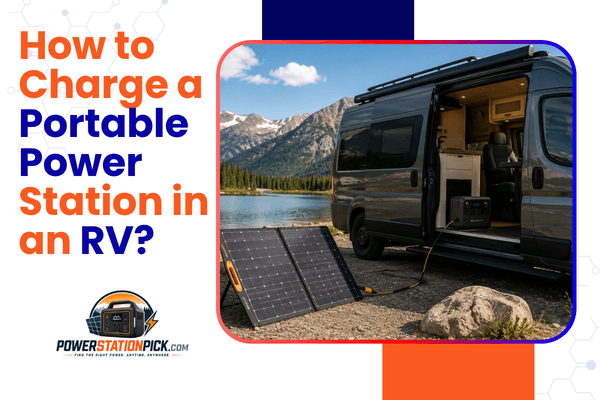
This is the most “emotional” way to charge—there is a unique satisfaction in seeing the sun turn into usable electricity. You can use portable “suitcase” panels or tap into your RV’s existing roof-mounted solar array.
RV 12V Outlet (The “Trickle” Method)
Every RV has a 12V “cigarette lighter” style outlet. While convenient, it is the slowest method. It’s best used for maintaining a charge rather than refilling an empty “tank.”
Charging While Driving (Alternator Power)
By using a DC-DC converter or simply plugging into the chassis power, you can harvest energy from your RV’s engine as you travel. This turns your drive time into productive charging time.
Generator Charging
If the clouds roll in and you’re off-grid, plugging your power station into a traditional inverter generator is a viable backup. It’s faster than solar but comes with the noise and fuel costs of a gas engine.
Campground Hookups (The Pedestal)
Sometimes, it’s easier to plug your power station directly into the park’s power pedestal using a standard 15A adapter. This bypasses your RV’s internal wiring entirely, reducing potential electrical interference.
Table 1: Charging Method Comparison (1000Wh Capacity Unit)
| Charging Method | Typical Input Watts | Est. Time (0-100%) | Best For… |
| Shore Power (AC) | 1000W – 1500W | 1 – 1.5 Hours | Campgrounds / Pre-trip prep |
| RV Solar (400W) | 250W – 350W | 3.5 – 5 Hours | Boondocking / Off-grid |
| DC Outlet (12V) | 96W – 120W | 10 – 12 Hours | Emergency topping off |
| Alternator (DC-DC) | 300W – 500W | 2.5 – 3.5 Hours | Long travel days |
| Gas Generator | 500W – 1000W | 1.5 – 2 Hours | Emergency backup / Winter |
3. How to Charge a Portable Power Station While Driving
Charging a portable power station while driving is the smartest way to ensure you arrive at your destination with a full battery. However, there are safety and technical hurdles to clear.
Step-by-Step Guide to Drive-Charging:
- Check the Port Limit: Most RV 12V sockets are fused at 10A or 15A. This means you can safely draw about 120W.
- Use the Correct Cable: Use the heavy-duty DC cable provided by the manufacturer. Avoid using thin, unbranded extensions, as they can overheat.
- Secure the Unit: A 40-pound power station becomes a projectile in an accident. Use tie-downs to secure it in your RV’s living area or a dedicated cabinet.
- Monitor Heat: Power stations generate heat while charging. Ensure there is at least 3 inches of clearance around the intake fans.
Alternator Limitations
Your RV’s alternator has a primary job: keeping the chassis battery charged and the engine running. If you try to pull too much power (via a high-wattage DC-DC charger), you could overheat the alternator. For most users, sticking to the standard 12V/24V car charging port is safe, but slow.
Expert Tip: If you want faster charging while driving, consider a bidirectional DC-DC charger. Brands like Bluetti now offer dedicated “Charger 1” kits that can pull up to 500W from your alternator safely, charging your rig 5x faster than a cigarette lighter port.
4. Using Solar Panels with an RV Power Station
An RV solar setup is incomplete without a way to store that energy. When using a solar generator for RV use, you have two main philosophies.
Portable vs. Roof-Mounted Solar Panels
- Portable “Suitcase” Panels: These are great because you can park your RV in the shade and put the panels in the sun. They usually connect via an XT60 or MC4 connector.
- Roof-Mounted Panels: These are “set it and forget it.” However, you have to find a way to route the wires from the roof to wherever your power station sits inside the RV.
The Magic of the MPPT Controller
Most high-quality LiFePO4 power stations in 2026 come with a built-in MPPT (Maximum Power Point Tracking) controller. This tech is crucial. It acts like a “smart transmission,” constantly adjusting the voltage and current to squeeze every possible drop of energy out of your panels, even in partial shade.
Best Solar Angle Tips
- The 90-Degree Rule: For maximum speed, your panels should be perfectly perpendicular to the sun.
- Cooler is Better: Paradoxically, solar panels lose efficiency as they get extremely hot. Ensuring airflow behind your panels can actually increase your charging portable power station speed.
[INSERT AFFILIATE BOX: TOP RECOMMENDED PORTABLE SOLAR PANELS 2026]
5. How Long Does It Take to Charge a Portable Power Station?
“How long will it take?” is the most common question I get. The math is simple, but the reality is messy.
The Formula: Total Watt-Hours (Wh) / Input Watts (W) = Hours
The Reality: You have to account for about 15% efficiency loss.
768Wh / 100W Input = ~8.8 hours.
Realistic Examples:
- EcoFlow Delta 3 (1024Wh): On AC Shore power (1200W), it takes about 1 hour. On 200W solar (real-world 160W), it takes about 7.5 hours.
- Jackery Explorer 2000 Plus (2042Wh): On AC power, about 2 hours. On 12V car charging (96W), it would take over 22 hours—not recommended!
Charging Speed Expectation: Always look at the Input Watts display on your station. If you see it fluctuating wildly, check your cable connections or look for shade on your solar panels.
6. Common Mistakes RV Owners Make
Even experienced “vanners” make these errors. Avoiding them will save your equipment and your sanity.
- Wrong Cable Gauge: Using a thin extension cord for AC charging can cause a significant voltage drop and even melt the cord. Always use a 12-gauge or 14-gauge heavy-duty cord.
- Charging in Extreme Heat: Batteries are like humans; they hate being over 100°F. If your power station is in a hot RV storage bay while charging, the BMS (Battery Management System) will throttle the speed to protect the cells. This is one of the main reasons for why power station fans make noise.
- Cheap Solar Panels: Low-quality “no-name” panels often have poor voltage regulation. A sudden spike can fry your power station’s input port.
- The 0% Trap: Leaving your LiFePO4 power station at 0% for months during winter storage is the fastest way to kill it. Always store it at 40-60% charge.
7. Best Portable Power Stations for RV Use in 2026
In 2026, the market has matured. We no longer buy just based on capacity; we buy based on ecosystem and charging versatility.
1. EcoFlow Delta 3 Series (The Speed King)
- Pros: Industry-leading AC charging speeds; excellent integration with EcoFlow’s “Smart Home Panel” for RVs.
- Cons: Fans can be a bit loud during rapid charging.
- Ideal Use: Travelers who jump from campground to campground and need a quick “refill” between stops.
2. Bluetti AC200 Series (The Workhorse)
- Pros: Massive solar input (up to 900W+); incredibly durable build quality; LiFePO4 cells rated for 10+ years.
- Cons: Heavier than the competition.
- Ideal Use: Full-time boondockers who rely 100% on solar. Read our full Bluetti reviews for a deeper look.
3. Anker SOLIX C1000 (The Long-Life Choice)
- Pros: Proprietary InfiniPower™ tech; sleek design; ultra-reliable.
- Cons: Fewer expansion battery options than Bluetti.
- Ideal Use: Weekend campers who want a “set it and forget it” unit for their portable power station for camper setup.
4. Jackery Explorer 2000 Plus (The Simplicity King)
- Pros: Easiest interface in the business; very quiet operation.
- Cons: Solar input is slightly lower than Bluetti’s top-tier units.
- Ideal Use: Beginners who want a plug-and-play solution without a steep learning curve.
[INSERT AFFILIATE BOX: EDITORS’ CHOICE RV POWER STATION 2026]
8. Portable Power Station vs. Traditional RV Generator
Why are we talking about charging portable power stations instead of just using a gas generator?
| Feature | Portable Power Station | Traditional Inverter Generator |
| Noise | Silent (or light fan hum) | Loud (52dB – 68dB) |
| Fuel | Sun / Electricity | Gasoline / Propane |
| Maintenance | Zero | Oil changes, spark plugs, carb cleaning |
| Indoor Use | Safe (Zero emissions) | DANGEROUS (Carbon Monoxide) |
| Long-Term Cost | High upfront, $0 running | Low upfront, high fuel/maintenance |
The Expert Take: For most RVers, the best way to charge a portable power station is solar, because it makes the unit a silent, “free” energy source. Generators are now strictly for “emergency only” or for running high-load items like a 15,000 BTU RV Air Conditioner for hours.
9. Pro Tips for Maximizing Battery Life
Your LiFePO4 power station is an investment. Treat it like one.
- The 20-80 Rule: To get the maximum lifespan, try to keep your battery between 20% and 80% charge. Constant 100% saturation or 0% depletion stresses the cells.
- Use DC for Efficiency: As we discuss in our energy efficiency guide, using the AC inverter wastes 10-15% of your power as heat. Use the DC cigarette or USB ports whenever possible.
- Firmware Updates: In 2026, most units have Wi-Fi/Bluetooth. Manufacturers often release updates that improve charging efficiency and fan curves.
- Avoid Sub-Zero Charging: Never charge a lithium battery if the internal temperature is below 32°F (0°C). Most modern units have “Low Temp Protection,” but it’s best to keep the unit in the heated cabin of your RV.
10. FAQ Section
Can I charge a power station from my RV battery?
Yes, but be careful. If you plug into a 12V outlet while the engine is off, you can quickly drain your RV’s starter battery, leaving you stranded. Only charge from the house battery or while the engine is running.
Can I use solar and AC charging together?
Most modern units from EcoFlow and Bluetti support “Dual Charging.” This allows you to combine solar and AC power to hit incredible charging speeds (e.g., 1500W+ total input).
Can a portable power station run an RV AC?
Yes, but only for a limited time. A standard 13,500 BTU RV AC draws about 1200W-1500W. A 2000Wh station will only run it for about 1 to 1.5 hours. For AC use, you need a massive “Whole-Home” style unit or a hybrid setup.
Is it safe to charge overnight?
Absolutely. Modern units have sophisticated BMS systems that prevent overcharging, overheating, and short circuits.
What size power station do I need for RV camping?
- Weekend/Lights only: 500Wh – 700Wh.
- Laptops/Fridge/Fan: 1000Wh – 1500Wh.
- Off-grid/Heavy use: 2000Wh+.
Can I charge my power station with my RV’s onboard solar?
Yes, but you usually need to tap into the “Load” side of your solar controller or use an adapter to plug into the RV’s external solar port (often called “Solar Ready” ports).
Does heat affect charging speed?
Yes. If the internal temperature gets too high, the unit will automatically slow down the charging rate to protect the battery cells.
Why is my 12V car charger so slow?
Because most car ports are limited to 10 Amps. $12V \times 10A = 120W$ max. Compared to a 1200W wall outlet, it’s 10x slower.
11. Final Verdict: What Is the Best Way to Charge?
After thousands of miles on the road, my final verdict is this: The best RV solar setup is a hybrid one.
- For the Casual Traveler: Rely on AC Shore Power for quick bursts and a 100W portable solar panel to keep your gadgets topped off while at the beach.
- For the Hardcore Boondocker: Invest in at least 400W of solar and a high-quality Bluetti or EcoFlow unit that supports high-speed DC-DC charging from your alternator.
The goal of having a portable power station for camper use is freedom. By mastering these charging methods, you’re no longer tethered to a noisy generator or an expensive RV park. You can park in the middle of nowhere, open your laptop, and have all the power you need.
Ready to find your perfect rig? Check out our latest portable power station reviews and see how the newest 2026 models performed in our “Torture Tests.”

Hi, I’m Andrew Richards. I created PowerStationPick to share what I’ve learned about portable power through real-world use—what actually works, what doesn’t, and what makes sense for different situations. I focus on helping you choose the right setup for home backup, camping, and everyday needs without overcomplicating things.