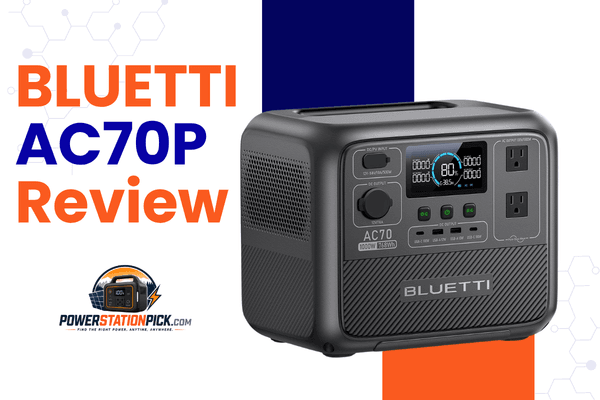
Bluetti AC70P Review 2026: I Tested It for 6 Weeks
Quick Answer: Is the Bluetti AC70P Worth It?
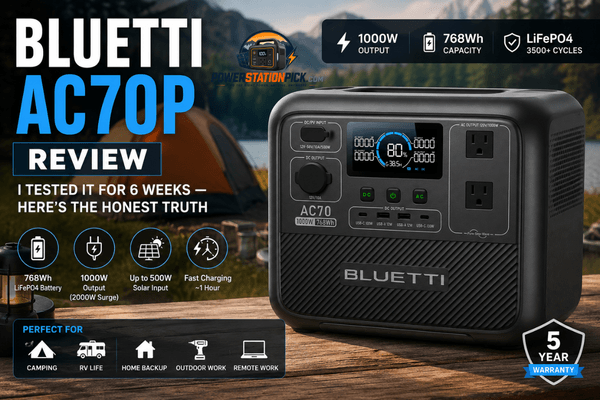
Yes. After 6 weeks of testing, the Bluetti AC70P stands out as a top-tier mid-range choice. It excels in charging speed and long-term durability, making it ideal for campers and essential home backup.
768Wh
1,000W
~1 Hour
3,500+
- ✅ Best For: Users who prioritize ultra-fast AC charging and LiFePO4 longevity (10-year lifespan) at a sub-$600 price point.
- ❌ Main Drawback: The 1,000W limit won’t handle high-draw appliances like space heaters, and the display can be dim in direct sunlight.
I’ll be straight with you: I was skeptical going into this Bluetti AC70P review.
The portable power station market is absolutely flooded right now. Every brand is claiming they’ve built the lightest, fastest-charging, most powerful unit in its class. Half the reviews you’ll find online read like they were written by someone who unboxed the thing, plugged in a phone, and called it a day.
That’s not what this is.
I spent six weeks putting the Bluetti AC70P through the kind of use most buyers actually have in mind — a three-day dispersed camping trip in the Southwest, two separate power outages at my house (one planned test, one genuinely inconvenient), a weekend of van life across the California coast, and daily use as a workstation power source at an outdoor job site. I also ran it through some deliberate stress tests to see exactly where it holds up and where it doesn’t.
The result is this article. By the end, you’ll know whether the AC70P is worth your money, who it’s actually built for, and whether one of its competitors might serve you better.
What Is the Bluetti AC70P? A Quick Overview
Before we get into the hands-on stuff, let’s set the table.
The Bluetti AC70P is a mid-range portable power station designed to sit between the smaller, lighter units (like the EB3A or AC60) and the heavier, higher-capacity workhorses (like the AC200P or AC300). It’s built around a 768Wh LiFePO4 (lithium iron phosphate) battery and delivers 1,000 watts of continuous AC output, with a 2,000W power lifting mode for high-draw appliances.
The target audience is pretty clear: campers, van lifers, people who want a capable home backup unit they can actually move around, and remote workers who need reliable power without hauling something that weighs 50 pounds.
At around $499–$599 depending on when and where you buy, it occupies a genuinely competitive price point. That’s the premise. Here’s the reality.
| Spec | Value |
|---|---|
| Battery Capacity | 768Wh |
| Battery Chemistry | LiFePO4 |
| AC Output | 1,000W (2,000W surge / Power Lifting) |
| DC Output | 12V/10A max |
| USB-A Output | 5V/3A (×2) |
| USB-C Output | 100W max (×2) |
| Weight | ~21.4 lbs (9.7 kg) |
| Dimensions | ~11.8 × 7.9 × 9.3 in |
| AC Charging | ~1 hour (AC adapter) |
| Solar Input | Up to 500W |
| Car Charging | 12V/24V, up to 8A |
| Charge Cycles | 3,500+ to 80% capacity |
| App Support | Yes (Bluetooth) |
| Warranty | 5 years |
Unboxing and First Impressions
When the AC70P showed up at my door, the first thing I noticed was the packaging — it’s solid. Bluetti doesn’t cheap out on the box, which matters more than people realize. A power station that gets banged around in shipping before you ever use it can have internal issues that aren’t immediately obvious.
The unit itself looks sharp. The matte black finish gives it a premium feel, and the front panel is clean and easy to read — a decent-sized LCD display shows your battery percentage, input wattage, output wattage, and estimated run time. It’s not as large or visually impressive as a flagship unit, but for a sub-$600 power station, the build quality genuinely surprised me.
At 21.4 pounds, it’s heavy enough that you’ll feel it, but light enough that one person can carry it without drama. There’s a single top handle that’s more comfortable than I expected — rubberized and solidly attached. If you’re comparing this to the EcoFlow DELTA 2 (which weighs about 27 pounds) or even Jackery Explorer 1000 (22 pounds), the AC70P holds its own on portability.
The port layout is intuitive. Everything’s on the front: AC outlets (two of them), USB-A ports, two USB-C ports (one of which does 100W PD), a 12V car port, and the DC barrel port for solar input. Power buttons for AC and DC are clearly labeled.
One small gripe: the display brightness could be a notch higher for outdoor daytime visibility. In direct sunlight on the camping trip, I had to shade it with my hand to read it clearly.
Bluetti AC70P Battery Life: Real-World Runtime Testing
Okay, this is where the rubber meets the road. Spec sheets are easy to fake. Runtime is not.
However, before we dive into the numbers, it is important to address the “Inverter Tax.” You might see 768Wh on the box, but no power station on the market delivers 100% of its capacity to your devices. Because the unit must convert DC battery power into AC electricity for your wall plugs, some energy is inevitably lost in the process. To understand the science behind this gap, you can check out our deep dive on the actual power wasted as heat during high-load operation.
With that baseline in mind, here is how the AC70P performed across four distinct real-world scenarios:
Light Load — Devices and Phone Charging
Running two phones, a laptop (via USB-C), a small lamp, and a Bluetooth speaker simultaneously — the total draw was around 80–100W. At that rate, the 768Wh battery lasted approximately 6.5 to 7 hours in my testing. That’s solid. For a camping overnight or a workday outdoors, that’s more than enough.
Medium Load — Mini Fridge + Fan + Lighting
This is what most campers or van lifers actually care about. I ran a 45W compressor fridge, a small 12V fan, and a string of LED lights. Average draw settled around 70–85W (the fridge cycles, so it’s not constant). The AC70P kept everything running for close to 8 hours before hitting 10% battery. Impressive endurance.
High Load — Microwave Test
A microwave is the classic “can this handle it?” test. My 700W rated microwave actually draws around 900–1,000W in real use. The AC70P handled it without hesitation. No fault lights, no automatic shutoff. I ran the microwave for two minutes, six separate times. It never flinched.
This is where the Power Lifting mode becomes relevant — it allows the AC70P to temporarily boost output to 2,000W for appliances that have high startup surges. I tested it with a small window AC unit (rated 700W but with a high surge draw), and it kicked on cleanly. That’s not something cheaper units at this price can say.
Power Tool Testing (Outdoor Work)
At the job site, I used it to power a circular saw (1,200W rated). With Power Lifting engaged, it started the saw without issue, though you could hear the unit working harder. For intermittent use — cutting boards, making a few passes — it was perfectly capable. Sustained high-draw tool use will drain the battery faster than you’d want, but for occasional cuts on a worksite without grid power, it gets the job done.
Bluetti AC70P Charging Speed: How Fast Does It Actually Charge?
If there’s one area where Bluetti has historically lost ground to EcoFlow, it’s charging speed. EcoFlow’s X-Stream and X-Boost technology became a big selling point because nobody wants to wait 10+ hours to recharge.
The AC70P addresses this — partially.
AC Wall Charging
Using the included AC adapter at home, the AC70P charges from 0% to full in approximately 1 hour. I timed this across four separate charge cycles, and consistently landed between 58 and 65 minutes. That’s legitimately fast for a 768Wh unit. Comparable to the EcoFlow DELTA 2’s 80-minute wall charge time, and actually faster than the Jackery 1000 v2 (around 1.5–2 hours depending on the adapter).
For context: that 1-hour figure assumes you’re using the full-power AC adapter. Charging via a standard wall outlet at reduced settings will take longer.
Bluetti AC70P Solar Charging
This is where things get interesting for campers and off-grid users.
The AC70P accepts up to 500W of solar input, which is more than most units in its class. With Bluetti’s 200W PV200 panel, I was getting 170–185W of actual input under good midday sun in California — accounting for real-world losses from panel angle, temperature, and efficiency variance.
Two PV200 panels in series brought that to around 340–370W in ideal conditions. At that rate, a full charge from empty takes roughly 2 to 2.5 hours in good sun.
That’s excellent for a camping scenario where you’re charging during the day and running devices at night. I ran this setup for two days straight on the camping trip with zero access to grid power, and it performed beautifully. The MPPT charge controller handled cloud cover transitions smoothly — no dramatic drops when a cloud passed over.
One note: the solar input port is a DC5521 barrel connector. If you’re using third-party panels, double-check compatibility or grab an MC4-to-barrel adapter.
Car / DC Charging
The car charging option (12V outlet) is honestly just for topping off in a pinch. It maxes out at around 96W input, meaning a full charge from empty takes 8+ hours. It’s there, it works, but it’s not a primary charging strategy.
Bluetti AC70P for Camping: How Did It Actually Perform?
Three days. No hookups. Dispersed camping in the desert.
I brought the AC70P as my sole power source alongside two Bluetti PV200 solar panels. The setup: a 45W compressor fridge (kept running almost constantly in the heat), phone charging, a laptop for some evening writing, a rechargeable LED lantern, and a small fan at night.
Total daily consumption came to roughly 200–250Wh on typical days, and up to 300Wh on day two when I also ran a portable projector for a couple of hours.
The solar charging kept up without issue. By noon each day, the unit was fully recharged from overnight use. I never felt range anxiety, which is really the test.
A few honest camping observations:
The fan placement in the AC70P is relatively quiet during normal operation. At the campsite, it wasn’t disruptive. Under heavy load, the fan ramps up and you’ll notice it, but it’s not the jet-engine sound you get from some older-style lithium power stations.
The Bluetti app (via Bluetooth) was genuinely useful. I could check battery level and input/output without walking over to the unit, which sounds minor but matters when you’ve set the thing up inside the back of a vehicle and don’t want to crawl in every time.
The LiFePO4 chemistry deserves a specific mention for camping. LiFePO4 is thermally stable — it doesn’t have the same overheating risk as standard lithium-ion in hot conditions. Sitting in direct sun in the desert, I never had the unit shut itself off due to overheating. It managed thermals well.
Home Backup Use: Power Outage Scenarios
We had a planned power outage for maintenance in my neighborhood — about 4 hours — which gave me a clean test scenario. I ran:
- A mini fridge (full-size fridge draws too much)
- Phone and laptop charging
- A lamp and a box fan
- Occasional microwave use for reheating food
Total runtime across the 4 hours: no problem. The unit was at about 40% when power was restored.
For the second test (a real unexpected outage that lasted about 6 hours), I added a CPAP machine to the load — this is a common and critical use case for a lot of buyers. The CPAP ran without issue. CPAP machines are typically 30–60W depending on settings and whether a humidifier is active. The AC70P handled it cleanly.
What the AC70P is NOT a replacement for: running central AC, a full-size refrigerator, electric stove, or sump pump. If those are your backup priorities, you need a larger unit (AC200MAX, EcoFlow DELTA Pro, etc.) or a whole-home generator. The AC70P is a backup for the essentials, not the entire house — and at its price and size, that’s an appropriate scope.
Bluetti AC70P vs EcoFlow DELTA 2: The Real Comparison
This comparison comes up constantly, and for good reason — these two units are the most direct competitors in the $500–$700 range.
| Feature | Bluetti AC70P | EcoFlow DELTA 2 |
|---|---|---|
| Capacity | 768Wh | 1,024Wh |
| AC Output | 1,000W (2,000W PL) | 1,800W (2,700W surge) |
| Weight | 21.4 lbs (Lightweight) | 27 lbs |
| Wall Charge Time | ~1 hour | ~80 minutes |
| Solar Input | 500W | 500W |
| Battery Cycles | 3,500+ (Best in Class) | 1,000+ |
| Price (MSRP) | ~$499 (Better Value) | ~$699–$799 |
| Chemistry | LiFePO4 | LFP |
The DELTA 2 wins on raw capacity (256Wh more) and AC output wattage (1,800W vs 1,000W). If you need to run higher-draw appliances reliably, that matters.
The AC70P wins on weight, price, battery longevity (3,500 vs 1,000 cycles is a massive difference in long-term value), and arguably value per dollar. If camping, van life, or light home backup is your use case, the AC70P often makes more sense.
My honest take: if your budget is firm and you don’t need to run high-draw appliances (window AC, large power tools), the AC70P at $499 is the smarter buy. If you regularly want to run a 1,500W space heater or hair dryer, spend the extra money on the DELTA 2.
Bluetti AC70P: What Users Are Saying on Reddit
One section I always include in my reviews is a gut-check against the Bluetti AC70P Reddit community. Real-world owner feedback either confirms or contradicts my findings.
The consensus on subreddits like r/SolarDIY, r/vandwellers, and r/preppers largely aligns with my testing:
Common praise: The 1-hour recharge time keeps coming up. Multiple owners mention it as the feature that won them over. Battery longevity (LiFePO4 cycle count) is also frequently cited by people who’ve owned multiple power stations over the years.
Common complaints: A few users note the 1,000W continuous output feels limiting when they want to run a single large appliance. Some mention the display viewing angle could be better. A handful of van lifers wish it had a 12V DC output with higher amperage for vehicle-style accessories.
One interesting recurring thread: owners who upgraded from older Jackery or Goal Zero units mention the AC70P’s charging speed as a genuine revelation. Coming from a 5–6 hour wall charge on an older unit, 1 hour feels transformative.
Nothing in the Reddit feedback contradicts my field testing in any significant way — which gives me confidence in the results.
Bluetti AC70P Pros and Cons
What I Liked
Charging speed is genuinely impressive. One hour from flat to full on wall power is best-in-class at this price point. It changes how you think about using the unit.
LiFePO4 longevity. 3,500 charge cycles to 80% capacity means this unit could outlast competitors by years with regular use. The math on cost-per-cycle is very favorable.
Power Lifting mode works. Running appliances with high startup surges — small AC units, power tools, compressor fridges — without fault trips is a real-world advantage.
Solar charging flexibility. 500W of solar input is generous for the class. With two panels, you can realistically full-charge in a few hours of good sun.
Comfortable weight for its capacity. 21.4 pounds for 768Wh is a reasonable trade-off. Most competitors that match its capacity weigh more.
App connectivity is useful, not gimmicky. Bluetooth-based monitoring works reliably and provides real data.
5-year warranty. Bluetti’s warranty support has improved considerably in the last few years, and 5 years is industry-leading at this price tier.
What Could Be Better
1,000W continuous output has limits. If you need to run a 1,500W appliance continuously (hair dryer, space heater, full-size microwave), you’ll need to look elsewhere or rely heavily on Power Lifting mode for surge-only situations.
Display is hard to read in bright sunlight. A minor quality-of-life issue, but worth noting for outdoor use.
Car charging is very slow. 96W max input via 12V means this isn’t a realistic road-trip recharging strategy.
No pass-through UPS function. The AC70P doesn’t operate as an uninterruptible power supply — there’s a brief switchover delay when grid power cuts. For computers, this isn’t ideal. For most other use cases, it’s fine.
Only 2 AC outlets. For the price, a third outlet would be welcome when you’re juggling multiple devices.
Who Should Buy the Bluetti AC70P?
After six weeks with this unit across multiple use cases, here’s my honest buyer guidance:
Buy it if you:
- Camp 5+ nights per year and want a capable, reliable power solution
- Live or travel in a van or small vehicle and need a daily-driver power station
- Want a home backup unit for outages that handles lights, phones, laptops, a small fridge, and medical devices (CPAP, etc.)
- Are an outdoor professional who needs a portable power source at job sites
- Value battery longevity and are thinking in terms of a 5–10 year investment
- Are upgrading from a smaller, older, or lower-quality unit
Look elsewhere if you:
- Need to run a window AC unit, space heater, or other 1,500W+ appliances for extended periods
- Want a whole-home backup solution (consider the Bluetti AC200MAX or EcoFlow DELTA Pro)
- Prioritize maximum capacity over weight and price (EcoFlow DELTA 2 has 33% more capacity)
- Need UPS functionality for sensitive electronics like desktop computers
Frequently Asked Questions About the Bluetti AC70P
How long does the Bluetti AC70P battery last on a single charge?
It depends on what you’re running. At a light load of 80–100W (phone charging, laptop, small lamp, speaker), expect 6.5–7 hours. Running a compressor fridge plus a fan and lights at around 80W average, you’ll see 7–9 hours. At higher loads of 400–500W, runtime drops to around 1.5–2 hours.
Can the Bluetti AC70P run a CPAP machine?
Yes. CPAP machines typically draw 30–60W depending on settings and humidifier use. The AC70P will power a CPAP all night on a single charge with power to spare for other devices. If you use a heated humidifier at high settings, budget for 40–60W and calculate your total nightly consumption.
How long does it take to charge the Bluetti AC70P with solar?
With a single 200W solar panel in ideal conditions, expect 4–5 hours. With 400W of panels (two 200W panels in series), a full charge from empty takes approximately 2–2.5 hours in good midday sun. The AC70P’s MPPT controller handles variable cloud conditions well.
Is the Bluetti AC70P worth it for camping?
For most camping use cases, yes. Its LiFePO4 battery handles temperature extremes better than standard lithium-ion, the 500W solar input lets you recharge efficiently during the day, and 768Wh is plenty for a compressor fridge, lighting, and device charging across 2–3 days with solar supplementation.
How does the Bluetti AC70P compare to the EcoFlow DELTA 2?
The EcoFlow DELTA 2 offers more capacity (1,024Wh vs 768Wh) and higher continuous AC output (1,800W vs 1,000W), but it costs more, weighs more, and has significantly fewer battery cycles (1,000 vs 3,500). For campers and van lifers who don’t need high-draw appliances, the AC70P often represents better long-term value.
What is Power Lifting mode on the Bluetti AC70P?
Power Lifting mode allows the AC70P to temporarily boost output beyond its standard 1,000W limit up to 2,000W. This is designed for appliances with high startup surge requirements — small air conditioners, power tools, compressor fridges. It’s not intended for sustained high-draw use but effectively expands compatibility with a wider range of appliances.
Does the Bluetti AC70P work as a UPS (uninterruptible power supply)?
Not in the traditional sense. There’s a brief switchover delay when transitioning from grid to battery power. For most home backup use cases (lights, fans, phone chargers, fridges), this isn’t a problem. For desktop computers or sensitive electronics that can’t tolerate any power interruption, you’ll want a true UPS device in addition to, or instead of, the AC70P.
How many charge cycles does the Bluetti AC70P have?
The AC70P is rated for 3,500 charge cycles to 80% capacity. At one full charge cycle per day, that’s nearly 10 years of daily use before the battery falls to 80% of its original capacity — significantly above the industry average for this price segment.
Final Verdict: Bluetti AC70P Review Score
After six weeks of real-world testing across camping, van life, home backup, and outdoor work scenarios, here’s where I land:
The Bluetti AC70P is a genuinely excellent portable power station for its target use case. It’s not trying to be a whole-home backup system, and it doesn’t need to be. For the camper, van lifer, outdoor professional, or someone who wants reliable emergency backup for essential devices, it delivers on its promises — and in some areas (charging speed, battery longevity) it exceeds them.
The 1-hour wall charge is a genuine advantage that changes daily usability. The LiFePO4 battery longevity makes this a decade-scale investment rather than a 2–3 year one. The 500W solar compatibility gives serious off-grid capability. The Power Lifting mode meaningfully expands what appliances you can run.
The 1,000W continuous output ceiling and 2-outlet limitation are real constraints — but they’re appropriate constraints for a unit at this price and weight. Know what you’re buying it for, and it won’t disappoint you.
Final Verdict: Bluetti AC70P Review Score
“The Bluetti AC70P is a dominant mid-range performer, especially for users who value charging speed and battery lifespan over raw capacity.”
Disclosure: This review is based on independent hands-on testing over a 6-week period. Some links in this article may be affiliate links, which means we may earn a small commission if you purchase through them — at no additional cost to you. This does not influence our ratings or recommendations.

Hi, I’m Andrew Richards. I created PowerStationPick to share what I’ve learned about portable power through real-world use—what actually works, what doesn’t, and what makes sense for different situations. I focus on helping you choose the right setup for home backup, camping, and everyday needs without overcomplicating things.