How to Connect Solar Panel to Power Station: The Ultimate 2026 Guide
⚡ QUICK SUMMARY
Connecting a solar panel to a power station is a 3-step process: 1. Match the voltage (ensure panel Voc < station Max Input), 2. Identify the connector (MC4, XT60, or DC8mm), and 3. Plug and monitor. Modern stations in 2026 have built-in MPPT controllers, making the process safer than ever.
In 2026, a portable power station is only as good as your ability to recharge it. While wall charging is fast, solar charging is what truly unlocks off-grid freedom. Whether you are boondocking in a van, prepping for a hurricane, or camping in a remote National Park, knowing how to connect a solar panel to a power station is a foundational skill.
However, it isn’t always “plug and play.” With different brands using various proprietary connectors and specific voltage limits, doing it wrong could result in slow charging—or worse—frying your expensive battery’s internal circuitry. This guide will walk you through the technicalities of solar connectivity.
1. Identifying Your Connectors: The “Secret Language” of Cables
The biggest hurdle for most users is the physical connection. Different brands use different “plugs.”
MC4 Connectors (The Industry Standard)
Most rigid and high-wattage foldable solar panels use MC4 connectors. These are round, weatherproof, single-pole connectors (one for positive, one for negative).
- Compatibility: You will likely need an MC4 to [Your Station Brand] adapter.
XT60 Connectors (The 2026 Speed King)
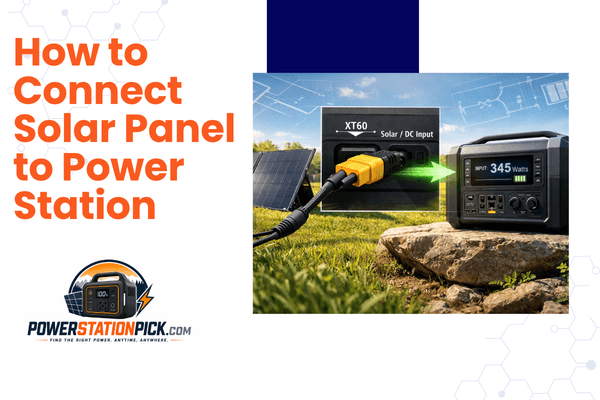
Popularized by EcoFlow and now used by brands like Anker, the XT60 is a high-current, yellow, two-prong plug. It is incredibly secure and can handle significant amperage without overheating.
DC 8mm (7909) and DC5521
These are “barrel” style plugs. Jackery is the most famous brand using the 8mm (DC7909) connector. While simple, they are generally limited to lower wattages (usually under 200W).
Anderson Powerpole
Used primarily in industrial-grade stations and DIY builds (Bluetti often uses these for high-power inputs). They are color-coded (Red/Black) and slide together.
2. Step 1: Matching Voltage and Wattage (The Math)
Before you plug anything in, you must verify that the “output” of the panel doesn’t exceed the “input” capacity of the station.
Check the Voc (Voltage Open Circuit)
On the back of your solar panel, look for the Voc. On your power station, look for the Max Input Voltage.
- The Rule: Panel Voc < Station Max Input Voltage.
- Example: If your panel has a Voc of $24V$ and your station’s input range is $12V-30V$, you are safe. If the panel is $48V$, you will trigger an overvoltage protection error or damage the unit.
Check the Wattage (Input Limit)
If your station has a $200W$ solar input limit and you connect a $400W$ panel, don’t worry—you won’t break it. The station’s MPPT (Maximum Power Point Tracking) controller will simply “clip” the power and only take $200W$.
Not sure how much solar you need? > 👉 Use our Portable Power Station Calculator to determine the ideal panel-to-battery ratio for your setup.
3. Step 2: The Physical Connection
Once you have the correct adapter (e.g., MC4 to XT60), follow these steps:
- Place the panels in the sun: Keep them covered or face-down initially to avoid “hot plugging” (sparking when the connection is made).
- Connect the adapter to the panel cables: Ensure the “clicks” are audible.
- Plug the adapter into the “DC Input” or “Solar Input” port: On your power station.
- Verify the LCD Display: Most modern units will show an “Input Watts” reading within 5–10 seconds as the MPPT controller optimizes the flow.
4. Advanced: Series vs. Parallel (Connecting Multiple Panels)
If one panel isn’t enough, you can link multiple panels together. This is where it gets technical.
Wiring in Series (Voltage Adds Up)
You connect the positive of Panel A to the negative of Panel B.
- Result: If you have two $20V$ panels, the output becomes $40V$.
- Warning: Ensure the total $40V$ is still under your station’s Max Input Voltage.
Wiring in Parallel (Amps Add Up)
You use a Y-branch connector to combine the positives and the negatives.
- Result: The voltage stays at $20V$, but the current (Amps) doubles.
- Best For: Small stations with low voltage limits but high amp capacity.
5. Factors Affecting Your Solar Input
Why is your $200W$ panel only showing $140W$ on the screen? In 2026, solar efficiency typically hovers around 20-23%, but external factors play a huge role:
- The 90-Degree Rule: Your panel should be perfectly perpendicular to the sun. Even a 10-degree tilt away can drop efficiency by 15%.
- The Shadow Effect: On most portable panels, if even a tiny corner is shaded by a tree branch, the output of the entire panel can drop by 50% or more.
- Cable Length: Long DC cables cause “voltage drop.” Try to keep the cable between the panel and the station under 20 feet.
- Temperature: Paradoxically, solar panels work better in cold, sunny weather. Overheating reduces cell efficiency.
❓ FAQ: Solar Connectivity Questions
Q: Can I use a Jackery panel with an EcoFlow station?
A: Yes, but you need an adapter (8mm to XT60). As long as the voltage is within range, solar is universal.
Q: Do I need a separate charge controller?
A: No. Almost all portable power stations in 2026 have a built-in MPPT or PWM charge controller. Connecting an external one will actually stop the system from charging.
Q: Can I charge my station while I’m using it?
A: Yes. This is called Pass-Through Charging. Note that if you are pulling 500W out but only getting 100W of solar in, your battery will still deplete, just slower.
🏆 Final Checklist for a Perfect Connection
- [ ] Verify Voltage: Check the Voc on the panel vs the Input range on the station.
- [ ] Get the Right Adapter: Usually MC4 to [XT60/8mm/Anderson].
- [ ] Clean the Panels: Dust and pollen can reduce output by 10%.
- [ ] Point South: If you are in the Northern Hemisphere, face your panels South for maximum sun exposure.
Ready to find the best panels for your station?
Check out our [Top 5 Portable Solar Panels for 2026] review to see which models offer the best wattage-to-weight ratio!

Hi, I’m Andrew Richards. I created PowerStationPick to share what I’ve learned about portable power through real-world use—what actually works, what doesn’t, and what makes sense for different situations. I focus on helping you choose the right setup for home backup, camping, and everyday needs without overcomplicating things.