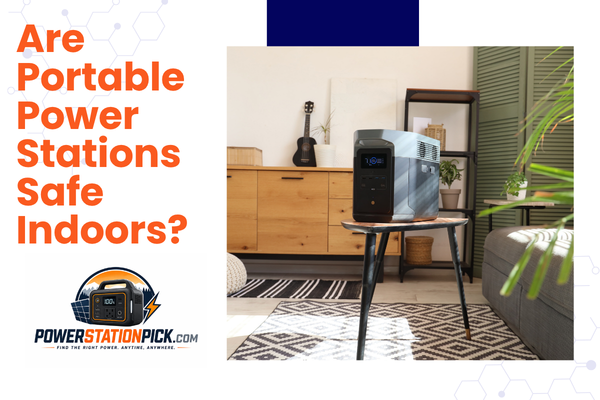
Are Portable Power Stations Safe Indoors? A 2026 Scientific Safety Guide
✅ THE BOTTOM LINE
Yes, portable power stations are 100% safe for indoor use, provided they are manufactured by reputable brands with proper certifications. Unlike gas generators, they produce zero carbon monoxide. However, safety depends on battery chemistry and the internal Battery Management System (BMS).
Introduction: The Misconception of “Indoor Generators”
For decades, the word “generator” was synonymous with danger inside the home. Every year, the Consumer Product Safety Commission (CPSC) warns against using gas-powered generators indoors due to the silent killer: Carbon Monoxide (CO).
However, in 2026, the rise of Portable Power Stations (PPS) has changed the landscape. These devices are technically large-scale lithium batteries, not “generators” in the traditional sense. Because they do not burn fuel, they are fundamentally different. But just because they don’t produce exhaust doesn’t mean they are free of all risks. To answer “Are portable power stations safe indoors?” we must look at the physics of lithium cells and electrical safety standards.
🚫 1. Carbon Monoxide: The Zero-Emission Reality
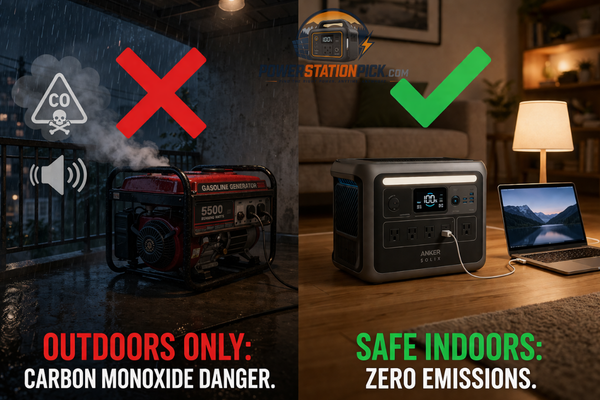
The most significant safety advantage of a portable power station is the absence of an internal combustion engine.
Why Gas Generators Kill
Gas generators burn fossil fuels, releasing $CO$ (Carbon Monoxide). In an enclosed space, $CO$ displaces oxygen in the blood, leading to unconsciousness or death within minutes. According to the CDC, over 400 Americans die annually from unintentional $CO$ poisoning.
Why Power Stations are Different
A portable power station is an electrochemical storage device. It stores electricity in solid-state or liquid-electrolyte battery cells.
- No Exhaust: No chemical combustion occurs.
- No Emissions: They do not release $CO$, $NOx$, or particulate matter.
- Silent Operation: Making them safe for use in bedrooms, nurseries, or offices.
🧪 2. Battery Chemistry: LiFePO4 vs. NMC (The Safety Shift)
Not all portable power stations are built with the same “internal organs.” The safety of your unit indoors depends heavily on the battery chemistry used.
Lithium Nickel Manganese Cobalt (NMC)
Most early power stations (and many budget models today) use NMC batteries—the same type found in smartphones and Teslas.
- Pros: High energy density (lighter weight).
- Risks: Lower thermal stability. If damaged, NMC cells can experience Thermal Runaway at approximately $210°C$ ($410°F$), which can lead to fires that are difficult to extinguish.
Lithium Iron Phosphate (LiFePO4 / LFP)
As of 2026, high-end brands like Anker, EcoFlow, and Bluetti have shifted to LiFePO4.
- Safety: LFP cells are significantly more stable. They can withstand temperatures up to $270°C$ – $300°C$ ($518°F$ – $572°F$) before risking thermal runaway.
- Lifespan: They last 3,000 to 6,000 cycles, making them the gold standard for indoor home backup.
Scientific Fact: LiFePO4 batteries are chemically “colder” and less prone to self-oxygenating fires, making them the only recommended choice for permanent indoor placement.
🛡️ 3. The “Brain” of the System: Battery Management System (BMS)
A power station is only as safe as its BMS. This is an internal computer that monitors the health of every individual cell in real-time. According to OSHA guidelines for energy storage, a robust BMS must protect against:
- Over-Voltage Protection: Prevents the cells from taking too much charge, which can cause swelling.
- Short-Circuit Protection: Shuts the system down instantly if an electrical fault is detected.
- Temperature Monitoring: If the inverter gets too hot while running a refrigerator, the BMS will throttle the power or shut down to prevent fire.
📜 4. Certifications You Must Look For
When using a high-capacity battery indoors, you shouldn’t just trust the marketing. Look for third-party safety certifications that prove the device has been stress-tested in a lab.
- UL 2743: This is the primary standard for portable power stations in the US. It tests for electrical shock, fire risk, and mechanical integrity.
- FCC Class B: Ensures the device doesn’t interfere with your home Wi-Fi or other electronics.
- UN 38.3: Confirms the battery is safe for transport and won’t explode under vibration or impact.
Expert Advice: If a power station on Amazon or a budget site does not list UL 2743 or ETL certification, do not use it inside your home.
⚠️ 5. Potential Indoor Risks (And How to Avoid Them)
While they are generally safe, “safe” doesn’t mean “indestructible.” There are three main ways a portable power station can become a hazard:
A. Heat Accumulation
When a power station converts DC battery power to AC wall power, the inverter generates heat.
- The Danger: Placing the unit on a thick carpet or inside a closed closet can block the cooling fans.
- The Fix: Always place the unit on a flat, hard surface with at least 4 inches of clearance on all sides.
B. Overloading the Inverter
Plugging too many high-draw appliances (like a space heater and a microwave) into a small unit can stress the internal components.
- The Fix: Use a Portable Power Station Calculator to ensure your device’s draw is well within the unit’s “Continuous Watts” rating.
C. Moisture and Water
Lithium and water are a catastrophic mix.
- The Danger: Using a power station in a damp basement or near a leaking pipe can cause an internal short circuit.
- The Fix: Keep the unit in a dry, climate-controlled environment.
🏠 6. Best Practices for Indoor Placement
| Location | Safety Rating | Reason |
| Living Room (Hard Floor) | ⭐⭐⭐⭐⭐ | Excellent ventilation, easy to monitor. |
| Kitchen Counter | ⭐⭐⭐⭐ | Safe, but keep away from the sink/water. |
| Bedroom | ⭐⭐⭐⭐ | Safe (if LFP), but fans might be noisy at night. |
| Closed Closet | ❌ | High risk of overheating; no airflow. |
| Garage (Summer) | ❌ | Excessive heat can degrade the battery cells. |
❓ FAQ: Indoor Safety Questions
Q: Can I sleep in the same room as a running power station?
A: Yes. Unlike gas generators, they are non-toxic. If you are using a LiFePO4 unit, the risk of fire is extremely low.
Q: Can I leave it plugged into the wall 24/7?
A: Yes, most modern units have a “pass-through” or “EPS” mode. The BMS will stop charging once the battery reaches 100%, so there is no risk of overcharging.
Q: What happens if it catches fire?
A: Lithium fires are Class B/C or D. Do not use water. Use a BC Dry Chemical fire extinguisher. However, with a UL-certified LFP unit, this scenario is incredibly rare.
🏆 Summary: How to Stay Safe
To ensure your home and family are protected, follow the PowerStationPick Safety Protocol:
- Buy LiFePO4 (LFP): It is the safest chemistry for indoor use.
- Check for UL 2743: Never buy an uncertified “no-name” brand.
- Provide Airflow: Don’t smother the unit with blankets or hide it in a drawer.
- Monitor Your Loads: Don’t exceed the rated capacity.
Portable power stations are the future of home emergency readiness. By choosing a quality unit and respecting the basic laws of thermodynamics, you can enjoy clean, silent, and safe power right in your living room.
Authored by the PowerStationPick Editorial Team.
Updated: April 2026.
References: National Fire Protection Association (NFPA) 855, CPSC Generator Safety Guidelines, UL 2743 Safety Standards.

Hi, I’m Andrew Richards. I created PowerStationPick to share what I’ve learned about portable power through real-world use—what actually works, what doesn’t, and what makes sense for different situations. I focus on helping you choose the right setup for home backup, camping, and everyday needs without overcomplicating things.