How Long Does a Power Station Hold Charge When Not in Use?
Quick Answer: How Long Does a Power Station Hold Charge When Not in Use?
Here’s a concise overview for those who want a direct answer:
- LiFePO4 (Lithium Iron Phosphate) power stations lose roughly 1–3% of their charge per month during storage. A fully charged unit can sit for 6–12 months and still retain 80–90% capacity if stored properly.
- Standard lithium-ion (NMC/NCM) power stations lose approximately 2–5% per month. Expect to recharge every 3–6 months for optimal battery health.
- Lead-acid based portable power stations are the worst performers, losing 5–15% monthly and often requiring a recharge every 1–2 months.
You bought a portable power station for emergencies, camping trips, or the occasional RV weekend—and now it’s been sitting in a closet for three months. You plug it in to check, and it’s half empty. Or worse, completely dead. Sound familiar?
This is one of the most common frustrations power station owners run into. The device worked fine when you bought it, but somewhere between then and now, the battery quietly drained itself with zero help from you.
Understanding how long a power station holds charge when not in use isn’t just a technical curiosity. It’s genuinely important if you’re relying on one for emergency backup power, storm prep, or extended outdoor adventures where you can’t afford a surprise dead battery.
The short answer is that all batteries self-discharge over time—some slowly, some faster than you’d expect. What separates a good power station from a frustrating one is often how gracefully it handles those quiet weeks or months between uses.
Let’s break down exactly what’s happening inside your unit, how different battery types compare, and what you can do to maximize storage life.
Why Power Stations Lose Charge Even When Turned Off
Turning a power station “off” doesn’t mean the battery goes completely idle. Several things are still happening inside.
Self-Discharge
Every battery chemistry known to science has some level of internal chemical reaction that continues regardless of external use. Electrons slowly migrate across internal boundaries, and over time, that movement costs capacity. It’s an inherent property of how electrochemical cells work—there’s no way to fully stop it.
The Battery Management System (BMS)
Nearly every modern portable power station includes a BMS—a circuit board that monitors cell voltage, temperature, and balance. Even in standby mode, this system draws a small continuous current to stay active. It’s usually a tiny draw (often less than 1–5 milliwatts), but over months, it adds up. Some manufacturers design their BMS to enter a deep sleep mode during extended storage, which helps noticeably.
Internal Electronics
Beyond the BMS, many power stations keep display circuits, Bluetooth modules, or protection electronics in a low-power ready state. These phantom loads are small, but they’re real. A unit with a fancy color display that stays active in standby will drain faster than a simpler model with a hard off switch.
Temperature Impact
Heat accelerates chemical reactions inside a battery—including the ones responsible for self-discharge. A power station stored in a hot garage in summer will lose charge noticeably faster than one kept in a climate-controlled room. Cold temperatures slow self-discharge but can temporarily reduce apparent capacity and stress certain battery types if they’re too cold during charging.
How Long Different Battery Types Hold Charge
LiFePO4 Power Stations
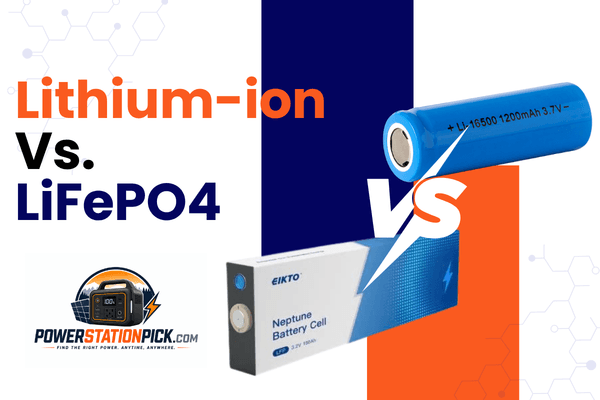
LiFePO4 is currently the best available chemistry for long-term power station storage. The chemistry is inherently more stable than standard lithium-ion, and its flat discharge curve means it loses charge slowly and predictably.
Real-world monthly self-discharge for LiFePO4 units falls between 1% and 3%. At that rate, a unit stored at 80% charge in September could realistically still show 65–75% in March. Brands that use LiFePO4 also tend to invest in better BMS hardware, which further reduces standby drain.
LiFePO4 cells also tolerate partial-state-of-charge storage much better than other chemistries. You don’t need to store them at exactly 50%—anywhere between 40–80% is fine for extended periods.
Long-term, these batteries degrade more slowly. A LiFePO4 pack might rate for 2,000–3,500 charge cycles, meaning years of regular use before you notice meaningful capacity loss.
Lithium-Ion Power Stations (NMC/NCM)
Standard lithium-ion—the chemistry in most older and budget power stations—self-discharges at roughly 2–5% per month under normal storage conditions. That’s not catastrophic, but it does mean that after six months in a closet, a unit that was at 80% might now be at 50–65%.
The bigger concern with lithium-ion is how storage state of charge affects long-term degradation. Sitting fully charged (100%) for weeks at a time stresses the cells more than LiFePO4. Conversely, deep discharge (dropping below 10–15%) can cause irreversible capacity loss with standard lithium-ion.
For lithium-ion units, storing at around 50–60% before a long idle period is the sweet spot.
Lead-Acid Battery Power Stations
True lead-acid portable power stations have become less common in the consumer market, but they still exist in some older models and lower-cost emergency backup setups.
Lead-acid batteries are the worst performers for storage by a significant margin. Monthly self-discharge can reach 5–15%, and if a lead-acid battery drops too low, it can develop a phenomenon called sulfation—where lead sulfate crystals form on the plates and permanently reduce capacity. A sulfated battery often can’t be recovered to its original state.
These units typically need a maintenance charge every 4–8 weeks. If you forget for three months, you may not get the runtime you expect when you actually need the unit.
Average Self-Discharge Rates by Battery Type
| Battery Type | Monthly Charge Loss | Recommended Recharge Interval | Expected Storage Duration |
|---|---|---|---|
| LiFePO4 | 1–3% | Every 6 months | 6–12 months between charges |
| Lithium-Ion (NMC/NCM) | 2–5% | Every 3–4 months | 3–6 months between charges |
| Lead-Acid | 5–15% | Every 4–8 weeks | 1–2 months between charges |
Storage duration assumes unit is kept at recommended temperature (60–77°F / 15–25°C) and stored at an appropriate charge level.
Factors That Affect How Long a Power Station Holds Charge
Storage Temperature
This is the single biggest variable outside of battery chemistry. Every 10°C increase in temperature can roughly double the rate of chemical reactions inside a cell—including self-discharge. A power station stored in a car trunk during a hot summer is degrading far faster than one sitting on a basement shelf.
Ideal storage temperature for most lithium-based units is between 60–77°F (15–25°C). Avoid garages, sheds, or car trunks in climates with extreme temperatures.
Humidity
Moisture doesn’t directly cause self-discharge, but it can cause corrosion on terminals and connectors over time. High humidity combined with high temperature is a particularly bad combination. If you’re storing a unit in a basement or garage, consider a sealed bag or a dry storage container.
Battery Age
As a battery ages and goes through charge cycles, its internal resistance increases. Higher internal resistance means a greater tendency to self-discharge. A three-year-old power station with 400 cycles on it will drain faster in storage than the same model when new.
State of Charge Before Storage
Storing at extreme states—either fully charged at 100% or fully depleted at 0%—accelerates long-term degradation. For lithium-ion, the optimal storage charge is around 40–60%. For LiFePO4, anywhere in the 40–80% range works well.
Brand Design and BMS Quality
Not all BMS hardware is created equal. Premium brands invest in BMS systems that intelligently reduce standby power consumption during idle periods. Some units have a dedicated storage mode activated from the app or a button that cuts phantom loads and optimizes cell voltage for long-term sitting.
Internal Power Consumption
Units with active displays, Wi-Fi, or Bluetooth running continuously in standby will drain faster. If your power station has an app-connected BMS or a screen that never fully powers down, factor that in.
How to Store a Portable Power Station Properly
Good storage habits extend both the charge retained and the long-term health of the battery. Here’s a practical step-by-step approach:
Step 1: Charge to the right level before storage. For lithium-ion units, aim for 50–60%. For LiFePO4, 60–80% is comfortable. Avoid storing either type at 100% for extended periods, and never store at 0%.
Step 2: Turn it completely off. Many units have a physical power button separate from the outlet switches. Use it. This cuts the BMS and display into its lowest power state. If your unit has a dedicated “storage mode” in the app, enable it.
Step 3: Choose a cool, dry location. A closet inside your home is ideal. Avoid garages, basements with humidity issues, and anywhere that sees significant temperature swings. Target 60–77°F.
Step 4: Set a calendar reminder. Decide on your recharge interval based on battery type—every 3 months for lithium-ion, every 6 months for LiFePO4—and actually schedule it. It takes 5 minutes to check the charge level and top it off if needed.
Step 5: Before each use after storage, do a quick charge cycle. Even if the unit shows 60%, run it through a full charge before an important use like a camping trip or storm prep. This re-balances the cells and gives you an accurate sense of remaining capacity.
What Happens If a Power Station Sits Too Long Without Charging?
The consequences range from inconvenient to permanent, depending on chemistry and how long the unit was neglected.
Deep Discharge
If a battery drops below a critical voltage threshold—usually around 2.5–2.7V per cell for lithium-based chemistries—the BMS may lock the battery in a protection state. The unit won’t turn on, won’t charge, and appears completely dead. Some units can be recovered with a slow “trickle” charge or a reset procedure, but it’s not guaranteed.
Capacity Loss
Even before hitting protection cutoff, spending extended time at very low state of charge causes lithium plating and electrolyte degradation inside lithium-ion cells. Each time a lithium-ion battery sits deeply discharged, you lose a small percentage of total capacity that you’ll never get back.
Permanent Damage
Lead-acid batteries that deep discharge completely and sit that way can suffer irreversible sulfation. Lithium-ion units left at 0% for months may lose 10–20% of their original capacity permanently. LiFePO4 is more tolerant but still not immune.
The practical takeaway: if you found a power station completely dead after a long storage period, try charging it immediately. Don’t assume it’s ruined. But don’t let it happen again.
How Often Should You Recharge a Stored Power Station?
The right interval depends on your use case and battery chemistry.
LiFePO4 units: Recharge every 6 months. These batteries are stable enough that a twice-yearly maintenance charge is sufficient for most storage scenarios. If you live in a hot climate, consider every 4 months.
Lithium-ion (NMC/NCM) units: Recharge every 3 months. Mark it on a calendar. This keeps the battery in its healthy operating range and prevents deep discharge from quietly happening.
Emergency backup power stations: These deserve a quarterly check regardless of chemistry, since the whole point is having a reliable charge when you actually need it. Every 3 months, check the level and top off to 60–80%.
Seasonal users (camping, RV): Before putting it away at the end of the season, charge to 60%, enable storage mode if available, and set a reminder for the middle of winter to do a quick check. Before the next season, run a full charge cycle.
Real-World Examples From Popular Brands
Jackery
Jackery’s lineup—including the Explorer series—predominantly uses lithium-ion NMC chemistry in older models and has transitioned some newer units toward LiFePO4. Their general storage guidance aligns with industry norms: store at 30–80% in a cool environment, and recharge every 3 months for NMC units. Users who leave Jackery units in the garage over winter typically report significant charge loss by spring.
EcoFlow
EcoFlow has been aggressive about adopting LiFePO4 across its Delta Pro and Delta 2 lines. Their delta series units include an X-Stream fast-charging system, but the more relevant feature for storage is their BMS optimization in standby. EcoFlow units with LiFePO4 chemistry tend to hold charge well during storage, and many users report losing only a few percent over 4–5 months under good conditions.
Bluetti
Bluetti has made LiFePO4 a centerpiece of its marketing, offering it across its AC and EB series. Their cells typically carry 3,000+ cycle ratings, and the chemistry backs up their storage performance claims. Bluetti units stored at 60–70% in mild conditions can easily last 6 months without a meaningful voltage drop.
Anker SOLIX
The SOLIX line uses LiFePO4 chemistry with a well-engineered BMS. Anker’s reputation for electronics quality extends to their power stations, and their BMS tends to have lower standby current draw than some competitors, which benefits long-term storage.
Goal Zero
Goal Zero’s older Yeti lineup used lithium-ion NMC, though newer models have shifted. Their storage guidance has historically recommended a recharge every 3 months, which aligns with what NMC chemistry actually needs. Users who neglect this often find their Yeti units showing noticeable capacity degradation after a year or two of irregular storage habits.
Best Power Stations for Long-Term Storage
If long-term charge retention is a priority, these are strong options currently available:
EcoFlow Delta 2
- Battery type: LiFePO4
- Storage advantage: 1–2% monthly self-discharge, excellent BMS optimization
- Expected charge retention: 80%+ after 6 months stored correctly
- Ideal for: Home emergency backup, RV owners who winterize
Bluetti AC200L
- Battery type: LiFePO4
- Storage advantage: High-capacity unit with stable chemistry and low standby draw
- Expected charge retention: Solid 6-month storage without top-off
- Ideal for: Serious emergency prep, off-grid use with solar
Anker SOLIX C800
- Battery type: LiFePO4
- Storage advantage: Compact form factor with smart BMS reducing standby drain
- Expected charge retention: 85%+ over 4–5 months in good conditions
- Ideal for: Campers, van life, weekend adventurers
Jackery Explorer 1000 Plus
- Battery type: LiFePO4
- Storage advantage: Jackery’s move to LiFePO4 in newer units dramatically improved storage performance over older NMC models
- Expected charge retention: 80%+ at 6 months
- Ideal for: Camping, tailgating, light emergency backup
Goal Zero Yeti 1500X
- Battery type: Lithium-ion (NMC)
- Storage advantage: Robust BMS with app monitoring for charge level tracking
- Expected charge retention: 60–70% after 4–5 months (lithium-ion limitation)
- Ideal for: Users who will actively manage and maintain charge levels
Common Mistakes That Reduce Battery Life During Storage
Storing at 0% or near-empty. This is the fastest way to cause permanent capacity loss or trigger BMS protection lockout. Never put a unit away depleted.
Leaving it in a hot vehicle or garage. Summer temperatures in a closed car or garage can reach 130–150°F. That’s genuinely damaging to lithium cells and accelerates degradation dramatically.
Storing at 100% for extended periods. Full charge keeps lithium cells under maximum stress. For storage longer than a week or two, drop to 60–80%.
Ignoring the maintenance charge schedule. Setting a reminder takes 30 seconds. Forgetting and finding a dead unit before a hurricane doesn’t.
Not turning the unit completely off. Leaving a power station in standby with the display active can drain it 2–3x faster than full off mode.
Using the wrong charger for reconditioning. If you find a deeply discharged unit, charging it slowly with a lower-wattage input gives the BMS time to recover. Blasting it at maximum input sometimes triggers protection faults.
Assuming it’s fine because it “looks” charged. Voltage sag under load means a unit that shows 30% on the display might deliver only 15% of its rated output. Verify with an actual test before a critical trip.
Frequently Asked Questions
Does a power station lose charge when turned off? Yes. All batteries self-discharge over time, and most power stations draw a small amount of power from their battery management systems and internal electronics even in standby. The rate depends on battery chemistry—LiFePO4 units lose charge more slowly than standard lithium-ion.
How long can a Jackery sit unused? Older Jackery Explorer units with NMC lithium-ion batteries should ideally be recharged every 3 months. Newer Jackery models using LiFePO4 can safely go 5–6 months between charges. Always store at 50–80%, not fully charged or depleted.
Is LiFePO4 better for storage? Yes, significantly. LiFePO4 has a lower self-discharge rate (1–3% monthly vs. 2–5% for NMC), tolerates partial state-of-charge storage better, and degrades more slowly over time. If long-term storage is your primary concern, LiFePO4 is the right choice.
Can a power station be overcharged? Modern power stations have BMS protection that stops charging at 100%. However, leaving a unit plugged in continuously at 100% for extended periods—especially in warm conditions—does stress lithium cells over time. Disconnect once charged, and don’t use a power station as a permanent wall plug replacement without monitoring temperature.
Should I leave my power station plugged in? For short-term use (several days), it’s generally fine. For long-term storage, no. Unplug once charged, set the unit to storage mode if available, and store at 60–80% rather than constantly at 100%.
What’s the ideal storage temperature for a power station? Between 60°F and 77°F (15–25°C) is ideal for most lithium-based units. Avoid temperature extremes in either direction. Moderate cold temporarily reduces apparent capacity but doesn’t usually cause permanent damage. Sustained heat above 95°F (35°C) causes cumulative chemical degradation.
How do I know if my power station battery is degrading? Signs include shorter runtime than when new despite a full charge, the charge level dropping faster than expected during storage, and the unit taking longer or shorter to fully charge than it used to. Some brands include a cycle count or health indicator in their companion apps.
Can I store a power station in a garage? It depends on your climate. A temperature-controlled garage is fine. An uninsulated garage in a hot or cold climate is not ideal. If your garage regularly exceeds 90°F in summer or drops below freezing in winter, store the unit indoors instead.
What happens if a power station completely drains during storage? Depending on the chemistry, you may encounter a BMS protection lockout where the unit won’t turn on or charge normally. Try plugging it into a low-wattage charger for 30–60 minutes before attempting a fast charge. If it fails to respond at all, contact the manufacturer—some units have reset procedures. Prevent this by scheduling regular maintenance charges.
Does solar charging help maintain a power station in storage? If you connect a solar panel to a stored unit, it can help offset self-discharge and keep the battery topped up. This is actually a good long-term storage strategy for units kept in locations with reliable sunlight access, like a garage with a window or a shed with a rooftop panel.
Final Verdict
Here’s the honest summary: most portable power stations will hold charge for 3–12 months without being plugged in, but the range is wide and depends heavily on battery chemistry, storage conditions, and brand quality.
LiFePO4 units are the clear winner for storage. They lose charge slowly, tolerate storage at partial charge levels, and degrade more gradually over time. If you’re buying a power station primarily for emergency backup or infrequent camping use, LiFePO4 is worth paying a premium for.
Lithium-ion (NMC/NCM) units aren’t bad—they’re just more demanding. Check them every 3 months, store at 50–60%, and keep them in a cool, dry place. Treat them right and they’ll perform reliably for years.
Lead-acid units require the most attention and deliver the worst storage performance. Unless you have a compelling reason to use one, the modern lithium options are simply better in every practical sense.
Key takeaways:
- Store at 40–80% charge, never at 0% or 100% for extended periods
- Keep units in a climate-controlled space, ideally 60–77°F
- Recharge every 3 months (lithium-ion) or every 6 months (LiFePO4)
- Enable storage mode if your unit supports it
- Don’t trust a stored battery without a quick capacity check before relying on it in the field
A little attention twice a year is all most power stations need to stay ready when you actually need them.
Published on PowerStationPick.com — your source for honest, in-depth portable power station reviews and buying guides.

Hi, I’m Andrew Richards. I created PowerStationPick to share what I’ve learned about portable power through real-world use—what actually works, what doesn’t, and what makes sense for different situations. I focus on helping you choose the right setup for home backup, camping, and everyday needs without overcomplicating things.