How Many Charge Cycles Does a Power Station Last?
Quick Summary: How Long Will It Last?
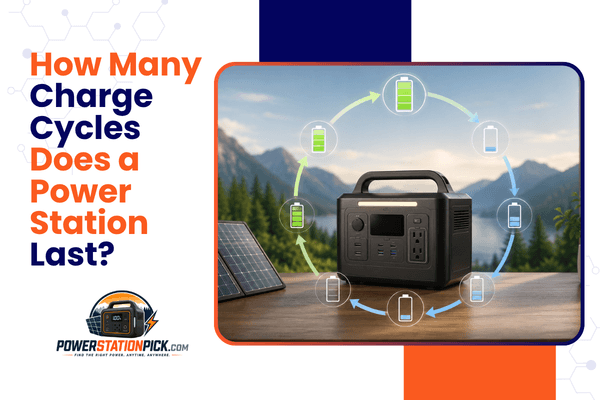
The lifespan of a portable power station is measured in charge cycles. In 2026, longevity depends entirely on the internal battery chemistry:
- LiFePO4 (LFP) Batteries: Last 3,000 to 4,000+ cycles (approx. 10–15 years of daily use) before degrading to 80% capacity.
- Standard Lithium-Ion (NMC) Batteries: Last 500 to 800 cycles (approx. 2–4 years of daily use) before degrading to 80% capacity.
When you invest anywhere from $300 to over $3,000 in a portable power station, you are essentially buying a miniature, off-grid utility company. But unlike a gas generator that can theoretically run forever with enough maintenance and fuel, lithium batteries have a biological clock. Eventually, every battery degrades.
If you are researching a solar generator for RV living, home backup, or weekend camping, the most critical specification isn’t just the wattage output—it is the power station battery lifespan.
Today, the difference between a high-quality unit and a budget knock-off isn’t just how many devices it can charge; it’s whether the unit will last for 3 years or 15 years. If you are wondering how long do portable power stations last, the answer is entirely dependent on battery chemistry and charge cycles.
In this comprehensive guide by PowerStationPick, we are going to break down exactly what charge cycles are, the reality of LiFePO4 vs lithium ion cycle life, and how you can dramatically extend the lifespan of your off-grid energy investment.
1. What Is a Charge Cycle?
Before we look at the lifespan of specific models, we need to understand the math behind a charge cycle. Manufacturers use this term constantly, but it is often misunderstood by consumers.
A charge cycle is defined as one complete 100% discharge and one complete 100% recharge of the battery.
However, this does not mean you have to drain the battery from 100% down to 0% in a single sitting to equal one cycle. Charge cycles are cumulative.
Partial Cycles vs. Full Cycles
Imagine you are boondocking in your camper van:
- Day 1: You use 25% of your battery to run a CPAP machine and a mini-fridge overnight. The next morning, your solar panels charge it back up to 100%.
- Day 2: You use another 25% and recharge it again.
- Day 3: You use 25% and recharge it.
- Day 4: You use 25% and recharge it.
You have plugged and unplugged the machine four times, but you have only consumed one total charge cycle (25% + 25% + 25% + 25% = 100%).
Why Cycle Count Matters More Than Years
Time alone does not kill high-quality lithium batteries; usage does. If you buy a power station and keep it in your closet for emergency hurricane prep, using it only twice a year, a 500-cycle battery could theoretically last you 250 years. Therefore, measuring portable power station lifespan in “years” is highly subjective. Cycle count is the only true, objective metric of a battery’s endurance.
2. Average Charge Cycles by Battery Type
In the modern power station market, there is a massive shift happening behind the plastic casings. If you buy a unit today, it will likely feature one of two lithium chemistries.
Understanding the difference between them is the single most important buying decision you will make.
Comparison Table: Battery Chemistries
| Battery Chemistry | Average Charge Cycles (to 80%) | Estimated Lifespan (Daily Use) | Heat & Safety Profile | Common 2026 Brands Using This |
|---|---|---|---|---|
| LiFePO4 (Lithium Iron Phosphate / LFP) | 3,000 – 4,000+ Cycles | 10 – 15+ Years | Ultra-safe, highly resistant to thermal runaway. | Bluetti, EcoFlow, Anker, Jackery (Plus Series), Pecron |
| NMC/NCA (Standard Lithium-Ion) | 500 – 800 Cycles | 2 – 4 Years | Higher energy density, but prone to overheating if stressed. | Older Jackery models, older Goal Zero, budget Amazon brands |
| Lead-Acid / AGM | 200 – 300 Cycles | 1 – 2 Years | Heavy, cheap, requires ventilation. | DIY setups, legacy RV house batteries |
Note: The “to 80%” metric means that after the stated number of cycles, the battery will still hold 80% of its original out-of-the-box capacity.
3. How Long Do Portable Power Stations Really Last?
When translating charge cycles into a real-world timeline, you have to look at your personal use case. How long do portable power stations last in the field?
Scenario A: The Full-Time RV / Van Lifer (Daily Use)
If you live off-grid and cycle your battery deeply every single day (running induction cooktops, laptops, and refrigerators), you are putting maximum strain on the system.
- With an older 500-cycle NMC unit, you will notice significant capacity loss within 1.5 to 2 years.
- With a modern 3,000-cycle LiFePO4 unit, it will take roughly 8.2 years of continuous, grueling daily use before the battery degrades to 80%.
Scenario B: The Weekend Camper (Occasional Use)
If you take your power station out for weekend camping trips 15 times a year, you are barely scratching the surface of its cycle life. In this scenario, a LiFePO4 battery will easily outlast the physical plastic casing, the AC inverter, and the LCD screen. You can expect 15+ years of reliable service.
Inverter Wear and Component Aging
It is vital to remember that a portable power station is more than just a battery. It contains a complex Battery Management System (BMS), a Pure Sine Wave AC inverter, LCD screens, and cooling fans. Even if your battery cells are rated for 3,500 cycles, the internal fans or motherboard could fail after a decade of rough use in dusty campsites.
4. LiFePO4 vs Lithium-Ion: Which Lasts Longer?
The debate over LiFePO4 vs lithium ion cycle life is effectively over. LiFePO4 (Lithium Iron Phosphate) is the undisputed king of longevity. But why?
Standard Lithium-Ion (NMC – Nickel Manganese Cobalt) batteries are the exact same batteries used in your smartphone and Tesla. They are prized because they are incredibly lightweight and energy-dense. However, their chemical bonds degrade faster under the stress of charging and discharging.
LiFePO4 cells use an iron-phosphate molecular bond that is exponentially more stable.
1. Cycle Life Dominance
An NMC power station degrades after 500 charge cycles. A comparable LFP power station degrades after 3,000 cycles. That is a 600% increase in lifespan for roughly the same price tag.
2. The Safety Factor (Thermal Runaway)
Because LFP cells are chemically stable, they are nearly impossible to ignite. If an NMC battery is punctured or heavily overcharged, it can enter “thermal runaway”—a self-sustaining chemical fire. LFP batteries can be pierced with a nail and will simply smoke and die peacefully. For an RV owner sleeping three feet away from a massive battery bank, LFP is the only responsible choice.
3. The Weight Trade-off
The only area where NMC wins is portability. Because LiFePO4 is less energy-dense, LFP power stations are generally 15% to 20% heavier than their NMC counterparts. If you are backpacking, an ultra-light NMC battery makes sense. If you are keeping the unit in a truck or home, weight is irrelevant—longevity wins.
5. What Happens After Maximum Charge Cycles?
A common misconception is that once you hit the 3,000th charge cycle, the power station suddenly dies or refuses to turn on.
This is false. Battery degradation in portable power stations is a slow, gradual fading process, much like an aging smartphone that doesn’t quite hold a charge until the end of the day.
The 80% Capacity Benchmark
The industry standard for rating cycle life is the “80% retention” benchmark.
If you purchase a massive 2,000Wh (Watt-hour) portable power station rated for 3,000 cycles, here is what happens:
- Cycles 1 to 2,999: You have roughly 2,000Wh of usable power.
- Cycle 3,000+: The chemical degradation means the battery can now only physically hold 80% of its original energy.
- The Reality: Your 2,000Wh power station is now effectively a 1,600Wh power station.
It will still power your microwave. It will still run your CPAP machine. The AC inverter still outputs the exact same wattage. It will simply run out of juice 20% faster than it did when you first bought it. It is entirely safe to continue using a degraded power station for years after it hits its cycle threshold.
6. Factors That Reduce Power Station Battery Life
While cycle counts are baked into the chemistry, your daily habits can drastically accelerate battery degradation. If you want to protect your solar generator battery lifespan, avoid these power station killers:
- Extreme Heat: Heat is the ultimate enemy of lithium. Operating or charging a power station in an environment over 105°F (40°C) causes internal resistance to spike, cooking the cells. Never leave your power station charging inside a locked, unventilated car on a summer day.
- Deep Discharging (The 0% Trap): Constantly draining your battery until the screen goes black stresses the internal cells. While the BMS has built-in protections, routinely hitting 0% will shave hundreds of cycles off your lifespan over time.
- Constant 100% Saturation: Leaving a power station plugged into the wall at 100% for months on end keeps the battery cells at maximum voltage stress.
- Extreme Cold Charging: While you can discharge a power station in freezing temperatures, charging a lithium battery below 32°F (0°C) causes “lithium plating,” which permanently destroys the battery capacity in a single stroke. Fortunately, premium brands in 2026 have thermal sensors that prevent charging in freezing temps.
7. How to Extend the Lifespan of a Portable Power Station
If you want to ensure your investment lasts well over a decade, follow these expert maintenance tips:
- The 20-80 Rule: The secret to maximum longevity is shallow cycling. Try to start recharging your unit when it hits 20%, and unplug it when it hits 80%. This avoids the highest stress points of the battery’s voltage curve.
- Proper Long-Term Storage: If you are putting the unit away for the winter, do not store it empty or totally full. Discharge it to roughly 50% to 60%, turn off the main power button, and store it in a cool, dry room indoors.
- Bi-Annual Calibrations: Every 3 to 6 months, take the unit out of the closet, charge it to 100%, and run it down to about 10%. This allows the BMS (Battery Management System) to recalibrate its sensors so your percentage display remains accurate.
- Use Standard Charging: Many modern units offer “Ultra-Fast AC Charging” (0-100% in 45 minutes). While convenient, pushing 1,500W into a battery generates massive heat. When you are not in a rush, use the app to set the charging speed to “Slow” or “Standard” to preserve cell health.
8. Which Portable Power Stations Last the Longest?
To achieve maximum portable power station lifespan, you must look at brands that have perfected both LiFePO4 cell integration and their proprietary Battery Management Systems.
Here is how the landscape looks in 2026:
Bluetti (The Longevity Pioneer)
- Bluetti cycle life is legendary. They were one of the first major brands to abandon NMC chemistry entirely in favor of LFP.
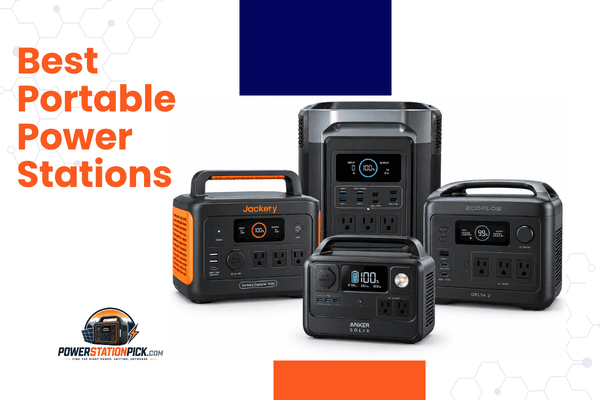
- Top Pick: The Bluetti AC180 or AC200L. Both offer premium LFP cells rated for 3,500+ cycles, making them the best long-lasting portable power stations for RV users.
EcoFlow (The Tech Innovator)
- EcoFlow battery lifespan used to trail behind because their earlier models used NMC. Today, their entire Delta and River lineups feature LFP cells rated for 3,000 cycles.
- Top Pick: The EcoFlow Delta 3 Plus. It combines ultra-fast charging with high-grade LFP cells and a 5-year warranty, making it ideal for home emergency backup.
Anker (The Durability Expert)
- Anker uses a proprietary system called InfiniPower™, which pairs EV-grade LFP batteries with drop-proof unibody designs and industrial-grade electronics.
- Top Pick: The Anker SOLIX C1000 or F3800. Anker rates these for an incredible 10-year lifespan and backs them with exceptional warranties.
Jackery (The Legacy Brand Catching Up)
- Historically, Jackery battery cycles were limited to 500 because they stubbornly stuck to lightweight NMC cells. With the release of their “Plus” series (Explorer 1000 Plus, 2000 Plus), they have finally transitioned to LiFePO4, boasting 4,000 charge cycles.
9. Are Expensive Power Stations Worth It?
When you browse Amazon, you will see “no-name” generic power stations selling for half the price of an EcoFlow or Bluetti. Are the premium brands worth the money?
The answer is found in Cost Per Cycle.
Let’s do the math on two hypothetical 1000Wh power stations:
- Budget NMC Power Station ($600): Rated for 500 cycles.
- $600 / 500 cycles = $1.20 per charge cycle.
- Premium LFP Power Station ($800): Rated for 3,000 cycles.
- $800 / 3000 cycles = $0.26 per charge cycle.
While the premium LFP station costs $200 more upfront, it is nearly five times cheaper to operate over its lifetime.
Furthermore, premium power stations come with 5-year warranties, intelligent smartphone apps for managing charge rates, and superior customer service networks. When buying off-grid power, purchasing cheap usually means purchasing twice.
10. FAQ Section
Is 500 cycles good for a power station?
In 2026, no. 500 cycles indicates older Lithium-Ion (NMC) battery technology. While acceptable for a lightweight hiking battery, any mid-to-large power station for home or RV use should feature LiFePO4 chemistry and offer at least 3,000 cycles.
How many years will a power station last?
A high-quality LiFePO4 power station will last roughly 10 to 15 years with daily use before degrading to 80% of its original capacity. With occasional weekend camping use, the battery can easily last 15 to 20 years.
Does leaving a power station plugged in damage it?
Yes, leaving a power station plugged into the wall at 100% capacity continuously stresses the battery cells. Unless your specific unit has a built-in “UPS Bypass” mode that directly routes wall power to your appliances without passing through the battery, it is best to unplug it once fully charged.
Is LiFePO4 really better?
Yes. LiFePO4 (Lithium Iron Phosphate) offers up to 6 times the cycle life of standard lithium-ion, is vastly safer regarding fire hazards, and can operate in wider temperature ranges. Its only drawback is being slightly heavier.
Which power station brand lasts longest?
Brands that exclusively utilize high-tier LiFePO4 cells and advanced thermal management systems last the longest. Bluetti, Anker (SOLIX line), and EcoFlow (Delta 3/Pro lines) are currently the industry leaders in long-term battery endurance.
Can you replace portable power station batteries?
Generally, no. Most portable power stations are built as sealed, all-in-one units. Opening them voids the warranty and exposes you to high-voltage danger. The exception is modular systems (like Goal Zero Yeti PRO or modular EcoFlow/Bluetti setups) where you can buy expansion batteries to replace older ones.
At what percentage should I store my power station?
You should store your portable power station at approximately 50% to 60% battery capacity in a cool, dry environment (ideally between 50°F and 70°F). Storing it at 0% or 100% will cause permanent chemical degradation.
Does using AC power degrade the battery faster than DC power?
Technically, yes. Using the AC wall outlets on your power station requires turning on the internal inverter, which wastes about 10–15% of the battery’s energy as heat. This heat puts slight thermal stress on the unit and requires you to charge the battery more frequently, consuming cycles faster than using the highly efficient DC/USB ports.
Can I charge my power station while using it?
Yes, this is called “pass-through charging.” Modern power stations are designed to allow you to run solar panels into the input while running appliances out of the output.
Why did my battery drain while turned off?
All lithium batteries suffer from “self-discharge,” usually losing 1% to 3% of their charge per month just sitting there. Additionally, if you forget to turn off the AC inverter button, the inverter will stay active and drain the battery completely dead in a matter of days, even if nothing is plugged in.
Final Thoughts
When evaluating the best long lasting portable power station for your needs, always flip straight to the “Specifications” tab and look for the magic acronym: LiFePO4 (LFP). By choosing the right chemistry and practicing shallow charging habits, your off-grid power supply will reliably keep the lights on for the next decade.

Hi, I’m Andrew Richards. I created PowerStationPick to share what I’ve learned about portable power through real-world use—what actually works, what doesn’t, and what makes sense for different situations. I focus on helping you choose the right setup for home backup, camping, and everyday needs without overcomplicating things.