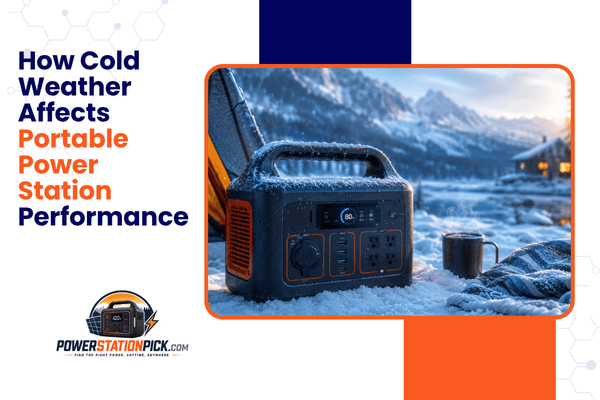
How Cold Weather Affects Portable Power Station Performance (And What to Do About It)
Pull a portable power station out of your truck bed on a 15°F January morning, switch it on, and you might notice something unsettling: the battery level looks right, but your devices are pulling down the percentage far faster than they should. You start running the numbers. The unit claims 1,000Wh. You’re running a 100W load. Simple math says you should get 8–10 hours. You’re getting maybe five.
Nothing is broken. Your power station is responding exactly as lithium chemistry predicts at low temperatures—and once you understand why, you’ll know exactly how to work with it rather than against it.
Cold weather is one of the most misunderstood variables in portable power use. It affects how much usable energy a battery can actually deliver, how the battery behaves under load, and critically, whether charging the unit is even safe. These aren’t edge cases or rare failures. They’re the expected, predictable behavior of electrochemical systems in low-temperature environments—and every serious power station user should understand them.
This guide covers the full picture: the science behind cold-weather performance loss, which battery chemistries handle low temperatures best, what happens if you try to charge in freezing conditions, how to protect your unit during winter use and storage, and practical strategies for getting reliable power even when it’s cold outside.
❄️ Quick Answer: How Does Cold Weather Affect a Power Station?
Here’s the short version for anyone who needs a fast reference:
- Electrochemical Slowdown: Cold temperatures slow the electrochemical reactions inside a battery. This increases internal resistance and reduces the amount of energy the battery can deliver at any given moment.
- Temporary Capacity Loss: Capacity loss in the cold is largely temporary. A battery that shows reduced runtime at 10°F will generally return to near-normal performance once it warms back up. The energy isn’t destroyed—it’s temporarily inaccessible.
- Sub-Freezing Charging Hazards: Charging lithium batteries below 32°F (0°C) can cause permanent damage. Lithium plating—a specific failure mode where metallic lithium deposits on the anode—can occur when charging at sub-freezing temperatures. Good BMS hardware will prevent charging in these conditions.
- Safer to Discharge: Discharging in cold weather is significantly less risky than charging in cold weather, though performance will be reduced.
- Chemistry Baseline: LiFePO4 batteries generally handle cold temperatures better than NMC lithium-ion, but they share the same low-temperature charging restrictions.
The Science: Why Cold Weather Reduces Battery Performance
Electrochemical Reactions Slow Down in the Cold
A lithium battery stores and releases energy through electrochemical reactions: lithium ions shuttle between the anode and cathode through an electrolyte as the battery charges and discharges. Like nearly all chemical processes, these reactions are temperature-dependent. Lower temperatures mean less molecular kinetic energy, which means slower ion migration through the electrolyte.
This relationship follows the Arrhenius equation, a fundamental principle in chemistry describing how reaction rates scale with temperature. The practical implication: for every 10°C (18°F) drop in temperature, electrochemical reaction rates decrease substantially—often by a factor of 1.5 to 2. At 0°C (32°F), a lithium battery’s internal reactions are running meaningfully slower than at room temperature (25°C / 77°F). At -20°C (-4°F), the slowdown is pronounced enough to reduce accessible capacity by 20–40% or more depending on chemistry and cell design.
Internal Resistance Rises with Falling Temperature
Internal resistance is a measure of how much the battery itself resists the flow of current through its internal structure. Lower internal resistance means the battery can deliver current efficiently with minimal energy loss as heat. Higher internal resistance means a larger voltage drop under load—and less usable output delivered to whatever you’re powering.
Cold temperatures increase a battery’s internal resistance because both ion mobility in the electrolyte and electron conductivity in the electrode materials decrease. A battery at -10°C might have three to five times the internal resistance of the same battery at 25°C.
The practical effect is a pronounced voltage sag under load in cold conditions. When you connect a significant load—an inverter running a power tool, a heater, a refrigerator compressor—the battery voltage drops more than it would at room temperature. If that voltage drop pushes individual cell voltages below the BMS cutoff threshold, the unit will shut down even though significant stored energy technically remains in the cells. This is why cold-weather “capacity loss” often feels more dramatic than the actual charge percentage might suggest.
The Distinction Between Available Capacity and Stored Energy
This is the nuance most cold-weather power station frustrations come from. When a battery performs poorly in the cold, the energy stored in the cells hasn’t physically disappeared. The molecules holding that electrochemical potential are still there. What’s changed is the battery’s ability to deliver that energy at a useful rate given its current internal resistance and reaction kinetics.
Warm the battery up, and the energy becomes accessible again. This is why a power station that seemed nearly dead after a cold night will often show improved performance and runtime after sitting in a warm space for an hour. The capacity genuinely recovered—not because the battery charged itself, but because the underlying chemistry returned to a more favorable operating temperature.
Understanding this distinction matters for practical use. If your power station underperforms in a cold environment, don’t assume it’s damaged. Bring it inside, let it warm up, and reassess.
How Different Battery Chemistries Handle Cold Temperatures
Not all lithium chemistries respond to cold equally. The differences are real and meaningful for buyers in cold-climate regions.
LiFePO4 (Lithium Iron Phosphate)
LiFePO4 is generally considered the better cold-weather performer among mainstream lithium chemistries, though the advantage is often overstated in marketing materials.
At moderate cold temperatures—say, 32°F to 23°F (0°C to -5°C)—LiFePO4 maintains a higher percentage of its rated capacity than NMC under equivalent conditions. This is partly due to LiFePO4’s flatter discharge curve and partly due to its electrode structure, which maintains better ionic conductivity at lower temperatures than some NMC variants.
At deeper cold—below -4°F (-20°C)—LiFePO4 performance degrades significantly as well, though it typically retains more usable capacity than NMC at equivalent temperatures.
The critical point: LiFePO4 batteries share the same low-temperature charging restriction as other lithium chemistries. Charging a LiFePO4 battery below freezing risks lithium plating just as charging NMC does. The improved cold-weather discharge performance of LiFePO4 does not exempt it from cold-weather charging risks. These are separate phenomena, and conflating them is a common source of confusion.
For buyers in cold climates, LiFePO4 is the better choice—its cold-discharge advantage is genuine, and its overall superior cycle life and safety profile reinforce that recommendation. But it still needs to be brought above freezing before charging. For more on why LiFePO4 is often the right choice for demanding use cases, see our LiFePO4 portable power station guide.
NMC/NCM Lithium-Ion
Standard NMC (nickel manganese cobalt oxide) lithium-ion cells generally show more pronounced capacity reduction in cold conditions than LiFePO4. The NMC cathode structure and electrolyte formulation are typically optimized for energy density and charging speed at room temperature rather than low-temperature performance.
At 32°F (0°C), an NMC power station might deliver 80–90% of its rated capacity. At 14°F (-10°C), that figure can drop to 60–75%. Below -4°F (-20°C), NMC capacity loss can be severe enough to make the unit effectively unreliable for high-demand loads.
NMC cells also face the same lithium plating risk during cold charging, and in some cases the threshold at which plating risk increases is slightly higher than for LiFePO4—potentially as high as 41°F (5°C) for fast-charging scenarios, versus 32°F (0°C) for LiFePO4 with more conservative charging rates.
Lead-Acid
Lead-acid batteries show significant capacity loss in cold weather—often more pronounced than lithium alternatives. At 32°F (0°C), a lead-acid battery might deliver only 70–80% of its rated 77°F capacity. At 0°F (-18°C), that can drop to 40–50% of rated capacity.
Lead-acid also has genuine charging concerns at low temperatures—the charging voltage requirements change with temperature, and many basic lead-acid chargers don’t compensate for this. Cold-temperature charging at standard voltages can lead to undercharging (leaving the battery perpetually sulfated) or overcharging (gassing and electrolyte loss).
For cold-weather use, lead-acid is the most problematic chemistry, which further reinforces why the market has shifted decisively to lithium alternatives
Cold-Weather Performance by Temperature Range
| Temperature | LiFePO4 Available Capacity | NMC Available Capacity | Charging Safe? |
|---|---|---|---|
| 77°F (25°C) | 100% (baseline) | 100% (baseline) | Yes |
| 50°F (10°C) | 95–98% | 92–96% | Yes |
| 32°F (0°C) | 85–92% | 80–90% | No — lithium plating risk begins |
| 14°F (-10°C) | 75–85% | 62–76% | No |
| -4°F (-20°C) | 60–75% | 45–60% | No |
| -22°F (-30°C) | 45–60% | 30–45% | No |
Values represent general ranges based on mainstream cell behavior. Actual performance varies by specific cell design, BMS configuration, discharge rate, and load type. Capacity figures represent available capacity during discharge; stored energy is higher but inaccessible at low temperatures due to kinetic and resistance effects.
The Critical Risk: Why Charging Below Freezing Can Cause Permanent Damage
This is the most important cold-weather rule for lithium power station owners, and it’s worth explaining in detail because the mechanism is specific and the damage is real.
What Lithium Plating Is
During normal charging, lithium ions extracted from the cathode travel through the electrolyte and intercalate—slot into the layered structure—of the graphite anode. This is the intended, reversible process that allows the battery to store energy cycle after cycle.
At sub-freezing temperatures, the graphite anode’s ability to accept lithium ions decreases significantly. Ion diffusion into the graphite layers slows dramatically as temperature drops. When charging current continues but the anode can’t absorb lithium ions fast enough, those ions instead deposit on the surface of the anode as metallic lithium metal—a process called lithium plating.
Metallic lithium deposits are problematic for several reasons:
- They’re partially irreversible. Some deposited lithium reacts with the electrolyte to form a thickened, resistive SEI (solid electrolyte interphase) layer. This lithium is permanently lost from the active material and reduces total battery capacity.
- They can form dendrites. Lithium deposits don’t form as smooth, even layers—they grow as irregular filaments called dendrites. Dendrites can grow long enough to penetrate the separator between anode and cathode, causing an internal short circuit. This is a serious safety event.
- The damage is cumulative. A single cold-temperature charging event may cause minimal measurable damage. Repeated charging in cold conditions causes progressive plating and capacity loss.
How BMS Systems Respond
Quality BMS hardware monitors battery temperature and imposes a low-temperature charging cutoff, typically at or slightly above 32°F (0°C). When the battery temperature is below this threshold, the BMS will refuse to accept charging current from any input source—wall adapter, solar panel, car outlet—until the battery warms sufficiently.
This protection is valuable but not universal. Some budget power stations include BMS systems with limited or absent temperature monitoring. Others have temperature sensors that measure only the pack exterior rather than individual cell temperatures, which can miss cold spots in the pack interior.
The user-visible symptom of BMS cold-charging protection is a unit that refuses to charge in cold conditions—no indicator lights, no progress on the display, possibly an error code. This is the BMS working correctly, not a malfunction. Bring the unit inside, allow it to warm for 30–60 minutes, and it will accept charge normally.
Discharging vs. Charging: An Important Distinction
Discharging a lithium battery in cold conditions does not cause lithium plating. The plating risk is specific to the charging process, where lithium ions are being forced into the anode under an applied voltage.
During discharge, lithium ions leave the anode—they’re moving outward, not being forced in. This process is less prone to the kinetic limitations that cause plating during charging. Cold discharge reduces performance (as detailed above) but doesn’t carry the same risk of structural anode damage.
This distinction matters practically: it’s generally safe to use—discharge—your power station in cold conditions, even if charging in those same conditions would be risky. Run your devices from the battery in the cold. Bring the unit inside to charge.
What Happens When a Cold Power Station Warms Back Up
Understanding the recovery process helps set realistic expectations and prevents unnecessary concern after a cold-weather performance event.
When a power station that performed poorly in cold conditions is brought inside and allowed to warm to room temperature, most of the capacity reduction reverses. The underlying electrochemical energy that was inaccessible due to high internal resistance and slow reaction kinetics becomes available again as those parameters normalize.
This recovery is typically complete within 30–90 minutes of returning to a room-temperature environment, depending on the size of the pack (larger packs take longer to equilibrate) and the ambient temperature. A 500Wh unit sitting at 20°F might need 30–45 minutes to warm through. A 2,000Wh unit at the same starting temperature might need 60–90 minutes.
After warming, the charge level displayed may actually increase slightly—not because the battery charged itself, but because the BMS recalibrates its state-of-charge estimate based on the improved cell voltage now that internal resistance has dropped.
If a power station doesn’t recover normal performance after adequate warming time, there may be a separate issue unrelated to temperature—battery aging, prior damage, or cell imbalance. But in the vast majority of cold-weather cases, warming the unit resolves the performance shortfall.
LiFePO4 in Cold Weather: Advantages and Limitations
LiFePO4 is frequently marketed with claims like “exceptional cold-weather performance” or “works in extreme temperatures.” Those claims deserve a careful look, because the reality is more nuanced.
The Genuine Advantages
LiFePO4’s cold-discharge advantage over NMC is real and measurable. At 14°F (-10°C), a LiFePO4 battery will typically deliver a higher percentage of its rated capacity than an NMC battery of equivalent size. This is meaningful for winter campers, emergency preparedness in cold climates, and anyone who genuinely needs to use a power station in low temperatures.
LiFePO4 also has a flatter discharge voltage curve, which means less voltage sag under load at low temperatures compared to NMC. This reduces the likelihood of a BMS cutoff due to low cell voltage during a cold-weather discharge, even when the battery still contains significant stored energy.
Long-term, LiFePO4’s superior cycle life (typically 2,000–3,500 cycles vs. 300–500 for NMC) means that the cold-weather performance degradation you’ll experience over years of use is less severe for LiFePO4 than NMC, since it degrades more slowly overall. For a power station you plan to own for many years and use in varied conditions, this matters. Explore how cycle life differences between chemistries translate to real-world longevity in our guide to portable power station lifespan.
The Real Limitations
LiFePO4 is not immune to cold-weather performance reduction. At -20°C (-4°F), even the best LiFePO4 cells lose a substantial fraction of accessible capacity. LiFePO4 still requires above-freezing temperatures before charging. And LiFePO4 cells are generally heavier and bulkier per watt-hour than NMC, which matters if you’re carrying a power station on a cold-weather backpacking trip.
Some manufacturers have developed heated battery systems—an internal resistive heater draws a small amount of power from the battery itself to maintain cell temperature above the charging threshold in cold environments. EcoFlow has implemented this in select models; several other brands have followed. These systems work, but they come with trade-offs: the heating element draws power, reducing the net energy available for loads, and the systems add cost and complexity.
If you’re specifically shopping for cold-weather camping or winter overlanding use, prioritize LiFePO4 chemistry and check whether the model includes a battery heating system. For a broader comparison of LiFePO4 options suited to outdoor use, see our best portable power station for camping guide.
Practical Strategies for Cold-Weather Power Station Use
Keep the Unit Warm Before and During Use
The single most effective strategy for cold-weather performance is maintaining battery temperature. Before using your power station in cold conditions, bring it inside to warm to room temperature—ideally above 50°F (10°C)—before taking it out.
During use, insulate the unit. A soft case, a sleeping bag wrap, or even a closed foam pad around the power station reduces heat loss from the battery mass. The battery generates some heat during discharge, which helps self-warm during operation, but in very cold conditions that self-heating may not offset heat loss fast enough without insulation.
In a vehicle, keep the power station inside the cab (not the bed or trunk) where cabin heat helps maintain temperature.
Charge Indoors, Deploy Outdoors
The safest cold-weather charging practice is simple: charge your power station inside your vehicle cabin, tent, cabin, or home—wherever it’s above freezing—and then take it outside once charged. This eliminates cold-charging risk entirely and means you’re deploying a warm, fully charged battery into the cold rather than a cold, depleted one.
Use Solar Input Carefully in Cold Conditions
Solar panels actually perform better in cold weather in one sense—photovoltaic output is modestly higher at low temperatures than at high temperatures, all else equal, because cold reduces panel resistance. But the battery receiving that solar input still has all the low-temperature concerns described above.
If you’re solar-charging in cold conditions, ensure your power station’s BMS will correctly refuse input if the battery temperature is below its threshold. Don’t attempt to override a charging refusal to “take advantage” of good solar conditions on a cold day. If the battery needs to warm first, it needs to warm first. For broader solar setup and maintenance strategies, including temperature considerations, see our solar generator maintenance tips.
Reduce Load Expectations Proportionally
If you know you’ll be operating in cold conditions, plan around realistic capacity rather than rated capacity. A rough working estimate for mid-cold conditions (around 14–23°F / -10 to -5°C):
- LiFePO4: budget for 75–85% of rated capacity
- NMC: budget for 65–75% of rated capacity
At more extreme cold (below -4°F / -20°C), these figures drop further. Build margin into your power planning rather than assuming full-rated performance.
Let the Battery Warm Before Reading Charge Level
A power station that just came in from the cold may display an inaccurate state-of-charge reading. The BMS bases its SOC estimate partly on cell voltage, which is suppressed by cold-induced internal resistance. After 20–30 minutes at room temperature, the reading will typically stabilize and more accurately reflect actual remaining capacity.
Cold Weather and Long-Term Battery Health
A natural follow-up question: does using a power station in cold weather permanently damage it over time, even if you avoid charging below freezing?
The answer is nuanced. Using (discharging) a lithium battery in cold conditions does not meaningfully accelerate its long-term degradation compared to room-temperature discharge. The stress on electrode structures during cold discharge is not substantially different from normal discharge.
Storing a battery in cold conditions is also generally acceptable for lithium chemistry. Cold temperatures slow self-discharge, which is actually beneficial for long-term storage. The concern is avoiding charging the cold battery, not the cold storage itself.
What does cause lasting damage is repeated charging below the threshold temperature, high-rate discharge in extreme cold (the combination of high current demand and elevated internal resistance creates significant internal heat stress), and physical stress from thermal cycling—repeated large temperature swings—which can affect cell-to-cell connections and enclosure integrity in poorly designed units over many seasons.
For users in cold climates, the single most protective habit is the simplest one: charge inside, use outside.
Real-World Cold-Weather Performance by Popular Brand
EcoFlow Delta 2
EcoFlow’s Delta 2 uses LiFePO4 chemistry and includes a battery temperature monitoring system. The Delta 2 will reject charging input below approximately 32°F (0°C) via BMS protection. At 14°F (-10°C), users in cold-climate regions generally report approximately 75–85% of rated capacity available for discharge. EcoFlow’s app provides real-time battery temperature readout, which is useful for confirming when the battery has warmed sufficiently for safe charging.
Jackery Explorer 1000 Plus
Jackery’s newer Explorer Plus models use LiFePO4 chemistry. Cold-weather discharge performance is similar to other LiFePO4 units—meaningful but not catastrophic capacity reduction at moderate cold. Jackery’s BMS implements a charging temperature cutoff, though the specific threshold has varied across firmware versions. Check the companion app for real-time temperature data before attempting cold-weather charging.
Bluetti AC200L
Bluetti’s AC200L uses LiFePO4 chemistry with a 2,048Wh capacity. At cold temperatures, the large battery mass actually provides a thermal buffer—a bigger pack takes longer to cool down to ambient temperature than a small one, which can extend usable performance in cold environments before the core temperature drops to problematic levels. Bluetti’s BMS is conservative about cold-temperature charging, which is the correct engineering approach.
Anker SOLIX C1000
The SOLIX C1000 uses LiFePO4 with what Anker describes as a wide operating temperature range. Discharge is rated down to -4°F (-20°C), though with the expected capacity reduction. Charging is restricted below 32°F (0°C), consistent with lithium plating prevention. The SOLIX app provides temperature monitoring similar to EcoFlow’s implementation.
Goal Zero Yeti Pro 1500
The Yeti Pro series uses LiFePO4 and includes app-based monitoring. Goal Zero’s documentation is transparent about low-temperature performance limits, providing explicit guidance on cold-temperature charging restrictions. Their battery management implementation is generally reliable at enforcing these limits.
Common Cold-Weather Mistakes That Damage Power Stations
Charging a cold power station as soon as you bring it inside. The exterior may feel room temperature within minutes, but the core of a large battery pack takes significantly longer to equilibrate. Wait 45–60 minutes after bringing a large unit in from the cold before connecting it to charge.
Leaving a power station in a vehicle overnight in freezing conditions and then charging from the car outlet in the morning. The battery is still below freezing. Let it warm inside before charging.
Ignoring a charge refusal and trying a different input method. If the BMS is refusing to charge due to low temperature, it’s not a cable problem or a port problem. Trying every available input port in sequence doesn’t change the battery temperature. Warm the unit.
Assuming cold-weather capacity loss indicates a faulty unit. Cold performance reduction is expected behavior, not a defect. Contact support only if the unit fails to recover normal performance after adequate warming time.
Operating at full rated load in extreme cold without accounting for reduced output. High-demand loads—power tools, large inverter loads, fast-charging laptops—pull more current, which interacts badly with the elevated internal resistance of a cold battery. Reduce load expectations proportionally in cold conditions.
Storing a damp or wet power station in freezing conditions. Water that penetrates an enclosure and freezes can cause physical damage to internal components. Keep units dry and inspect for moisture intrusion before cold storage.
Frequently Asked Questions
Does cold weather permanently damage a portable power station?
Not from discharge alone. Using a power station in cold weather reduces available capacity temporarily but doesn’t cause permanent damage. What causes permanent damage is charging below freezing temperatures, which risks lithium plating on the anode. Bring the unit above freezing before charging.
How much capacity will I lose in winter temperatures?
A rough guide: at 32°F (0°C), expect 85–92% of rated capacity from LiFePO4 and 80–90% from NMC. At 14°F (-10°C), expect 75–85% from LiFePO4 and 62–76% from NMC. At -4°F (-20°C), expect 60–75% from LiFePO4 and 45–60% from NMC. These are general estimates; actual performance varies by model, load type, and cell design.
Will my power station recover after being in the cold?
Yes, in the vast majority of cases. The capacity reduction from cold temperatures is largely reversible. Allow the unit 30–90 minutes to warm to room temperature (longer for larger units) and performance will return to near-normal. The energy was temporarily inaccessible, not destroyed.
Why won’t my power station charge in the cold?
The BMS is preventing charging to avoid lithium plating damage. This is correct protective behavior. Bring the unit inside, allow it to warm to above 32–40°F (0–5°C) for at least 45–60 minutes, and try again. If it still won’t charge after warming, there may be a separate issue.
Is LiFePO4 really better in cold weather?
It’s better at cold-temperature discharge—it retains a higher percentage of its rated capacity than NMC at equivalent temperatures. However, LiFePO4 still requires above-freezing temperatures before charging and still loses significant capacity at extreme cold. It’s the better cold-weather choice, but not a cold-weather-proof choice.
Can I charge from solar panels in cold weather?
The solar panel itself works fine—PV output is actually modestly better in cold weather. But the battery receiving that charge is still subject to cold-temperature restrictions. The BMS will reject solar charging input if the battery is below its temperature threshold, just as it would reject wall charging. Ensure the battery is above freezing before solar-charging in cold conditions.
How do I keep a power station warm during winter camping?
Keep it inside your sleeping shelter at night rather than leaving it in a vehicle or tent vestibule. A soft insulating cover (sleeping bag wrap, foam pad wrap) reduces heat loss during use. If you’re in a tent, the power station inside with you will benefit from your body heat overnight. Avoid leaving it in a closed car overnight in freezing temperatures.
At what temperature does a power station stop working entirely?
Most lithium power stations have a hard low-temperature discharge cutoff somewhere between -4°F and -22°F (-20°C to -30°C), though available capacity will be severely reduced long before that point. Lead-acid units have effective cutoffs around 0°F (-18°C) at reasonable loads. For temperatures regularly below -22°F (-30°C), purpose-built cold-weather battery solutions are worth exploring.
Should I warm a power station up before checking the battery level?
Yes. Cell voltage—and therefore the BMS’s state-of-charge estimate—is suppressed by cold-induced internal resistance. A cold battery may display a lower charge level than its actual state. Wait 20–30 minutes after bringing the unit to room temperature for an accurate reading.
Does repeatedly using a power station in cold weather reduce its lifespan?
Cold discharge alone does not significantly accelerate long-term battery degradation. The primary lifespan concern in cold weather is charging below freezing, which you should avoid. Large thermal cycles (repeatedly going from very cold to very warm) can stress mechanical connections inside the pack over many years, but for typical seasonal winter use this is not a meaningful concern with quality hardware.
Final Verdict
Cold weather and portable power stations are compatible—but only if you understand what’s actually happening inside the battery and plan accordingly.
The core principles are simple enough to memorize:
- Cold reduces available capacity. LiFePO4 handles it better than NMC, but both lose meaningful capacity in genuine cold. Plan for 75–85% of rated capacity in moderate cold, less in extreme conditions.
- The capacity loss is temporary. Warm the unit up and it comes back. The energy isn’t gone—it’s temporarily inaccessible.
- Never charge a cold lithium battery. Below 32°F (0°C), charging risks lithium plating: permanent, progressive damage to the anode. The BMS in a well-made unit will prevent this automatically. Let the unit warm before charging.
- Discharge is safe in the cold; charging is not. Run your devices in the field. Come inside to charge.
- LiFePO4 is the better choice for cold-climate use, offering superior cold-discharge performance and longer cycle life. But it’s not exempt from cold-charging restrictions.
If you’re buying a power station specifically for winter camping, cold-climate emergency backup, or overlanding in variable conditions, prioritize LiFePO4 chemistry, verify the BMS includes temperature-controlled charging protection, and check whether the model includes an internal battery heating system for below-freezing operation.
With the right equipment and realistic expectations, a portable power station is genuinely useful in winter—it just needs to be treated according to what it actually is: a sophisticated electrochemical device with specific temperature-related behaviors, not an inert container of electricity that works identically at any temperature.

Hi, I’m Andrew Richards. I created PowerStationPick to share what I’ve learned about portable power through real-world use—what actually works, what doesn’t, and what makes sense for different situations. I focus on helping you choose the right setup for home backup, camping, and everyday needs without overcomplicating things.