Best Time of Day to Charge Power Station With Solar
The Solar Charging Sweet Spot
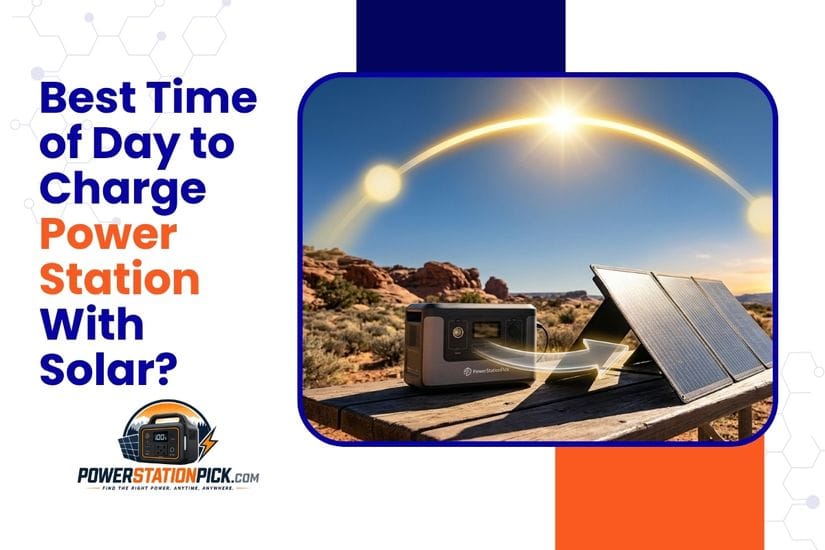
The best time of day to charge power station with solar panels is between 10:00 AM and 3:00 PM. During this specific 5-hour midday window, the sun reaches its highest angle in the sky, passing through the least amount of atmospheric interference. This creates “Peak Sun Hours,” allowing your panels to operate at 75% to 90% of their advertised wattage rating. Outside of this window, early morning and late afternoon sunlight strikes the panels at an oblique angle, causing solar generation to drop by 50% or more.
Plugging a portable power station into a folding array of solar panels is the ultimate milestone of off-grid freedom. Whether you are keeping a 12V portable fridge cold at a remote Bureau of Land Management (BLM) campsite, powering a remote workstation from the roof of a camper van, or building a silent emergency backup system for home blackouts, solar energy represents absolute self-sufficiency.
However, many newcomers treat solar panels like household wall outlets. They assume that as long as the sun is visible in the sky, their solar panels will pump a continuous, fixed stream of electricity into their battery box.
The hard reality of field physics is that solar energy is highly volatile. If you set up your panels at sunrise and ignore them all day, you will likely return to a half-empty battery pack by nightfall.
Maximizing your alternative energy setup requires shifting your mindset from passive collecting to active harvesting. To get the absolute fastest charging speeds out of your panels, you have to align your routine with the movement of the sun.
pinpointing the best time of day to charge power station with solar panels will drastically cut your recharge times, prevent field errors, and ensure your system recovers its capacity before the sun slips below the horizon.
Why Solar Charging Performance Changes Throughout the Day
To understand why solar charging speeds fluctuate so wildly across a 12-hour day, we have to look at how solar cells process sunlight. Photovoltaic (PV) panels do not absorb heat; they absorb photons. When photons strike the silicon cells inside a panel, they agitate electrons, creating a flow of Direct Current (DC) electricity.
The volume of photons striking those cells relies on two main variables:
1. The Angle of Incidence
When the sun is low on the horizon during the early morning or late afternoon, its light hits the solar panels at a shallow, oblique angle. This means the solar energy is spread across a larger geographical surface area, diluting its intensity.
When the sun climbs directly overhead at midday, the angle of incidence drops to zero. The photons strike the panel squarely and directly, packing the maximum possible energy into every square inch of silicon.
2. Atmospheric Mass (Air Mass Coefficient)
Sunlight must travel through the earth’s atmosphere before reaching your campsite. The atmosphere is filled with dust, water vapor, ozone, and smog, all of which scatter and absorb photons.
At sunrise, because the sun is striking the earth from the side, its light must travel through a massive thickness of atmosphere to reach your panel. At noon, the sun is directly above you, meaning the light travels down through the thinnest possible layer of air. This short path minimizes photon scattering, delivering maximum charging raw power to your equipment.
3. The Counter-Intuitive Temperature Factor
While intense sunlight is excellent for solar production, intense heat is actually a battery killer. As solar panels get physically hotter (often climbing past 115°F on a metal roof), their internal silicon cells experience an increase in electrical resistance. This causing their output voltage to drop.
This means a crisp, clear 65°F morning at 11:00 AM will often yield significantly higher solar charging numbers than a suffocatingly hot 100°F afternoon at 1:00 PM, even though the later sun looks brighter to the human eye.
What Are Peak Sun Hours?
When planning an off-grid energy budget, you cannot simply count the total hours of daylight. Instead, solar professionals calculate metrics using Peak Sun Hours.
A single Peak Sun Hour is defined as any one-hour period where the intensity of solar radiation reaches an average of 1,000 watts of energy per square meter ($1000\text{ W/m}^2$).
Think of a peak sun hour as a metric of energy quality, not time duration. For instance, if your panels sit out in shallow, weak morning light for three hours, they might only collect the energy equivalent of one single Peak Sun Hour.
Typical Regional Peak Sun Ranges
Across the United States, the average number of Peak Sun Hours varies dramatically by geographic region and season:
- The Desert Southwest (Arizona, New Mexico, Nevada): Enjoys an incredible 6 to 7+ Peak Sun Hours per day, making solar harvesting exceptionally fast.
- The Pacific Northwest & New England: Often averages only 3 to 4 Peak Sun Hours per day, requiring users to buy significantly larger solar panel arrays to harvest the exact same amount of battery power.
Knowing your local peak sun hours prevents you from making the classic mistake of assuming 10 hours of daylight equals 10 hours of maximum speed charging.
Best Time of Day to Charge a Portable Power Station With Solar
Let’s break down a typical day in the field chronologically so you can structure your gear deployment for optimal portable power station solar efficiency.
Early Morning Charging (7:00 AM – 10:00 AM)
- Sunlight Profile: Low intensity, highly scattered photons, long shadows from surrounding trees and campers.
- Real-World Performance: Poor to Mediocre. Your 200W solar panel will likely only register between 20W to 50W of actual input power on your station’s LCD screen.
- The Advantage: The silver lining here is ambient temperature. Because the air and the solar panels are still cold from the night before, the silicon cells function at their highest baseline chemical efficiency.
- Action Step: If you want to capture this early morning trickle of energy, you must physically tilt your solar panels completely upright, facing directly East. Leaving them lying flat on the ground during these hours will result in virtually zero charging input.
Midday Charging (10:00 AM – 3:00 PM)
- Sunlight Profile: Maximum intensity, shortest atmospheric path, highest concentration of direct photon delivery.
- Real-World Performance: Peak Efficiency. This is the golden window where you charge power station with solar panels at maximum capability. A high-quality 200W solar panel running through an advanced MPPT charge controller will consistently pump between 150W to 180W of clean electricity straight into your battery cells.
- The Challenge: Heat management. Your trạm sạc di động (portable power station) will generate substantial internal heat while accepting this massive input load.
- Action Step: Adjust your panels to lay flatter (matching your local latitude angle) facing directly South. Most importantly, ensure your actual power station box is tucked away completely in the shade under your van, table, or awning while the panels bake in the sun.
Late Afternoon Charging (3:00 PM – 6:00 PM)
- Sunlight Profile: Rapidly declining photon concentration, sun sinking into Western treelines, long atmospheric scattering paths.
- Real-World Performance: Sharp drop-off. Expect your incoming wattage to drop back down to 30% of its peak value by 4:00 PM, slowing down to a crawl by 5:30 PM.
- Action Step: If you desperately need to squeeze out a few more watt-hours before dusk, reset your panels to point directly West, angling them vertically to catch the final, low-hanging rays of the setting sun.
How Weather Affects Solar Charging Performance
While the clock provides a guide, the atmosphere writes the rules. Here is a realistic look at how varying weather conditions impact your solar charging performance.
Cloudy and Overcast Skies
A thick blanket of dark gray clouds will decimate your solar input, dropping your panel efficiency by roughly 70% to 90%. However, do not make the mistake of packing your gear away. High-end panels paired with a modern MPPT controller in portable power station units can still harvest ambient “diffuse” light, pulling in a valuable 15W to 30W trickle that can keep small electronics alive.
Extreme Ambient Heat
As mentioned during our technical overview, scorching summer heat reduces solar panel voltage. If you are desert camping in 105°F heat, your solar panels will likely top out at 75% of their rated capacity, even under perfectly clear skies. Ensure you keep the panels off hot surfaces (like baking asphalt or dark vehicle roofs) by using their integrated tilt-legs to allow cooling airflow underneath.
Rain and Snow
Rain drops will temporarily lower your solar output, but they provide a hidden benefit: they wash away accumulated dust, pollen, and salt crusts, leaving your panels pristine once the storm clears.
Snow is a double-edged sword. If snow physically covers your solar cells, your power generation drops to exactly zero. However, if you clear the snow off your panels, fresh snow lying on the ground around your campsite acts like a giant mirror. This phenomenon reflects extra sunlight back up onto your array, sometimes boosting your solar generation past the panel’s official factory rating.
How Long Does Solar Charging Take?
To give you an honest estimation of what to expect in the field, the table below bypasses perfect laboratory conditions and profiles real-world charging timelines during Peak Sun Hours (assuming an average 80% panel efficiency conversion).
Table 1: Real-World Solar Charging Timelines
| Solar Panel Configuration | Actual Midday Output (Est.) | Small Power Station (approx. 300Wh Capacity) | Medium Power Station (approx. 1,000Wh Capacity) | Large Solar Generator (approx. 2,000Wh Capacity) |
|---|---|---|---|---|
| 1x 100W Portable Panel | ~75W – 80W | ~4 to 4.5 Hours | ~13 to 14 Hours (Multiple Days) | Impractical (Too slow) |
| 1x 200W Portable Panel | ~150W – 160W | ~2 Hours (Max limit) | ~6.5 to 7 Hours | ~13 to 14 Hours |
| 2x 200W Panels (400W Array) | ~300W – 320W | Overload risk (Do not use) | ~3.2 to 3.7 Hours | ~6.5 to 7 Hours |
| 4x 200W Panels (800W Array) | ~600W – 640W | Do not use | Overload risk (Check specs) | ~3.3 to 3.8 Hours |
Factors That Affect Solar Charging Efficiency
If your trạm sạc is charging slower than expected during peak midday hours, look for these common hidden bottlenecks:
- Power Station DC Input Limitations: Every solar generator has a strict electrical gatekeeper inside. If you buy a massive 400W solar panel array, but plug it into a compact power station whose internal charge controller maxes out at 100W maximum solar input, the machine will intentionally discard the extra 300 Watts. Always verify that your power station’s input wattage limit can match your panel capacity.
- The Shadow Domino Effect: Portable folding panels are wired in an internal grid. If a shadow from a single thin camping chair or tree branch covers just 10% of your folding solar array, it can completely choke the current flow, causing the output of the entire panel to drop by up to 50% or more.
- Cheap, Low-Grade Cords: Running high-amperage solar current through thin, uninsulated 16-gauge extension wires creates intense electrical resistance, bleeding off precious voltage as useless heat before it ever reaches your battery box. Always deploy heavy-duty 10-gauge or 12-gauge solar extension cables.
PWM vs. MPPT Charge Controllers: Older or ultra-budget power stations utilize primitive PWM (Pulse Width Modulation) controllers, which clip excess solar voltage away entirely. Premium modern brands utilize MPPT (Maximum Power Point Tracking) microprocessors, which dynamically convert excess voltage into bonus charging current, boosting your field efficiency by 20% to 40%.
How to Maximize Solar Charging Performance
To squeeze every available drop of energy out of your off-grid solar grid, build these four professional habits into your daily camping routine:
🛠️ Professional Solar Optimization Checklist
- Chase the 90-Degree Angle: Don’t leave your solar panels lying flat on a picnic table all day. Every 2 to 3 hours, take 30 seconds to walk over and realign the panels so they face the sun perfectly straight-on.
- The Microfiber Wipe Down: A thin, barely visible layer of dust, morning pollen, or dried salt crust can block significant light photons. Keep a clean microfiber towel in your gear kit and wipe the transparent face of your panels every couple of days.
- Elevate Off Baking Surfaces: Air circulation keeps cell resistance low. Use the panel’s integrated tilt-legs to lift them off hot vehicle roofs, gravel, or dark dirt paths, allowing cooling wind to sweep underneath.
- Wire in Series for Long Distances: If you need to place your panels far away in a sunny clearing while keeping your power station cool inside your van, wire your panels in a high-voltage Series configuration to minimize transmission line losses.
Common Solar Charging Mistakes
Avoid these four classic pitfalls to protect your budget and your hardware from field failure:
- Leaving Panels Flat All Day: Setting your panels flat on top of your overland roof rack or tent floor might look clean, but it forces them to operate at an inefficient, highly oblique angle for nearly 70% of the day. You are leaving massive amounts of free power on the table.
- Exceeding the Inverter’s Voltage Limit: While a power station’s MPPT controller can safely ignore or “clip” excess Watts or Amps, pushing too much input Voltage into the port will instantly fry the motherboard. If your power station reads “60V Max Input,” and you wire two large residential panels together that output a combined Open Circuit Voltage (Voc) of 74V, you will instantly break your equipment. Always cross-reference your panel’s Voc sticker before connecting cables.
- Expecting 100% Rated Power: If you purchase a panel stamped with a “100W” logo, do not expect to see 100W flashing on your power station display. Solar ratings are determined in laboratory chambers under unrealistic conditions. In the real world, due to atmospheric interference, cord resistance, and ambient heat, a healthy, perfectly optimized panel will typically output roughly 75% to 85% of its advertised rating during peak midday sun.
- Charging Through Glass Windows: Placing a portable solar panel on the dashboard of your car or behind a residential house window cuts its efficiency by up to 50% to 70%. Modern glass windows are intentionally treated with specialized UV-blocking and infrared-reflecting coatings that filter out the exact light photons your solar cells need to harvest power. Always place your panels directly outdoors in the open air.
Real-World Solar Charging Scenarios
To help you visualize your setup, let’s move past sterile numbers and profile how real-world solar enthusiasts structure their daily power harvesting routines.
Scenario A: The Weekend Overlander (Car Camping)
You are running a 45W portable compressor fridge, charging camera gear, and running camp lighting off a mid-sized Bluetti AC180 (1,152Wh capacity).
- The Routine: You leave camp at 9:00 AM to go hiking. Before leaving, you set up a 200W folding solar panel array on the ground, point it directly South, and prop it at a 45-degree angle.
- The Result: Between 10:00 AM and 3:00 PM, the panels harvest roughly 750 Watt-hours of clean solar power. When you return at 4:00 PM, your power station has fully recovered the capacity it lost overnight running the fridge, resetting your system back to 100% for the upcoming evening.
Scenario B: The Digital Nomad (Van Life Setup)
You live out of your van full-time, running a roof-mounted Starlink internet satellite dish, a laptop, induction cooktops, and max ventilation fans using an EcoFlow Delta 3 Plus.
- The Routine: Since your panels are mounted flat to your roof rack, you cannot tilt them easily. To compensate for the shallow angle inefficiency, you “over-panel” your roof with 400W of total solar capacity to make up for the structural limitations.
- The Result: Even though your flat panels never hit peak efficiency, their massive surface area allows you to pull a steady 220W of continuous power during the core 10:00 AM to 3:00 PM window, completely covering your daytime remote work power needs without making a single dent in your internal battery percentage.
Best Portable Power Stations for Solar Charging
Here is an analytical breakdown of the top-performing portable power stations available today, featuring premium internal MPPT electronics engineered specifically to maximize solar intake.
1. EcoFlow Delta 3 Plus (The Quickest Solar Tracking Engine)
The EcoFlow Delta 3 Plus is a phenomenal choice for mobile solar setups, utilizing an incredibly fast, highly responsive internal MPPT processor that continuously maps fluctuating weather patterns.
- Solar Intake Specs: Supports up to 500W of solar input within an expansive 11V–60V voltage range, accepting a maximum current of 13A.
- Field Efficiency: Outstanding. Its dynamic tracking algorithm adapts to shifting cloud coverage within milliseconds, keeping your intake curve stable.
- Best Use Case: Digital nomads, van lifers, and emergency home readiness where every minute of midday sun counts.
- Pros: Fast tracking algorithm; exceptional smartphone app metrics; wide voltage input window.
- Cons: Internal cooling fans run loudly when processing a full 500W input load.
2. Bluetti AC180 (The High-Voltage Overlander Workhorse)
Bluetti’s AC180 is engineered with heavy-duty, industrial-grade electrical components designed to handle high-voltage configurations flawlessly.
- Solar Intake Specs: Accepts up to 500W of solar power within a wide 12V–60V input window at up to 10A of current.
- Field Efficiency: Highly consistent. It displays exceptional thermal mitigation, meaning it maintains a steady charge rate even when ambient temperatures climb.
- Best Use Case: Full-time RVers and boondockers who want to link multiple heavy-duty, rigid residential panels in a series array.
- Pros: Toughest EV-grade LiFePO4 cells (3,500+ cycles); solid build quality; quiet internal fans.
- Cons: At roughly 35 lbs, it requires some muscle to move around camp compared to direct capacity competitors.
3. Anker SOLIX C1000 (The Rugged Outdoor Champion)
Anker has established a massive footprint in the alternative energy space with their ultra-tough InfiniPower™ construction, packing a highly optimized solar brain into a sleek package.
- Solar Intake Specs: Boasts a class-leading 600W solar intake ceiling within an 11V–60V processing window at up to 12.5A.
- Field Efficiency: Excellent. Its internal architecture specializes in keeping cell temperatures exceptionally cool during long, intense midday charging sessions.
- Best Use Case: Backyard tailgating, remote off-grid DIY construction projects, and long-term disaster readiness kits.
- Pros: Impact-resistant drop-proof chassis; highly competitive price-per-watt; premium 5-year comprehensive warranty.
- Cons: Companion app requires a local 2.4GHz Wi-Fi or Bluetooth connection for remote tracking.
Are Portable Power Stations Worth Using With Solar?
If you only use your portable power station once a year to power a projector for a backyard summer movie night, purchasing expensive solar panels is a financial waste. You are better off simply charging the unit via your home wall outlet before the event.
However, a solar-integrated power station is 100% worth the investment if you value long-term self-sufficiency. It completely frees you from the logistical hassles of traditional gas generators. You no longer have to carry smelly gasoline cans, perform routine engine oil changes, or listen to a roaring 70-decibel mechanical engine drown out the sounds of nature.
For emergency home preparedness during a massive grid failure or prolonged storm blackout, solar panels transform your power station from a simple, limited storage tank of temporary power into a permanent, self-sustaining off-grid electrical utility.
Frequently Asked Questions
What time of day is best for solar charging?
The absolute best time of day to charge a power station with solar panels is between 10:00 AM and 3:00 PM. During this core 5-hour midday window, the sun sits directly overhead at its highest angle, traveling through the thinnest layer of atmosphere and delivering maximum photon concentration to your solar array.
Can solar panels charge on cloudy days?
Yes, solar panels can still charge on cloudy days, but their output will drop by roughly 70% to 90% compared to clear skies. High-end monocrystalline panels paired with a modern MPPT power station can still process ambient diffused light to harvest a helpful 15W to 40W trickle of energy through heavy cloud coverage.
Why is my solar charging slow?
Slow solar charging is usually caused by four factors: charging outside the peak 10 AM – 3 PM window, partial shading blocking a section of the panel cells, old or low-gauge extension wiring causing a massive voltage drop, or your power station hitting its internal built-in DC input amperage limit.
How many solar panels do I need to charge my power station?
As a general rule of thumb, look at your power station’s watt-hour capacity and match it to a panel array that can theoretically charge it in 6 to 7 hours of field sun. For a 500Wh power station, a single 100W panel is ideal. For a larger 1,000Wh power station, a 200W or 300W solar panel array is recommended.
Can I leave solar panels connected to my power station all day?
Yes. Modern premium portable power stations feature highly advanced Battery Management Systems (BMS) with integrated over-charge protection circuitry. Once your battery hits 100%, the power station will automatically stop accepting incoming current, allowing your panels to safely sit out in the sun all day without risk of damaging your equipment.
Do portable power stations charge faster in winter or summer?
They actually charge faster on clear late spring or early summer days when the sun is highest in the sky. While winter offers clear skies, the sun sits low on the horizon, reducing peak sun hours. However, cold winter temperatures actually make the solar cells operate with less internal resistance, meaning a clear winter noon can sometimes match summer performance if the panels are angled correctly.
Does heat reduce solar efficiency?
Yes, counter-intuitively, excessive heat reduces solar panel efficiency. Once the physical temperature of a solar panel rises past 77°F (25°C), its internal silicon cells experience an increase in electrical resistance, causing its output voltage to drop by roughly 0.4% for every degree higher.
Can I charge my power station through a house window?
No, we do not recommend it. Charging through a residential window pane or vehicle windshield will drop your solar output by 50% or more. Modern window glass is treated with complex UV-blocking and infrared-reflecting layers that filter out the specific light spectrum wavelengths your solar cells require to generate electricity.
What is the difference between parallel and series wiring for solar panels?
Series wiring links panels end-to-end (positive to negative), which combines their voltages while keeping the amperage the same—ideal for long cable runs to an MPPT controller. Parallel wiring links panels side-by-side (positive to positive), which combines their amperages while keeping the voltage the same—ideal for older PWM systems or smaller capacity setups.
How do I protect my power station from theft while charging outside?
When boondocking or camping in public spaces, use a long, heavy-duty 30-foot solar extension cable. This allows you to chain your solar panels out in the open sun while locking your expensive power station securely inside your vehicle trunk or camper van chassis out of plain sight.
Final Verdict
To unlock the maximum potential of your alternative energy setup, your routine must adapt to the mechanics of the solar system.
Remember these key takeaways for your next off-grid excursion:
- Always schedule your heavy power-consuming activities (like running electric cooktops or recharging high-drain drone batteries) during the peak 10:00 AM to 3:00 PM solar window so you can run them directly off incoming solar energy, bypassing battery drain entirely.
- Take 30 seconds every couple of hours to adjust your panels to face the sun directly at a sharp 90-degree angle rather than leaving them lying flat on the ground all day.
- Keep your actual power station unit cooling in the deep shade while leaving your high-grade, clean monocrystalline panels exposed to the sun.
By prioritizing a high-quality LiFePO4 / MPPT-equipped power station like the EcoFlow Delta 3 Plus or Bluetti AC180, and timing your harvesting cycles with peak sun hours, you will achieve the ultimate goal of alternative energy: stable, infinite, silent power wherever your adventures take you.

Hi, I’m Andrew Richards. I created PowerStationPick to share what I’ve learned about portable power through real-world use—what actually works, what doesn’t, and what makes sense for different situations. I focus on helping you choose the right setup for home backup, camping, and everyday needs without overcomplicating things.