Portable Power Stations for Medical Equipment: The Ultimate Guide
When Power is Not Just a Luxury
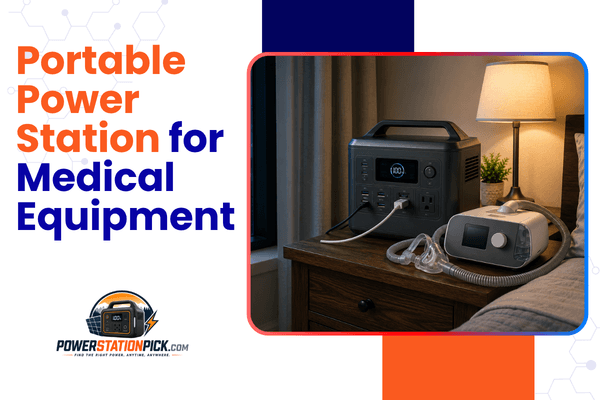
For most people, a power outage means a dark house and a dead phone. But for millions of individuals relying on medical equipment, a blackout is a high-stakes emergency. Whether it’s a CPAP machine for sleep apnea, an oxygen concentrator, or a home dialysis unit, electricity is quite literally a lifeline.
In 2026, the technology behind the portable power station for medical equipment has evolved significantly. We have moved past noisy, gas-guzzling generators that can’t be used indoors. Today’s backup solutions are silent, emission-free, and sophisticated enough to protect sensitive medical electronics.
At PowerStationPick, we understand that choosing a backup battery isn’t just about “buying a gadget”—it’s about peace of mind. In this guide, we will break down exactly what you need to look for to ensure your medical devices stay running when the grid fails.
Quick Verdict: The 3 Non-Negotiables
- Pure Sine Wave Inverter: Essential to prevent damaging sensitive medical electronics.
- LiFePO4 Chemistry: Offers 3,000+ cycles, ensuring the unit works even after years of storage.
- UPS Functionality: Look for “Uninterruptible Power Supply” with <20ms switchover to prevent device restarts.
Recommended Capacity: 700Wh for CPAP (multi-night); 2000Wh+ for Oxygen Concentrators.
Why a Portable Power Station is Better Than a UPS or Gas Generator
Traditionally, people chose between a small computer UPS or a large gas generator. Both have fatal flaws for medical use:
- Standard UPS: Designed for computers to save files and shut down. They usually last only 15–30 minutes—not long enough for a 6-hour sleep session or a long-duration outage.
- Gas Generators: You cannot run them indoors due to carbon monoxide. In a storm or a middle-of-the-night emergency, going outside to pull-start a generator is often impossible for medical patients.
A portable power station (PPS) sits in the “sweet spot.” It is silent, safe to keep right next to your bed, and provides hours (or days) of high-capacity energy.
Critical Technical Requirements for Medical Use
If you are buying a portable power station for medical equipment, you cannot just grab the cheapest unit on Amazon. You must check these three technical specs:
Pure Sine Wave Inverter (The Most Important Spec)
Cheap power stations use “Modified Sine Wave” inverters. These produce “choppy” electricity. While a simple lightbulb won’t care, a CPAP motor or a ventilator will hum, overheat, or even fail permanently. Only buy a unit labeled “Pure Sine Wave.”
Battery Chemistry: LiFePO4 (LFP)
In 2026, avoid old Lithium-ion (NMC) batteries. LiFePO4 cells are safer (less fire risk) and last much longer. For medical backup, you want a unit that can sit in your closet for months and still be ready to perform. LFP batteries can be charged over 3,500 times before losing significant capacity.
Pass-Through Charging & UPS Mode
A medical-grade power station should support “Pass-Through Charging.” This allows you to keep the station plugged into the wall, and your medical device plugged into the station. If the power goes out, the station takes over instantly (usually in under 20 milliseconds), so your machine never stops.
Runtime Estimates for Common Medical Devices
How long will a 1000Wh station actually last? Runtimes vary wildly based on the device’s wattage.
Table 1: Estimated Runtimes (Based on 1000Wh Capacity)
| Medical Equipment | Typical Watts | Estimated Runtime |
| CPAP (No Humidifier) | 30W – 40W | 20 – 25 Hours |
| CPAP (With Heated Humidifier) | 60W – 100W | 7 – 10 Hours |
| Oxygen Concentrator | 300W – 600W | 1.5 – 3 Hours |
| Medical Fridge (Small) | 20W – 50W | 15 – 30 Hours |
| Nebulizer | 50W – 100W | 8 – 12 Hours |
| Home Dialysis Machine | 300W – 500W | 1.5 – 2 Hours |
Note: For Oxygen Concentrators, we always recommend units with at least 2000Wh or expandable battery modules.
Top Recommendations for Medical Backup in 2026
Best for CPAP Users: Bluetti AC70P
The Bluetti AC70P is a favorite because it is nearly silent. If you are using it for sleep apnea, you don’t want a loud cooling fan next to your head.
- Why it works: Its 768Wh capacity can easily handle 2–3 nights of CPAP use if you turn off the heated humidifier.
- Pro Tip: Read our full Bluetti AC70P review to see how it handled our noise-level testing.
Best for Oxygen Concentrators: EcoFlow Delta 3 Plus
Oxygen concentrators are energy-hungry. The EcoFlow Delta 3 offers 1024Wh but, more importantly, it supports expandable batteries.
- Why it works: You can stack extra batteries to reach 4000Wh+, providing 10+ hours of continuous oxygen flow. Its ultra-fast charging (0-80% in 45 mins) is vital if power comes back on only briefly.
Best for Reliability: Anker SOLIX C1000
Anker’s InfiniPower™ technology is built for longevity. If this unit is going to sit in a bedroom for years “just in case,” the Anker SOLIX C1000 is the most reliable “set it and forget it” option.
How to Maximize Runtime During an Outage
When the grid goes down, every watt counts. Here is how to stretch your battery:
- Disable Heated Features: On a CPAP, the heated tube and humidifier draw 50% to 70% of the total power. Turning these off can triple your runtime.
- Use DC Adapters: Converting battery power (DC) to wall power (AC) and back to the device’s DC power is inefficient. This is known as the “Inverter Tax.” Buying a 12V or 24V DC “car charger” cord for your CPAP or medical device can save 15–20% of your energy. We discuss this in our guide on mistakes when using portable power stations.
- Solar Recharge: In an extended outage (like after a hurricane), you need to recharge. A 200W solar panel can refill a mid-sized station in 5–7 hours of sunlight.
Travel and Compliance (FAA & TSA)
If you plan to fly with your medical equipment backup battery, you must be aware of FAA regulations:
- Under 100Wh: Allowed in carry-on without approval.
- 100Wh – 160Wh: May be allowed with airline approval (limit 2).
- Over 160Wh: Strictly Prohibited on passenger aircraft.
Most “portable power stations” are well over 160Wh. If you are traveling, look for specialized “CPAP Travel Batteries” (like the Medistrom Pilot-24) which are specifically designed to be TSA-compliant.
Financial Assistance: HSA, FSA, and Insurance
Can you use your HSA (Health Savings Account) or FSA (Flexible Spending Account) to buy a portable power station?
The answer is often YES. Because a power station is a “medical necessity” for devices like ventilators or CPAPs, many accounts will cover the cost if you have a Letter of Medical Necessity (LMN) from your doctor. Always check with your plan administrator first, but this can save you 30% or more via pre-tax dollars.
FAQ Section (Optimized for Snippets)
Can I use a portable power station to run a full-size medical fridge?
Yes, but runtimes vary. A standard 1000Wh station will run a small medical fridge for about 20–30 hours. For long-term vaccine or insulin storage, we recommend a 2000Wh unit paired with solar panels.
How do I know if my power station is Pure Sine Wave?
Check the manufacturer’s spec sheet. If it doesn’t explicitly say “Pure Sine Wave,” assume it is modified. All reputable brands like Bluetti, EcoFlow, and Jackery use Pure Sine Wave in their 2026 models.
Is it safe to charge my power station while my CPAP is plugged in?
Yes, this is called Pass-Through Charging. As long as your power station has a quality BMS (Battery Management System), it is perfectly safe and actually recommended for medical use.
How often should I check the battery level of my backup?
We recommend checking the charge every 3 months. Even the best LiFePO4 batteries have a tiny amount of “self-discharge.” Keep it at 80% to 100% for emergency readiness.
Does insurance cover portable power stations?
Rarely. Traditional insurance (like Medicare) usually covers the medical device itself but not the backup power source. However, as mentioned, HSA/FSA funds are a great alternative.
Final Verdict: Don’t Wait for the Storm
The worst time to shop for a portable power station for medical equipment is when the sky is turning grey. By then, shipping is delayed and local stores are sold out.
If you or a loved one depends on medical technology, a backup battery isn’t a luxury—it’s an insurance policy.
- For CPAP users, the Bluetti AC70P is our top choice for its silent operation.
- For heavy equipment, look into the EcoFlow Delta series for its expandable capacity.
Ready to protect your health? Check out our latest reviews and comparisons to find the unit that fits your specific medical needs and budget.

Hi, I’m Andrew Richards. I created PowerStationPick to share what I’ve learned about portable power through real-world use—what actually works, what doesn’t, and what makes sense for different situations. I focus on helping you choose the right setup for home backup, camping, and everyday needs without overcomplicating things.