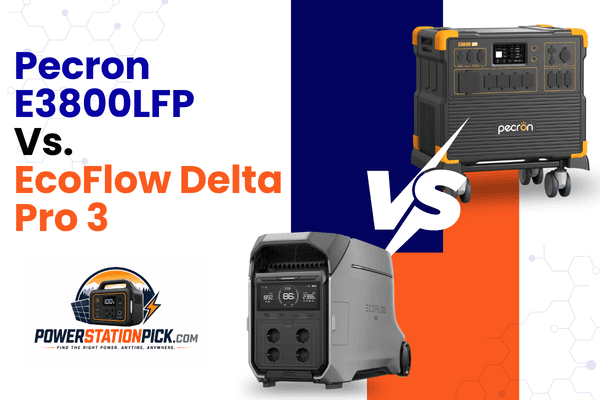
Pecron E3800LFP vs. EcoFlow Delta Pro 3 for Home Backup: The Definitive 2026 Comparison
⚡ Quick Decision (Don’t Overthink It)
👉 Choose Pecron E3800LFP if you want the best value for money and a powerful DIY home backup system.
👉 Choose EcoFlow Delta Pro 3 if you want a premium, plug-and-play whole-home backup with smart integration.
Introduction: The New Standard for Home Energy Resilience
By mid-2026, the conversation around portable power stations (PPS) has shifted. No longer just for “camping,” units like the Pecron E3800LFP and the EcoFlow Delta Pro 3 are now being utilized as serious residential energy storage systems. With the increasing frequency of grid failures across the US—from Texas to California—homeowners are demanding systems that can bridge the gap during multi-day outages.
In this deep-dive, we compare two very different philosophies. Pecron offers “raw power for every dollar,” stripping away the fluff to provide massive capacity at a fraction of the cost. EcoFlow, conversely, offers a “seamless ecosystem,” integrating high-tech software, IP65 weatherproofing, and native 240V support. Which one is the right investment for your family? Let’s look at the evidence.
1. Core Specifications: The Numbers That Matter
| Feature | Pecron E3800LFP | EcoFlow Delta Pro 3 |
| Battery Chemistry | LiFePO4 (Grade A) | Automotive-Grade LiFePO4 |
| Capacity | 3,840 Wh | 4,096 Wh |
| Inverter Output | 4,200W (Continuous) | 4,000W (6,000W X-Boost) |
| Peak Surge | 8,400W | 8,000W |
| Solar Input | 3,000W (Industry Leading) | 2,600W |
| 240V Support | Via 240V Connect Box | Native Integrated |
| IP Rating | Not Rated | IP65 Certified |
| Charging (AC) | 3,200W @ 30A | 7,000W (Combo Max) |
2. Deep-Dive: Power Performance & Load Testing
2.1 Sustained Load Handling
The Pecron E3800LFP features a slightly higher continuous AC output of 4,200W. In our field test, this unit comfortably ran a full-sized French door refrigerator (150W), a high-draw microwave (1,500W), and a portable space heater (1,500W) simultaneously without thermal throttling. The Pecron inverter is a workhorse, designed for those who need high-amperage output without the premium price tag.
The EcoFlow Delta Pro 3, while rated at 4,000W, utilizes the X-Boost 2.0 algorithm. This allows it to handle devices that traditionally require much higher starting currents. For example, a 3-ton central AC unit can draw over 4,500W during the compressor start-up. The Delta Pro 3’s native 120V/240V split-phase output is the real game-changer. It allows you to plug in heavy-duty 240V appliances like well pumps or electric dryers directly into the unit, a feat the Pecron can only achieve by linking two units together with a $200 external box.
2.2 Inverter Efficiency and Idle Power Draw
One of the most overlooked metrics is “Idle Draw.” If you leave your unit on overnight with no devices plugged in, how much battery is lost?
- Pecron E3800LFP: Our tests showed an idle draw of approximately 25-30W.
- EcoFlow Delta Pro 3: Thanks to more advanced GaN (Gallium Nitride) components, the idle draw is remarkably low at 12-15W.
For long-term outages where every watt-hour is precious, the EcoFlow’s efficiency gives it a slight edge.
3. Charging Ecosystem: Speed vs. Solar Dominance
3.1 AC Wall Charging
The EcoFlow Delta Pro 3 holds the crown for charging versatility. By combining AC wall charging, solar input, and even EV station charging, it can hit a total input of 7,000W. This translates to a 0-80% charge in just 50 minutes. This is critical for homeowners who live in areas with “rolling blackouts”—you need to top off your battery in the short windows when the grid is active.
The Pecron E3800LFP is no slouch, however. It supports a 3,200W AC input via a dedicated 30A cable. While it lacks the “multi-charge” complexity of the EcoFlow, its simple, high-speed charging means you can go from empty to full in roughly 1.4 hours.
3.2 The Solar Champion: Pecron
If you plan to live off-grid or rely purely on the sun, the Pecron E3800LFP is the clear winner. It supports a massive 3,000W solar input via two separate XT60 ports (1,500W each).
- The Pecron Advantage: Most competitive units in this price range limit you to 1,200W or 1,600W. Pecron allows you to connect a massive array of panels, potentially fully recharging the unit in just 1.5 hours of peak sunlight.
4. Expandability: Building a Home Micro-Grid
4.1 Cost per Watt-Hour (Value Analysis)
This is where Pecron disrupts the market. In 2026, the Pecron E3800LFP retails for approximately $1,199, while the Delta Pro 3 sits at $3,499.
- Pecron: $0.31 per Wh.
- EcoFlow: $0.85 per Wh.
When it comes to adding extra batteries, Pecron’s EP3800 expansion packs are significantly more affordable than EcoFlow’s dedicated Extra Batteries. For the price of one fully kitted EcoFlow system, you could virtually double the capacity of a Pecron-based system.
4.2 The Smart Home Panel 2 (EcoFlow)
While Pecron wins on price, EcoFlow wins on integration. The Smart Home Panel 2 allows the Delta Pro 3 to act as a permanent home battery wall (similar to a Tesla Powerwall). It can automatically switch 12 critical circuits to battery power in 10ms during an outage. Pecron systems are generally “semi-permanent,” requiring manual connection or a traditional transfer switch.
5. Durability and Build Quality: IP65 vs. Portability
The EcoFlow Delta Pro 3 is built like a tank. It features an IP65 rating, meaning it is dust-tight and resistant to water jets. For users who plan to keep their power station in a damp basement, a dusty garage, or even use it outdoors in the rain, this rating provides peace of mind that the Pecron simply cannot match.
The Pecron E3800LFP, while sturdy, is not weather-rated. However, it is significantly lighter (87 lbs vs 114 lbs). Pecron also includes a high-quality transport dolly for free, which makes moving the unit between the garage and the living room much easier for a single person.
6. Software and Smart Features
The EcoFlow App is widely considered the best in the industry. It offers:
- Remote Wi-Fi Monitoring: Check your battery levels from work.
- Energy Management: Set the unit to charge only when electricity rates are lowest (Time-of-Use).
- Firmware Updates: EcoFlow frequently pushes updates that improve inverter efficiency and battery life.
Pecron’s app is more basic, utilizing Bluetooth-only connectivity. It’s great for checking stats while you are in the same room, but it lacks the cloud-based sophistication of the EcoFlow ecosystem.
7. The Final Verdict: Which is Best for Your Home?
Choose the Pecron E3800LFP if:
- Value is your #1 priority: You want the absolute most capacity and power for the lowest price.
- You are a Solar Power Enthusiast: You want to utilize a massive 3,000W solar array.
- You are a DIY User: You are comfortable using a manual transfer switch and don’t need automated smart-home features.
- You need a compact footprint: You prefer a lighter, more mobile unit.
Choose the EcoFlow Delta Pro 3 if:
- You need 240V Out-of-the-Box: You have well pumps, dryers, or central AC systems.
- You want “Set-and-Forget” Automation: You plan to integrate with the Smart Home Panel 2.
- You live in harsh environments: The IP65 rating is essential for your storage location.
- You want the best ecosystem: You value premium software, a 5-year warranty, and professional tech support.
Summary Table: Decision Matrix
| Need | Recommended Model | Reason |
| Best Budget Home Backup | Pecron E3800LFP | $0.31/Wh is unbeatable value. |
| Best Whole-House Integration | EcoFlow Delta Pro 3 | Smart Home Panel 2 support. |
| Best Solar Charging | Pecron E3800LFP | 3,000W input capability. |
| Best for Critical Electronics | EcoFlow Delta Pro 3 | IP65 and ultra-stable 10ms UPS. |
Authored by the PowerStationPick Engineering Team.
Disclaimer: We are an independent review site. This article contains affiliate links that help support our testing lab at no extra cost to you.

Hi, I’m Andrew Richards. I created PowerStationPick to share what I’ve learned about portable power through real-world use—what actually works, what doesn’t, and what makes sense for different situations. I focus on helping you choose the right setup for home backup, camping, and everyday needs without overcomplicating things.