OUPES Portable Power Station: Complete 2026 Lineup Review & Buying Guide
✈️ Quick Answer
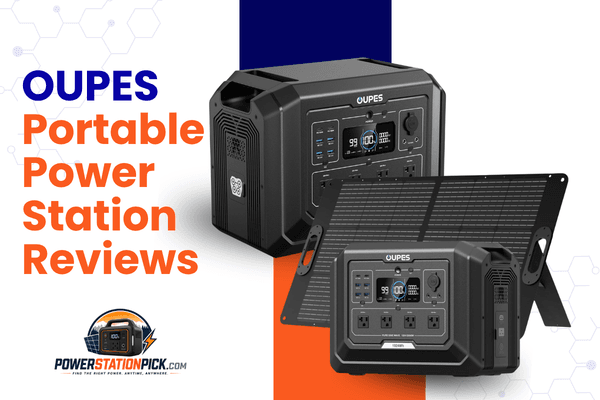
OUPES is a budget-focused portable power station brand engineered around two primary product lines: the Exodus series (compact, entry-level travel units from 256Wh to 2,232Wh) and the Mega series (high-output, expandable solar generators from 1,024Wh up to 5,040Wh). The standout model in their ecosystem is the OUPES Mega 1. It pairs a highly durable 1,024Wh LiFePO4 battery with a massive 2,000W continuous Pure Sine Wave inverter — offering premium flagship performance while typically costing $200 to $400 less than legacy competitors like Jackery or Goal Zero.
Who Is OUPES, and Is It a Brand You Can Trust?
OUPES entered the competitive clean energy market by positioning itself directly against established industry giants — Jackery, EcoFlow, Bluetti, and Anker. Their core value proposition is straightforward: provide near-identical tier-1 specifications at a drastically lower consumer price point by controlling their own automated production lines rather than outsourcing to third-party factories.
This value-driven business design has proven highly effective in independent product assessments. In leading 2026 off-grid field testing, OUPES hardware consistently recorded one of the lowest cost-per-watt-hour metrics in the industry, alongside remarkably fast AC charging profiles.
However, being a budget-forward contender means navigating a few operational compromises:
- Proprietary Connections: The AC charging cables utilize a non-standard connector configuration. If you lose the factory-supplied cord, a standard hardware store replacement will not fit.
- Software Polish: The companion smartphone application is functional but lacks the slick, hyper-refined user interface design found in EcoFlow or Anker ecosystems.
- No Integrated Flashlight: Unlike many compact camping power banks, OUPES frequently omits built-in LED ambient light bars on their chassis designs.
Despite these minor layout quirks, OUPES backs its hardware with a rock-solid 5-year warranty (extendable to 6 years with free online registration), proving they stand behind their structural build quality.
OUPES Product Lineup: Exodus vs. Mega Series
To find the right model for your specific off-grid energy budget, you must understand the distinction between their two primary product families.
1. Exodus Series — Compact and Entry-Level Travel Units
The Exodus line is tailored explicitly for vehicle tailgating, weekend car camping, overlanding electronics, and light-duty emergency backup. These units prioritize basic portability over heavy appliance handling.
| Model | Battery Capacity | Continuous AC Output | Best Off-Grid Application |
|---|---|---|---|
| Exodus 600 | 256Wh | 600W | Day trips, phone charging, laptop power |
| Exodus 600 Plus | 512Wh | 600W | Weekend tent camping, drone batteries, CPAP machines |
| Exodus 1200 | 992Wh | 1,200W | Overland travel fridges, power tools, mobile workstations |
| Exodus 1500 | 1,488Wh | 1,500W | Multi-day excursions, compact microwave ovens, blenders |
| Exodus 2400 | 2,232Wh | 2,400W | Home backup basics, off-grid cabins, heavy power tools |
2. Mega Series — High Output and Expandable Hubs
The Mega lineup is designed for high-amperage applications. These units run demanding household appliances (full-sized refrigerators, electric space heaters, sump pumps) and feature modular link ports to attach external expansion battery packs.
| Model | Base Capacity | Continuous Output | Peak Surge Rating | Max Expandable Limit |
|---|---|---|---|---|
| Mega 1 Lite | 1,024Wh | 1,800W | 4,500W | 5,120Wh |
| Mega 1 (Top Pick) | 1,024Wh | 2,000W | 4,500W | 5,120Wh |
| Mega 2 / Pro | 2,048Wh | 2,500W | 5,000W | Expandable Hub |
| Mega 3 | 3,072Wh | 3,600W | 7,000W | Expandable Hub |
| Mega 5 | 5,040Wh | 4,000W | 8,000W | Expandable Hub |
⚠️ Naming Warning: OUPES product numbering conventions do not always scale linearly with storage volume. For instance, the Mega 1 shares an identical 1,024Wh capacity size with the Mega 1 Lite but carries a significantly more robust internal inverter system. Always read the exact Wh (capacity) and W (continuous load) limits.
OUPES Mega 1: The Standout Model
The OUPES Mega 1 is widely considered the flagship value champion of the brand’s ecosystem, striking the ideal balance between power output capability, capacity size, and price.
Core Performance Specifications:
- Storage Matrix: 1,024Wh premium LiFePO4 chemistry cell block.
- Inverter Profile: 2,000W continuous Pure Sine Wave AC threshold (4,500W Peak Surge).
- Speed Recharge: 0% to 100% capacity in 36 minutes utilizing combined AC wall and solar intake paths (2,200W Max).
- Solar Intake Controller: Integrated MPPT handling up to 800W of photovoltaic input.
- Cell Longevity: Rated for 3,500+ complete charge-discharge cycles before dipping to 80% original health.
- Standby UPS Transition: Under 20-millisecond automated emergency transfer speed.
What truly differentiates the Mega 1 from legacy alternatives is its aggressive inverter-to-battery ratio. Most competitors in the 1,000Wh class pair that specific battery volume with a smaller 1,000W to 1,500W inverter to artificially limit high-draw consumption and extend baseline runtime metrics.
OUPES heads the opposite way. By placing a full-sized 2,000W inverter inside a 1,024Wh box, they ensure you can run power-hungry hardware like espresso machines, electric grills, or induction hotplates that would instantly trigger an overload fault on competing budget models.
The natural trade-off is runtime: drawing 1,800 Watts out of a 1,024Wh battery means emptying the system quickly. However, for real-world operations, the ability to run high-draw appliances for brief periods is vastly more useful than owning a low-output power bank restricted to small electronics.
Real-World Performance: What Testing Shows
Stepping away from basic promotional data sheets, real-world electrical stress testing highlights several critical operational truths about OUPES hardware:
The Realities of Inverter Efficiency Curves
No portable battery bank converts stored chemical energy into household AC power with 100% perfection. The internal Pure Sine Wave inverter generates noticeable heat, creating a steady baseline energy drain.
Interestingly, OUPES units reveal distinct efficiency variances based on the attached load profile. When subjected to a low-wattage background draw, the system’s baseline power drain eats up a larger percentage of total capacity over time, leading to roughly 60% overall efficiency. However, when hooked up to a high-wattage continuous appliance, the conversion efficiency jumps to an impressive 76% to 80%.
💡 The Takeaway: If you plan to power low-draw items for days (like mobile Wi-Fi routers or small camping lights), use the power station’s native DC ports (USB or 12V cigarette plugs). This keeps the energy-hungry AC inverter turned off, bypassing the conversion overhead entirely. For a deeper look at managing your off-grid energy allocations, check out our portable power station calculator.
Solar Charging & Field Replenishment
The Mega 1’s native 800W solar controller input window outperforms many mid-tier market alternatives, which frequently cap out near 500W. Under ideal midday sun using matched monocrystalline solar panel arrays, you can completely top off the internal cells in roughly 1.5 to 2 hours.
To see how environmental freezing cycles interact with off-grid charging times, read our analysis on how cold weather affects portable power stations.
OUPES vs. Jackery vs. EcoFlow vs. Bluetti: Where It Fits
If you’re choosing between OUPES and the more established brands, here’s the honest comparison:
| Factor | OUPES | Jackery / EcoFlow / Bluetti |
| Price for equivalent capacity | Typically $200-400 lower | Higher, but often discounted during sales |
| Charging speed | Among the fastest in its class | Comparable on flagship models, slower on budget models |
| App/software polish | Functional, dated UI | Generally more refined |
| Warranty | 5 years (6 with registration) | 5-6 years on premium lines |
| Brand track record | Newer entrant, smaller install base | Established, larger user base, more long-term reliability data |
| Accessory compatibility | Some proprietary cables/connectors | Generally more standard connectors |
| Customer support | US-based, smaller team | Larger support infrastructure |
Bottom line: If your priority is maximizing capacity and output per dollar, and you’re comfortable with a slightly less polished software experience, OUPES is a legitimate alternative to the bigger names — not a compromise pick, but a genuine value pick. If brand longevity, accessory ecosystem, and app polish matter more to you than saving a few hundred dollars, the established brands still have an edge.
Who Should Buy OUPES (and Who Shouldn’t)
Good fit if you:
- Want the most capacity and output per dollar spent
- Plan to run appliances (coffee makers, mini fridges, power tools) rather than just charging small electronics
- Are comfortable troubleshooting minor software quirks without extensive customer support hand-holding
- Want fast recharge times for short-turnaround use (weekend trips, frequent outages)
- Are building a home backup system and want room to expand capacity later via add-on batteries
Consider a different brand if you:
- You want the most polished app experience and broadest accessory ecosystem
- You’re buying for a mission-critical use case (medical equipment) where you want maximum brand track record and support infrastructure
- You’ve had a bad experience with proprietary cables before and want to avoid that risk entirely
- Resale value and long-term brand recognition matter for your purchase
Frequently Asked Questions
Is OUPES a reliable brand for portable power stations?
Yes. OUPES has established a reliable reputation in the alternative energy sector by delivering competitive core hardware performance, stable Pure Sine Wave inverters, and durable LiFePO4 cell chemistry at a lower cost than legacy brands. While their software ecosystem and accessory polish are basic, their structural safety standards remain high.
What is the best OUPES power station for emergency home backup?
The OUPES Mega 1 is the ideal entry point for standard home defense, supplying a 2,000W output inverter to run household appliances during unexpected blackouts. For extended multi-day outages, step up to the Mega 2 or Mega 5, which offer larger base battery capacities and support modular expansion packs.
How does OUPES compare to Jackery regarding retail price?
OUPES power stations are generally priced $200 to $400 lower than comparable Jackery units within the identical capacity class, making them an excellent choice for budget-conscious buyers looking to maximize their return on investment.
Can an OUPES power station run a full-sized refrigerator?
Yes. Any OUPES model inside the Mega series (starting with the Mega 1’s 2,000W continuous output baseline) easily handles the intense inductive startup surge of a standard residential refrigerator compressor.
What is the structural difference between the Mega 1 and Mega 1 Lite?
Both models utilize the exact same 1,024Wh LiFePO4 battery pack. However, the standard Mega 1 features a larger 2,000W inverter (vs. 1,800W on the Lite variant) and supports a faster AC fast-charge timeline (36 minutes vs. 46 minutes).
Can I connect third-party solar panels to an OUPES generator?
Yes. OUPES units utilize standard Anderson-style input ports on their solar controllers. You can safely connect third-party monocrystalline solar arrays, provided the combined voltage string fits cleanly within the power station’s maximum DC input parameters.
Final Verdict
OUPES has carved out a unique position in a crowded alternative energy market by focusing almost entirely on absolute consumer value. They deliver more watt-hours and higher continuous inverter output per dollar than nearly any other brand, backed by rapid recharge speeds and ultra-safe LiFePO4 battery chemistries engineered to survive over a decade of regular use.
The software interface remains plain, and the proprietary charging cord requires careful tracking, but these minor trade-offs are small hurdles given the massive cost savings you enjoy in return.
- Choose OUPES if: You want maximum electrical capability per dollar spent and do not mind a plain, no-frills software app experience.
- Choose Jackery, EcoFlow, or Anker if: Seamless app ecosystems, extensive accessory markets, and established global track records matter more to you than saving a few hundred dollars.

Hi, I’m Andrew Richards. I created PowerStationPick to share what I’ve learned about portable power through real-world use—what actually works, what doesn’t, and what makes sense for different situations. I focus on helping you choose the right setup for home backup, camping, and everyday needs without overcomplicating things.