Can a Portable Power Station Charge an EV? Real-World Range, Limitations…
⚡ Quick Answer
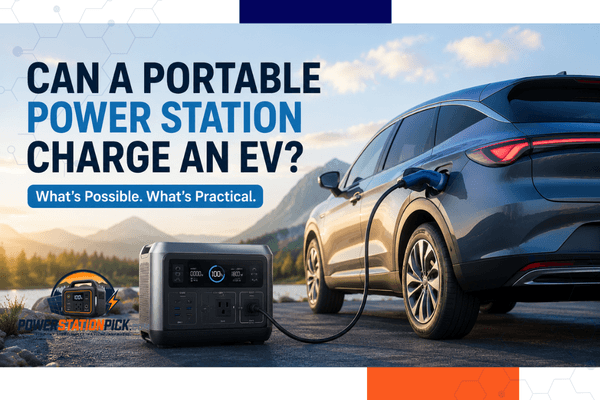
Can a portable power station charge an EV? Yes—but only in specific emergency or off-grid camping situations. A portable power station can act as an electrical safety net, supplying standard Level 1 AC charging to add roughly 3 to 5 miles of driving range per hour of transfer. To execute this successfully, your station must feature a Pure Sine Wave inverter delivering at least 1,500W of continuous output, and you must utilize a neutral-ground bonding plug to bypass the vehicle’s automatic open ground fault error. It is strictly an emergency “jerrycan” top-off, not a replacement for daily home charging or DC fast chargers.
If you visualize throwing a small camping battery into your trunk as a backup safety net to prevent getting stranded on a remote road trip, the reality of electrical conversion metrics may surprise you. Electric vehicles are high-capacity, heavy-duty machines. Portable power stations are essentially compact energy reserves designed for consumer electronics and appliances.
When you bridge these two worlds together, you face severe efficiency losses, tricky grounding faults, and relatively long charging times. This comprehensive manual breaks down the real physics, exact range math, and structural safety precautions you need to know before attempting to hook up an electric car to a portable battery backup system.
Can a Portable Power Station Charge an EV?
The short answer is yes, but you must understand the distinction between possible and practical. You cannot simply buy a standard $500 portable power station, plug in a 60,000-watt-hour electric car, and expect a meaningful range increase.
Using a portable power station for EV charging works exclusively as an emergency EV charging strategy or as a very slow, baseline alternative for off-grid EV charging while camp-hosting for days at a time. It is a slow, iterative top-off designed to deliver an extra 5 to 20 miles of driving buffer.
Think of it as the electrical equivalent of carrying a one-gallon plastic jerrycan of gasoline in the trunk of an old internal combustion car. It will not fill your tank, but it will keep you from paying for an expensive flatbed tow truck hookup if you miscalculate your distance to the next highway exit.
How EV Charging Actually Works
To understand why a portable battery for electric vehicle support behaves the way it does, we must first analyze the fundamental standards governing vehicle power input. EVs accept electricity via three distinct pathways defined by SAE International protocols.
Level 1 Charging
This format utilizes standard residential 120-volt alternating current (AC) electricity. It is the slowest charging framework available, pulling power through a standard three-prong wall socket. Most factory-supplied mobile connector cords default to this format, drawing roughly 12 Amps of continuous current.
Level 2 Charging
This is the standard for residential garages and public municipal parking spaces. It operates on 240-volt AC power, pulling anywhere from 16 to 80 Amps. It requires dedicated heavy-gauge lines and robust internal circuit breakers.
DC Fast Charging (Level 3)
This configuration bypasses the electric car’s internal conversion components completely. It pumps high-voltage direct current (DC) directly into the EV battery capacity cells at massive speeds, pushing anywhere from 50 kW to 350 kW of continuous energy.
When you draw power from a portable power station EV interface, you are almost always defaulting to a Level 1 EV charging profile. The power station must take the direct current stored in its internal lithium cells, push it through an internal inverter to output 120V AC power, and send it through your car’s charging cord. Once inside the car, the vehicle’s onboard charger (OBC) must convert that AC signal back into high-voltage DC to fill the car’s main drive pack.
| Charging Type | Voltage Rating | Power Delivery Threshold | Typical Replenishment Speed | Best Practical Application |
|---|---|---|---|---|
| Level 1 (AC) | 120V AC | 1.4 kW – 1.9 kW | 3 – 5 miles of range per hour | Overnight home garage or emergency backup |
| Level 2 (AC) | 240V AC | 3.6 kW – 19.2 kW | 15 – 45 miles of range per hour | Daily residential home charging setups |
| DC Fast Charging | 400V – 800V DC | 50 kW – 350 kW | 100 – 300+ miles in 20 minutes | High-speed interstate travel corridors |
| Portable Power Station | 120V (Standard) / 240V (Pro Hubs) | 1.4 kW – 3.6 kW | 2 – 10 miles of range per hour | Emergency survival or remote campsite basecamps |
Why Most Portable Power Stations Cannot Fully Charge an EV
The core limitation comes down to an extreme mismatch in battery capacity scale. Portable power station capacities are generally measured in Watt-hours (Wh), whereas electric vehicle battery sizes are calculated in Kilowatt-hours (kWh). One kilowatt-hour equals exactly 1,000 watt-hours.
A high-end, premium portable power station designed for off-grid camping typically houses around 2,000Wh of total energy storage. That sounds like a lot when running a travel fridge or laptop, but it amounts to just 2 kWh of absolute capacity.
In comparison, a standard modern electric crossover like the Tesla Model Y or Hyundai Ioniq 5 features an internal battery pack sizing between 75 kWh and 84 kWh.
The Energy Capacity Scale Disconnect
| Portable Power Station Model Class | Total Internal Capacity (Wh) | Capacity in Kilowatt-Hours (kWh) | Percentage of a Standard 75kWh EV Pack |
|---|---|---|---|
| Compact Tailgate Unit | 300 Wh | 0.3 kWh | 0.4% |
| Mid-Sized Camping Unit | 1,000 Wh | 1.0 kWh | 1.3% |
| Heavy-Duty Overlanding Box | 2,000 Wh | 2.0 kWh | 2.6% |
| Premium Home Emergency Hub | 4,000 Wh | 4.0 kWh | 5.3% |
| Flagship Expandable Power Rig | 6,000 Wh | 6.0 kWh | 8.0% |
Looking at these metrics, even if you deploy a massive, heavy premium emergency backup unit, you are still only carrying enough raw energy to fill roughly 5% to 8% of a completely depleted electric car battery pack. This is why you must maintain realistic performance expectations.
How Much Range Can You Realistically Add?
To calculate the exact driving distance you can claw back from a portable battery backup for EV systems, we have to look past basic marketing claims and do some rigorous electrical math. Two major efficiency losses heavily drain your energy reserves during this process:
- Inverter Efficiency Loss: Portable power stations suffer an average 15% energy loss when converting internal DC battery power into an AC wall outlet output.
- Onboard Charger (OBC) Thermal & System Overhead: When an electric vehicle is actively charging, its internal thermal computers, cooling pumps, and cabin sensors stay awake. This steady vehicle system overhead consumes roughly 200 to 300 Watts of power continuously just to run the charging process. At low-amp Level 1 speeds, this background draw can eat up 15% to 20% of the incoming power signal.
Combined, your total round-trip charging efficiency hovers around 68% to 72%. This means a 2,000Wh (2 kWh) power station only delivers about 1.4 kWh of actual, usable energy directly into your EV’s drive pack cells.
An average electric crossover achieves roughly 3 to 3.5 miles of driving distance per kilowatt-hour of energy under temperate weather conditions. A more aerodynamic sedan can hit closer to 4 miles per kWh.
Real-World Driving Range Added Estimates
| Station Base Capacity | Usable Output to EV Pack (Factoring ~30% Total Loss) | Distance Added: Aerodynamic Sedan (~4 miles/kWh) | Distance Added: Crossover / Compact SUV (~3 miles/kWh) | Distance Added: Heavy EV Truck (~2 miles/kWh) |
|---|---|---|---|---|
| 1,000Wh (1 kWh) | 0.70 kWh | ~2.8 Miles | ~2.1 Miles | ~1.4 Miles |
| 2,000Wh (2 kWh) | 1.40 kWh | ~5.6 Miles | ~4.2 Miles | ~2.8 Miles |
| 4,000Wh (4 kWh) | 2.80 kWh | ~11.2 Miles | ~8.4 Miles | ~5.6 Miles |
| 6,000Wh (6 kWh) | 4.20 kWh | ~16.8 Miles | ~12.6 Miles |
Popular US Electric Vehicle Driving Efficiency References
| Electric Vehicle Model | Factory Battery Pack Volume (kWh) | Real-World Driving Efficiency Baseline | Maximum Range from a 4,000Wh Station |
|---|---|---|---|
| Tesla Model 3 Long Range | 75.0 kWh | 4.1 miles per kWh | ~11.4 Miles |
| Tesla Model Y Crossover | 75.0 kWh | 3.4 miles per kWh | ~9.5 Miles |
| Hyundai Ioniq 5 | 77.4 kWh | 3.2 miles per kWh | ~8.9 Miles |
| Ford Mustang Mach-E | 91.0 kWh | 3.0 miles per kWh | ~8.4 Miles |
| Chevrolet Equinox EV | 85.0 kWh | 3.2 miles per kWh | ~8.9 Miles |
| Ford F-150 Lightning Truck | 131.0 kWh |
The Vital Technical Requirements for EV Battery Power Backup
You cannot simply plug an EV charging cord into any generic battery pack that has an AC outlet. Electric vehicles enforce strict electrical safety rules before they allow their high-voltage contactor switches to snap closed.
Pure Sine Wave Inverter Output
Your power station must feature a premium Pure Sine Wave inverter. Modified sine wave inverters—frequently found on cheap, low-end backup hardware—generate electrical noise and choppy AC waveforms. Attempting to pass a modified sine wave signal into an electric vehicle will instantly cause its internal safety computer to flag an error, blocking power transmission entirely to protect its delicate electronics.
Minimum Continuous Inverter Wattage
Most standard portable EVSE cords draw a baseline threshold of 12 Amps at 120 Volts. This sets your continuous power draw at 1,440 Watts. Your power station’s inverter must be rated to supply at least 1,500W to 1,800W of continuous running power, not just peak surge capacity. If your station handles a max continuous threshold of only 1,000W, the vehicle’s initial current draw will trip the power station’s internal safety breaker immediately.
The Floating Neutral Dilemma: Why Your EV Will Refuse to Charge
The most common roadblock users encounter when trying to charge an electric car with a portable power station is a grounding fault error.
Standard home electrical grids utilize a bonded system where the neutral line connects directly to the physical copper grounding rod driven into the earth. Electric Vehicle Supply Equipment (EVSE) charging cords check for this connection automatically to ensure you do not suffer an uninsulated electrical shock while plugging in your vehicle in a rain-slicked driveway.
However, nearly all portable power stations utilize a floating neutral configuration for safety when operating as standalone units. Because the station sits isolated on its rubberized feet, the neutral line does not share a physical pathway with the chassis frame ground circuit.
When you hook up your EV charging cord directly to the station’s AC faceplate outlets, the cord’s internal logic controller scans the line, detects the missing neutral-to-ground link, flashes an “Open Ground Fault” warning light, and safely locks out the entire charging process.
🛠️ The Grounding Solution: Neutral-Ground Bonding Plugs
To bypass this open ground error code, you must insert a specialized Neutral-Ground Bonding Plug into any secondary vacant AC socket on the power station faceplate. This simple dummy plug contains an internal jumper wire that bridges the neutral slot directly over to the circular ground pin slot. This loops the circuit, satisfy the EVSE cord’s safety checks, and allows the power station to charge your vehicle smoothly.
When Does Using a Portable Power Station for EV Charging Make Sense?
Given these distinct performance restrictions, deploying a portable battery backup makes the most sense in targeted off-grid scenarios:
Remote Overlanding and Backcountry Camping
If you frequently use your electric vehicle to charge EV while camping in isolated wilderness areas far from public infrastructure, an expandable power station can save the day. While staying at a basecamp for four to five days, you can connect large solar arrays to slowly top off the power station, which can then feed that energy back into your vehicle to replace any background power drain.
Emergency Stranded Survival
If you miscalculate an interstate driving route or experience severe cold-weather range drop, running completely out of battery power can leave you stranded in an unsafe location. Carrying a mid-sized power station in your lower trunk space gives you a valuable self-rescue option, adding just enough mileage to reach a nearby farm or small town outlet without requiring a tow truck.
Extended Storm Power Failures
During a major natural disaster or grid failure, your home charging setup will stay offline for days. Having a high-capacity expandable home backup battery panel allows you to slowly bleed energy into your vehicle’s drive pack to keep its cabin climate control ready or to handle short local utility transit runs.
When It Does Softly Drop Off: Scenarios Where It Makes No Sense
- Daily Commuting Cost Reductions: Attempting to charge your vehicle from a portable power station daily to save money on your residential electricity bill is a losing strategy. The ~30% conversion efficiency loss means you waste a massive amount of power just running the transfer process.
- Rapid Transit Needs: If you are running late for an appointment and need an instant, high-speed power boost, a portable power station cannot help. Level 1 transfer speeds add only 3 to 5 miles of range per hour, which is far too slow for time-sensitive situations.
Can You Charge a Tesla with a Portable Power Station?
Yes, you can execute a Tesla emergency charging run using a portable power station, but you have to plan around Tesla’s sensitive monitoring systems.
To charge a Tesla vehicle successfully, you will need to utilize your factory-issued Tesla Mobile Connector cord. Because modern Tesla models have transitioned to the North American Charging Standard (NACS) format, if your power station features an direct integrated EV outlet port (like an older SAE J1772 plug format), you will need to clip on a standard J1772-to-NACS conversion adapter block.
Tesla’s internal charging computers are incredibly sensitive to voltage drops and grounding consistency. If your power station’s battery drops low and its output voltage sags below roughly 108 Volts, the car will instantly stop drawing power and flash an alert code on the center touchscreen console.
To ensure success, always configure the car’s interior charging control screen to lock the maximum current draw at 12 Amps (or drop it down to 8-10 Amps) before starting the process. This lowers the continuous stress on the power station’s inverter components, reducing fan noise and keeping voltage lines perfectly stable.
Can Solar Panels Charge an EV Through a Portable Power Station?
Yes, you can construct a functional portable solar generator for EV replenishment, but you must remain objective about the time requirements.
When attempting this off-grid configuration, you are dealing with a complex multi-stage conversion chain that experiences significant energy losses at each step:
To gather enough photovoltaic energy to pass through this chain and add meaningful range to an electric vehicle, you need serious surface area. A standard premium folding 400-Watt solar panel array requires roughly 5 to 6 hours of unshaded, direct midday sunlight to generate 2,000Wh (2 kWh) of raw storage power.
Once you route that 2 kWh storage reserve through the system’s electrical conversion losses, you will only add about 4 to 5 real-world driving miles to your car’s pack. Therefore, running an EV completely off solar panels via a portable power station requires setting up camp for multiple days and utilizing massive, multi-panel arrays.
Best Portable Power Stations for Emergency EV Charging
When tracking down the best portable power station for EV support, your choices fall into three distinct capability size tiers. Smaller, low-capacity camping power banks can be skipped entirely, as they lack the inverter output size needed to run an EVSE cord.
Verified Portable Power Stations for EV Support
| Model Tier | Representative Models | Inverter & Capacity Specs | Estimated Range Added | Practical Charging Context |
|---|---|---|---|---|
| Entry-Level / Small (Bare Minimum) | • EcoFlow Delta 2 Max • Anker SOLIX C1000 • Jackery Explorer 1000 v2 | 1,000Wh – 2,000Wh Capacity 1,500W – 2,400W Inverter | ~2 to 4 Miles | Strict emergency use only. Adds just enough range to cross a highway exit or move clear of a dangerous intersection. |
| Mid-Sized / Practical (Recommended) | • Anker SOLIX F2600 • Bluetti AC200L • EcoFlow DELTA 3 Plus | 2,000Wh – 2,500Wh Capacity 2,400W continuous output | ~5 to 8 Miles | Decent safety buffer for remote backcountry vehicle overlanding and weekend campground trailering setups. |
| Pro / Expandable Hubs (High Performance) | • EcoFlow Delta Pro Ultra • Anker SOLIX F3800 • Bluetti AC500 Power Hub | 3,800Wh – 6,000Wh+ Base 3,600W – 6,000W Inverter (240V) | ~12 to 20+ Miles | True residential grade systems. Features native NEMA 14-50 or TT-30 outlets to support fast, robust Level 2 charging profiles. |
Pros and Cons Matrix
Table 6: Summary Pros vs. Cons Matrix
Frequently Asked Questions
Can a Jackery power station charge a Tesla?
Yes, provided the Jackery unit features a pure sine wave inverter rated for at least 1,500 Watts of continuous AC output (such as the Jackery Explorer 1000 v2 or 2000 Plus). You will also need to insert a neutral-ground bonding plug into a vacant AC outlet slot on the faceplate to bypass Tesla’s open ground error lockout.
Will charging an electric vehicle damage the portable power station?
No. As long as your vehicle’s current draw matches the power station’s continuous output limits, it will not cause any damage. The power station’s internal Battery Management System (BMS) manages current flows and thermal cooling dynamically to ensure safe operation.
How many miles of driving range can a 2,000Wh power station add?
Because of conversion overhead losses through the inverter and the vehicle’s internal computer loops, a 2,000Wh station delivers about 1.4 kWh of actual energy to the vehicle’s pack. This translates to roughly 4 to 6 real-world driving miles for an efficient electric sedan or crossover.
Can I charge my EV from a power station while driving?
No. Modern electric cars feature electronic safety overrides that lock out the drive motor the moment a charging connector pin seats into the vehicle’s charge port. The car must be completely parked in “Park” to initiate power transfer.
Can a portable battery replace my home Level 2 charging garage system?
No. A Level 2 residential wall charger supplies between 7.2 kW and 11.5 kW of continuous power to refill an EV overnight. Standard portable power stations deliver power at much slower Level 1 speeds (1.4 kW), making them unfeasible for daily residential charging needs.
Why does my electric car flash a grounding error code when plugged into my battery station?
This happens because portable batteries utilize an isolated, floating neutral circuit layout for safety. Since the vehicle’s mobile charging cord requires a bonded neutral-to-ground link to ensure user safety, it blocks power transmission until you resolve the fault using a neutral-ground bonding plug.
Can you use portable solar panels to charge an EV through a power station?
Yes, but the process requires patience. A large 400-Watt folding panel array needs roughly 5 to 6 hours of clear, unshaded direct sunlight to generate enough energy to add about 5 miles of real-world driving range to your vehicle.
Is it safe to charge an electric car from a portable generator in the rain?
You should keep your portable power station chassis and open cable terminals sheltered and completely dry to prevent short circuits. However, the connection between your vehicle’s charging port and the EVSE plug is weather-sealed and safe to run in damp conditions once properly seated.
What inverter size do I need to run a standard factory EV mobile connector?
Most standard factory mobile connectors draw roughly 12 Amps of current at 120 Volts, creating a continuous power demand of 1,440 Watts. Therefore, your power station must feature an inverter rated for at least 1,500W to 1,800W of continuous output.
Can I use an EV battery backup unit inside my apartment?
Yes, completely. Unlike conventional gas or diesel combustion generators, portable lithium battery stations produce zero hazardous exhaust fumes or carbon monoxide emissions, making them perfectly safe to run inside enclosed residential spaces.
Does cold weather affect charging efficiency from a power station to an EV?
Yes. Dropping temperatures slow down chemical reactions inside lithium batteries and increase the vehicle’s background energy draw to run its internal cell heaters. This extra overhead reduces your total charging transfer efficiency significantly in freezing weather.
Can a portable power station provide true Level 2 charging speeds?
Only large flagship units equipped with specialized 240V outlets (such as the Anker SOLIX F3800 or EcoFlow Delta Pro Ultra) can deliver Level 2 power outputs (3.6 kW to 7.2 kW). Standard, single-box portable stations are limited to Level 1 speeds.
Should You Buy a Portable Power Station for EV Charging? The Final Verdict
Who should buy a portable power station for EV support:
- Remote Off-Grid Adventurers: If you frequently overland or camp in wilderness areas far from public charging stations, a high-capacity power station paired with solar panels offers a valuable safety net.
- Preparedness-Minded Drivers: If you live in a rural area prone to frequent winter power failures, keeping a high-output battery hub handy gives you a reliable way to add an emergency driving buffer when the grid goes down.
Who should completely skip it:
- Budget-Minded Daily Commuters: If your primary goal is reducing your daily driving costs, a portable power station is not the answer. The efficiency losses during power transfers make it far more economical to charge directly from a standard residential wall outlet.
Table 7: Strategic Buying Decision Matrix
| If Your Primary Goal Is: | The Recommended Path Forward: | Final Strategic Assessment |
|---|---|---|
| Emergency situational backup protection | Purchase a heavy-duty 2,048Wh LiFePO4 station along with a matching neutral-ground bonding plug. | Highly Feasible Product Match |
| Long-duration off-grid wilderness camping | Invest in a modular expandable power hub paired with at least 400 Watts of folding solar panels. | Feasible, but requires clear sunlight |
| An affordable alternative to a residential Level 2 wall installation | Hire a local electrician to install a dedicated 240V NEMA 14-50 outlet in your garage. | Completely Unfeasible; avoid this path |
Ultimately, using a portable power station to charge an electric car is a technically possible but highly limited solution. Think of it as an emergency reserve rather than a day-to-day charging method. While it can safely deliver those critical few miles needed to reach a high-speed charger during a highway emergency or a remote camping trip, it remains an emergency safety net rather than a practical alternative for everyday vehicle refueling.

Hi, I’m Andrew Richards. I created PowerStationPick to share what I’ve learned about portable power through real-world use—what actually works, what doesn’t, and what makes sense for different situations. I focus on helping you choose the right setup for home backup, camping, and everyday needs without overcomplicating things.