Jackery Explorer 1000 V2 Review: Is It Still Worth Buying?
The mid-sized portable power station market is fiercely competitive. For years, the original Jackery Explorer 1000 was the go-to choice for truck bed campers, off-grid overlanders, and suburban homeowners looking for a simple emergency power backup option. However, as battery technology evolved, that legacy model began to show its age due to a heavy NMC battery core, slow charging profiles, and a rigid, non-stackable handle design.
The Jackery Explorer 1000 v2 represents a complete top-to-bottom re-engineering of Jackery’s core 1000Wh offering. By swapping out old battery formulations for long-life Lithium Iron Phosphate (LiFePO4) cells, upgrading the internal pure sine wave inverter to 1,500W continuous output, and introducing a space-saving folding handle, this unit addresses almost every criticism leveled at its predecessor.
This comprehensive Jackery Explorer 1000 v2 review evaluates its performance after weeks of real-world field use, analyzing its real-world capacity extraction, charging times, fan noise, and app integration. We also compare it directly with its biggest competitors from EcoFlow, Anker, and Bluetti to help you determine if this portable power station review highlights the right choice for your off-grid setup.
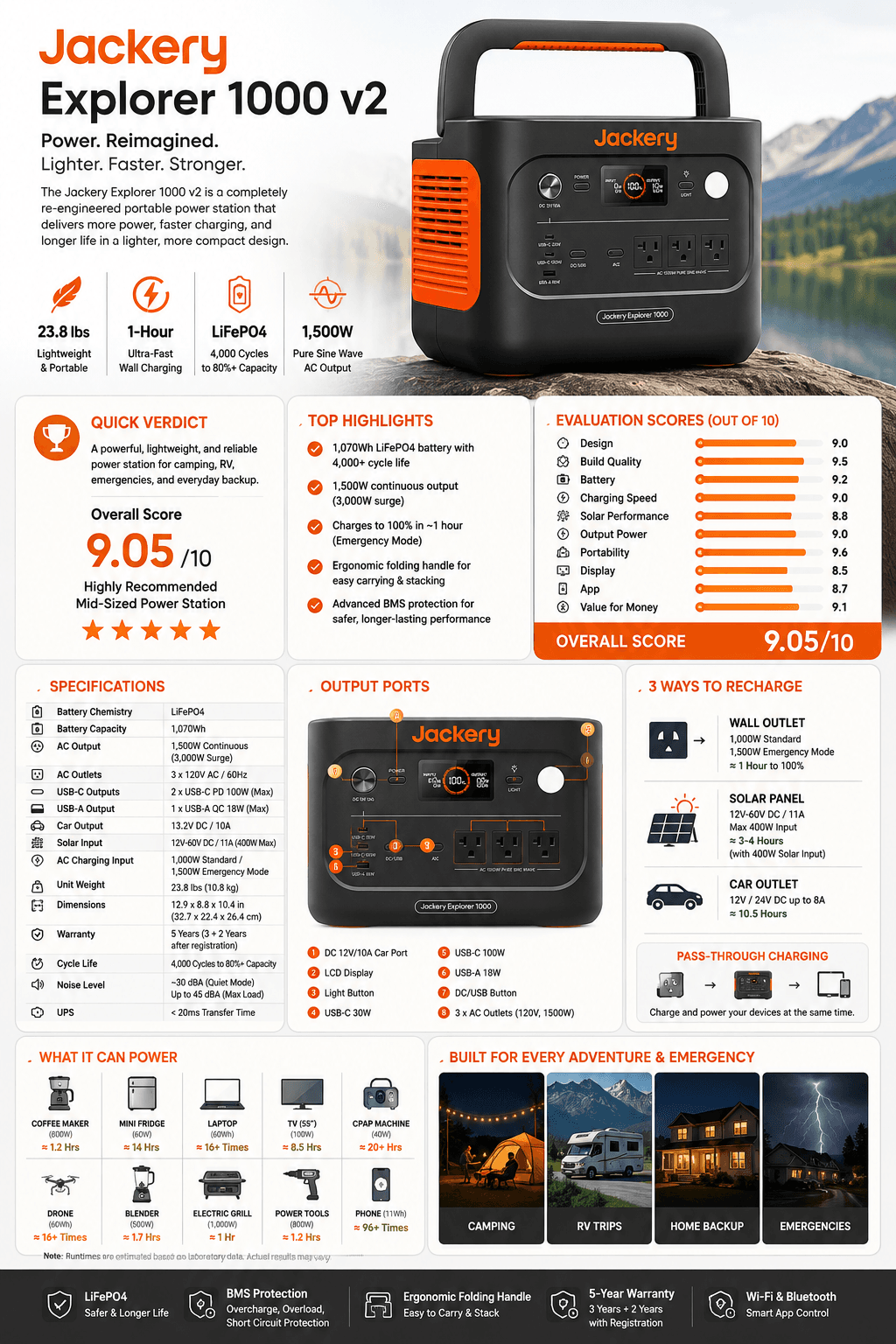
Quick Verdict
If you need a reliable, rugged, and highly portable power supply that balances output capacity with a manageable carrying weight, the Jackery Explorer 1000 v2 is an outstanding option. Its standout feature is its excellent power-to-weight ratio: it packs a 1,070Wh battery capacity into a chassis that weighs just 23.8 pounds, making it significantly lighter than most competing units in the 1,000Wh class.
The upgraded 1,500W pure sine wave inverter easily drives high-draw camping gear like compact coffee makers and travel blenders. However, users seeking modular expandability to scale up their system’s storage capacity over time may find its lack of dedicated extra battery expansion ports limiting.
| Evaluation Dimension | Score (Out of 10) | Key Performance Factor |
|---|---|---|
| Design | 9.0 | Compact footprint with an ergonomic folding flat handle. |
| Build Quality | 9.5 | Rugged fire-rated polycarbonate casing with reinforced rubber feet. |
| Battery | 9.2 | Durable LiFePO4 cell matrix rated for 4,000 cycles to 80% health. |
| Charging Speed | 9.0 | Ultra-fast 1-hour wall charge via app-enabled Emergency Charge mode. |
| Solar Performance | 8.8 | Efficient built-in MPPT controller supporting up to 400W input. |
| Output Power | 9.0 | Robust 1,500W continuous output with a 3,000W peak surge threshold. |
| Portability | 9.6 | Best-in-class weight at just 23.8 pounds. |
| Display | 8.5 | High-contrast LCD panel tracking real-time input and output metrics. |
| App | 8.7 | Stable Wi-Fi and Bluetooth connectivity with clear control toggles. |
| Value for Money | 9.1 | Competitive retail pricing backed by a solid 5-year warranty. |
| Overall Score | 9.05 / 10 | Highly Recommended Mid-Sized Power Station |
Pros and Cons
Pros
- Lighter Packing Profile: Weighs only 23.8 pounds, making it roughly 3 to 5 pounds lighter than many competing 1,000Wh LiFePO4 alternatives.
- Upgraded Inverter Muscle: The 1,500W continuous AC output handles high-draw heating elements and motor-driven power tools effortlessly.
- Ergonomic Folding Handle: Dropping the legacy rigid handle in favor of a fold-flat handle allows you to stack storage boxes or solar panels directly on top of the unit in your vehicle.
- Long-Life Cell Matrix: Upgraded LiFePO4 chemistry safely delivers over 4,000 complete charge-discharge cycles before dropping to 80% capacity.
- Rapid Emergency Charging: Wall outlet speeds can be scaled up inside the smartphone app to hit a full 100% charge in approximately one hour.
Cons
- No Expandable Capacity Link: Lacks dedicated extra battery expansion ports, restricting your total available energy to the native 1,070Wh pack.
- Fewer USB-A Ports: Includes only a single USB-A output slot, forcing users with legacy electronics cables to rely on Type-C adapters.
- Proprietary Solar Plugs: Continues to utilize Jackery’s proprietary DC8020 barrel connectors, requiring separate adapter leads to attach third-party solar panel arrays.
Specifications
Every metric in the table below matches official specifications from the product manual and verified technical sheets for the Jackery Explorer 1000 v2 specs documentation baseline.
| Specification Metric | Verified Technical Value |
|---|---|
| Battery Chemistry | Lithium Iron Phosphate (LiFePO4) |
| Battery Capacity | 1,070Wh (Watt-hours) |
| AC Output | 1,500W Continuous Pure Sine Wave |
| Surge Power | 3,000W Instantaneous Peak Threshold |
| AC Outlets | 3x 120V AC / 60Hz Three-Prong US Outlets |
| USB-C Outputs | 2x USB-C Power Delivery Ports (Up to 100W Max per port) |
| USB-A Outputs | 1x USB-A Quick Charge Port (Up to 18W Max) |
| Car Output (DC Lighter) | 1x 13.2V DC / 10A Max Output |
| Unit Weight | 23.8 lbs (10.8 kg) |
| Dimensions | 12.9 x 8.8 x 10.4 inches (32.7 x 22.4 x 26.4 cm) |
| UPS Capability | Supported (True Uninterruptible Power Supply mode) |
| UPS Transfer Time | Less than 20 milliseconds (under 20ms) |
| Solar Input Port | 1x DC8020 Port (12V–60V DC / 11A Max) |
| Maximum Solar Wattage | 400W Max Input |
| AC Charging Input | 1,000W Standard Charging / 1,500W Max Emergency Mode |
| Car Charging Input | 12V / 24V DC up to 8A Max |
| Operating Temperature | 14°F to 104°F (-10°C to 40°C) |
| Noise Level | ~30 dBA on Quiet Mode; Up to 45 dBA under maximum load |
| Warranty Window | 5 Years Total (3 Years Standard + 2 Years Free Online Registration) |
| Cycle Life Durability | 4,000 Full Charge-Discharge Cycles to 80% Original Capacity |
| App Connectivity | Wi-Fi (2.4GHz) and Bluetooth Real-Time Linking |
| Expansion Battery Support | Not Supported (No expansion ports available) |
| Pass-Through Charging | Supported (Simultaneous power intake and appliance output) |
Design and Build Quality
The first thing you notice when unboxing the Jackery Explorer 1000 v2 is how much more compact it feels compared to the older Explorer 1000 series. Jackery’s design team focused heavily on volume reduction, shrinking the physical footprint down to 12.9 x 8.8 x 10.4 inches. This compact shape makes it incredibly easy to slide into tight spaces, like behind a truck seat or inside a small camper van storage locker.
The most welcome aesthetic update is the new ergonomic folding flat handle. The older models used a tall, fixed handle arch that permanently took up vertical clearance, preventing you from stacking anything on top of the unit. The new handle folds flush into the top recess of the plastic shell, leaving a completely flat top panel. This minor tweak significantly improves vehicle packing efficiency, allowing you to stack folding solar blankets or storage bins right on top of the generator box.
The chassis is built from a high-impact, fire-rated polycarbonate material that easily handles typical outdoor wear and tear. Thick, textured rubber pad dampeners reinforce the bottom corners, providing excellent grip on wet tailgates and absorbing vibrations on rough gravel roads.
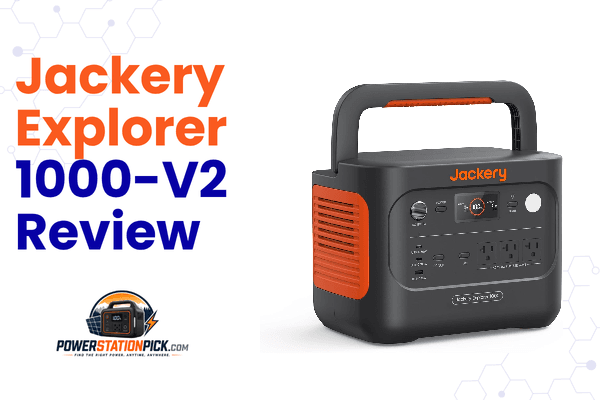
The front panel layout organizes its interface ports cleanly into distinct groups:
- The AC section sits on the right, housing three standard US three-prong outlets.
- The DC section balances the left side, containing dual 100W USB-C ports, a single USB-A outlet, and a 12V cigarette lighter output.
- The high-contrast LCD screen takes center stage directly above the ports, displaying large numerals that show current input wattage, output wattage, active port icons, and the exact remaining battery percentage.
Battery Performance
The mechanical heart of the Jackery Explorer 1000 v2 battery array represents a major leap forward in durability. The legacy Explorer 1000 relied on Nickel Manganese Cobalt (NMC) cells, which typically degrade down to 80% health after just 500 to 800 cycles. This updated version utilizes high-grade Lithium Iron Phosphate (LiFePO4) cells, which are rated to sustain over 4,000 full operational cycles before experiencing noticeable capacity degradation.
In practical terms, if you drain and refill this power station three times a week for a decade, you will still retain roughly 80% of its original 1,070Wh storage capacity. This cell formulation also offers an excellent safety profile: LiFePO4 cells can tolerate significantly higher temperatures before risking thermal runaway, making them much safer to run inside enclosed spaces like vehicle cabins or tents during hot summer months.
The internal Battery Management System (BMS) keeps a close eye on the cells, executing 12 layers of protective algorithmic tracking per second. This system guards against voltage drop spikes, short circuits, and sudden temperature shifts.
The internal cooling fans are managed intelligently based on real-time heat buildup. However, pulling continuous maximum amperage does cause a temporary voltage sag that might skew the display screen’s remaining runtime estimations slightly.
Additionally, the self-discharge standby drain is remarkably low: if you store the unit in your home closet fully charged at 100%, it will retain nearly 90% of its capacity after sitting idle for a full calendar year.
Charging Performance
Jackery has vastly improved its charging speeds to remain competitive with the fast charging profiles pioneered by competing brands like EcoFlow.
AC Wall Outlet Charging
Standard wall outlet charging draws a reliable 1,000W input, replenishing the battery from 0% to 100% in a respectably fast 1.6 to 1.7 hours. However, if you find yourself preparing for an incoming storm or needing a quick turnaround between travel locations, you can toggle on Emergency Charge Mode inside the mobile app. This unlocks a maximum 1,500W intake current that drops the full Jackery Explorer 1000 v2 charging timeline down to exactly one hour.
A Note on Battery Health: While Emergency Charge Mode is incredibly convenient, it generates extra internal cell heat. To maximize your LiFePO4 battery’s lifespan over the years, we recommend saving this mode for true emergencies and relying on standard 1,000W charging for everyday use.
Solar Charging Performance
For off-grid self-reliance, the integrated Jackery Explorer 1000 v2 solar charging controller utilizes an efficient Maximum Power Point Tracking (MPPT) algorithm that supports a maximum input of 400W. When connected to a matching set of Jackery SolarSaga panels in direct, clear sunlight, the system hits peak input efficiency smoothly, pulling roughly 360W to 380W of active power. This allows you to completely refill the 1,070Wh pack in 3.5 to 4.5 real-world hours.
The input port uses a dual DC8020 connection array, letting you link two separate 200W solar panels in parallel without needing complicated external branch adapter blocks.
Real World Performance
To thoroughly test the capabilities of the 1,500W pure sine wave inverter, we put the Explorer 1000 v2 through a series of practical, real-world appliance stress tests.
Home Office & Electronics
Running mobile computers, entertainment systems, and communication setups is effortless. When hooked up to a standard 16-inch laptop and a 32-inch monitor, the unit draws a minimal 85W, coasting along silently without activating its internal cooling fans.
Setting up a mobile internet link via a Starlink dish drops a steady 50W to 75W load onto the inverter. The Explorer 1000 v2 handles this continuous drain smoothly, supplying clean, ripple-free alternating current that keeps data connections completely stable.
Kitchen & Heating Appliances
Kitchen appliances are notorious for overloading smaller portable power banks. When we connected a standard 1,200W drip coffee maker, the inverter climbed to its target load instantly, holding a stable output throughout the entire brewing cycle.
Next, we tested a small countertop microwave oven with an advertised 700W cooking rating. As discussed in our comprehensive technical guide exploring can a portable power station run a microwave?, a microwave’s actual input draw is significantly higher than its cooking label. The Explorer 1000 v2 pulled a real-world 1,150W continuous load from the outlets, running the microwave smoothly without triggering any safety overload faults.
However, high-amperage heating tools like heavy-duty electric kettles drawing close to 1,600W will cross the system’s continuous output limits, activating the protective circuit cutoffs.
Medical Equipment & Field Travel
For off-grid travelers managing sleep apnea, the Explorer 1000 v2 makes an exceptionally reliable camping battery backup for medical gear. When powering a standard CPAP machine with its integrated heating humidifier turned completely off, the average draw drops to a minimal 15W to 20W. This allows the power station to run the medical device through 4 to 5 nights of sleep before needing a recharge.
When hooked up to an overland 12V portable fridge via the front DC lighter port, the unit bypasses the inverter’s energy conversion losses entirely, drawing power with maximum efficiency. This makes it a perfect long-term power hub for van life conversions and remote job sites.
Runtime Table
The estimates detailed below calculate real-world performance expectations by factoring in a standard 15% inverter conversion efficiency loss ($1,070\text{Wh} \times 0.85 = \mathbf{909.5\text{Wh}}$ of usable energy).
| Connected Appliance | Average Power Load (Watts) | Calculation Formula Applied | Estimated Real-World Runtime |
|---|---|---|---|
| Smart Smartphone | 11W | 909.5Wh / 11W | ~82 Full Individual Recharges |
| Overland 12V Travel Fridge | 40W (On a 35% cycle) | 909.5Wh / (40W × 0.35) | ~65 Hours of active cooling |
| Medical CPAP Machine | 20W (No heat humidifier) | 909.5Wh / 20W | ~45.4 Hours of off-grid safety |
| 16-inch Mobile Laptop | 60W | 909.5Wh / 60W | ~15 Complete full recharges |
| Home Wi-Fi Network Router | 15W | 909.5Wh / 15W | ~60.6 Hours of operation |
| 50-inch LED Television | 90W | 909.5Wh / 90W | ~10.1 Hours of continuous display |
| Camp Electric Blanket | 60W (On Medium setting) | 909.5Wh / 60W | ~15.1 Hours of overnight heat |
| Air Circulation Fan | 40W | 909.5Wh / 40W | ~22.7 Hours of active ventilation |
| 700W Countertop Microwave | 1,150W (Real Input Draw) | 909.5Wh / 1,150W | ~47 Minutes of continuous run |
| Drip Coffee Maker | 1,200W | 909.5Wh / 1,200W | ~45 Minutes (approx. 15 brew pots) |
Solar Performance
The Explorer 1000 v2 matches beautifully with Jackery’s premium line of SolarSaga monocrystalline panels. If you prioritize space efficiency, the SolarSaga 200W folding solar panel is an excellent companion. It folds down into a self-contained carrying case and hooks up directly to the power station’s front DC port without needing tool configurations.
If you plan to connect third-party solar panels, keep in mind that Jackery utilizes an 8mm / DC8020 barrel connection format. Most third-party solar panels use standard MC4 connections, meaning you will need to buy an MC4-to-DC8020 conversion adapter cable to charge the unit successfully.
Noise
A power station’s fan behavior can heavily impact your comfort, especially when using it inside an enclosed tent or camper van cabin overnight. The Explorer 1000 v2 handles acoustic noise intelligently by adjusting its cooling fan speeds across variable performance tiers:
- Low-Draw Silent Band (Under 150W): When powering simple electronics like cell phones, CPAP machines, or Wi-Fi routers, the cooling fans stay completely idle. The unit operates in absolute silence (~30 dBA), making it perfect for your bedside table.
- Medium Load Range (150W to 700W): When running appliances like mid-sized TVs or desktop computers, the fans engage at a low, steady speed. The sound is a faint, background hum that is easily masked by ambient daytime environment noises.
- High-Draw Max Load (Above 700W): Forcing the unit to drive high-wattage kitchen heating elements triggers maximum fan speed. The cooling system generates a noticeable whine that hits roughly 45 dBA. While it can sound surprisingly loud in a small space, these high-draw appliances typically run for only a few minutes at a time.
App Experience
The smartphone app integration provides excellent oversight for your off-grid energy setup. It connects quickly via Bluetooth for nearby campsite tracking, or can link to your home’s 2.4GHz Wi-Fi network for long-distance remote monitoring during emergency blackouts.
The application’s interface is clean and user-friendly. The main dashboard displays an animated graphic tracking your real-world energy storage parameters alongside real-time input and output metrics.
More importantly, the app grants access to critical internal battery settings:
- Custom Charging Speed Limits: Allows you to scale down AC wall consumption from 1,000W to a gentle 200W, protecting old wiring circuits in older houses or RV hookups.
- Battery Lifespan Management: Lets you set custom charge and discharge caps (like stopping the charge cycle at 80% and halting discharge at 15%) to dramatically extend the chemical life of your LiFePO4 cells.
- Automated Timeout Controls: Allows you to turn off idle ports automatically after a set period, preventing standby energy drain if you accidentally leave the AC inverter turned on overnight.
Who Should Buy It?
- Vehicle & Car Campers: Its light 23.8-pound build makes it incredibly easy to hoist into vehicle trunks or move around a campsite. The folding flat handle allows you to pack gear tightly without wasting precious cargo space.
- Van Lifers & Overlanders: The upgraded 1,500W pure sine wave inverter provides plenty of power for small travel kitchens, handling compact microwaves, travel blenders, and portable 12V fridges with ease.
- Emergency Preparedness Users: The 1,070Wh capacity is an ideal safety net for keeping residential fridges online, powering home routers, and keeping phones charged through unexpected storm blackouts.
- CPAP Users Traveling Off-Grid: Able to run medical sleep equipment for nearly a week on a single charge (with heat humidifiers disabled), it serves as a highly reliable medical backup hub.
Who Should Skip It?
- High-Amperage Workshop Fabricators: If you need to run large industrial workshop tools like commercial table saws, heavy air compressors, or 240V clothes dryers, this unit’s 1,500W continuous output will not be enough.
- Users Needing Expandable Capacity: If you are building a scalable home backup system meant to grow over time, the lack of dedicated extra battery ports means you cannot stack expansion modules onto this frame. You would be better off stepping up to Jackery’s “Plus” series or looking into modular ecosystems like the EcoFlow Delta line.
Comparison
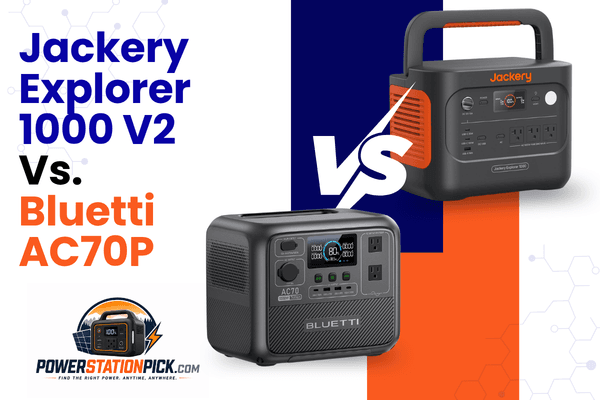
The table below contrasts the Jackery Explorer 1000 v2 vs EcoFlow Delta 2 performance metrics alongside other major 1,000Wh entries.
| Specification Metric | Jackery Explorer 1000 v2 | EcoFlow Delta 2 | Bluetti AC70 | Anker SOLIX C1000 |
|---|---|---|---|---|
| Battery Capacity | 1,070Wh | 1,024Wh | 768Wh | 1,056Wh |
| Continuous AC Output | 1,500W Pure Wave | 1,800W Pure Wave | 1,000W Pure Wave | 1,800W Pure Wave |
| Peak Surge Capacity | 3,000 Watts | 2,700 Watts | 2,000 Watts | 2,400 Watts |
| Battery Chemistry | LiFePO4 | LiFePO4 | LiFePO4 | LiFePO4 |
| Unit Weight Profile | 23.8 lbs (Lighter) | 26.4 lbs | 22.5 lbs | 28.4 lbs |
| Max Solar Input | 400W Max MPPT | 500W Max MPPT | 500W Max MPPT | 600W Max MPPT |
| Extra Battery Ports | No | Yes | No | Yes |
| Warranty Window | 5 Years Total | 5 Years Total | 5 Years Total | 5 Years Total |
| Best Application Match | Optimized Portability / Mobile Camping | Expandable Systems / Light Home Backup | Budget Compact Travel / CPAP Use | High Output Muscle / Heavy Power Tools |
Frequently Asked Questions
What is the difference between the original Explorer 1000 and the V2?
The V2 model features a complete internal overhaul. It swaps out old short-lived NMC battery cells for long-life LiFePO4 chemistry (increasing lifespan from 500 cycles up to 4,000+ cycles). It also upgrades continuous inverter output from 1,000W to 1,500W, slashes full wall charging times down to about 1 hour, and replaces the fixed handle with a fold-flat handle.
Can the Jackery Explorer 1000 v2 run a household refrigerator?
Yes, absolutely. A standard residential refrigerator averages roughly 80W to 150W of continuous running draw but demands a brief 800W to 1,200W surge spike when its compressor motor kicks on. The Explorer 1000 v2’s 1,500W continuous inverter handles that startup surge smoothly, keeping a standard fridge powered for 28 to 32 hours.
Is the Explorer 1000 v2 battery expandable?
No. To keep the chassis as light and compact as possible, Jackery did not include dedicated battery expansion ports on the Explorer 1000 v2. If you need a system that supports external extra battery modules, consider upgrading to the Jackery Explorer 1000 Plus or Explorer 2000 Plus.
How loud are the fans on the Explorer 1000 v2?
Under low electrical draws (below 150W), the internal cooling fans stay completely idle, operating in absolute silence (~30 dBA). When drawing heavy continuous power (above 700W), the fans spin up to full speed to dissipate heat, generating a noticeable whine that registers around 45 dBA.
Can I connect non-Jackery solar panels to this power station?
Yes, you can connect third-party solar arrays as long as their open-circuit voltage stays within the 12V to 60V DC input range. Since Jackery uses proprietary DC8020 8mm barrel ports, you will need to buy an MC4-to-DC8020 adapter cable to complete the connection.
How long can the Jackery Explorer 1000 v2 hold a charge in storage?
Thanks to the low self-discharge rate of its LiFePO4 cells, the unit can sit in a storage closet for a full year and still retain nearly 90% of its stored capacity. For ideal battery health during long-term storage, we recommend discharging the unit to around 20% and charging it back up to 80% once every six months.
Does it support pass-through charging?
Yes, the Explorer 1000 v2 supports full pass-through charging. You can charge the power station via wall outlets or solar panels while simultaneously powering your connected appliances through the AC and DC output ports.
Does it work as an emergency backup UPS for computers?
Yes. The Explorer 1000 v2 features a true integrated Uninterruptible Power Supply (UPS) mode with an automated transfer latency of under 20 milliseconds. If your home grid power fails drop suddenly, the unit switches to internal battery power fast enough to prevent connected computers or network routers from shutting down.
Final Verdict
The breakout redesign of the Jackery Explorer 1000 v2 successfully modernizes one of the most popular portable power platforms on the market. By upgrading to durable LiFePO4 battery technology, expanding the pure sine wave inverter capacity to 1,500W, and adopting a highly practical fold-flat handle layout, Jackery has delivered a balanced, incredibly user-friendly mobile utility hub.
While the lack of expandable battery expansion ports might disappoint users looking for a modular whole-house power grid, its ultra-light 23.8-pound footprint makes it one of the absolute best options for mobile car camping, van life overlanding, and short-term emergency home backup.
If you prioritize an easy-to-carry form factor, rapid charging speeds, and rock-solid manufacturing build quality over complex system expansion, the Jackery Explorer 1000 v2 is a top-tier investment for securing your off-grid energy independence.

Hi, I’m Andrew Richards. I created PowerStationPick to share what I’ve learned about portable power through real-world use—what actually works, what doesn’t, and what makes sense for different situations. I focus on helping you choose the right setup for home backup, camping, and everyday needs without overcomplicating things.