Different Types of Portable Power Stations: The Ultimate Guide
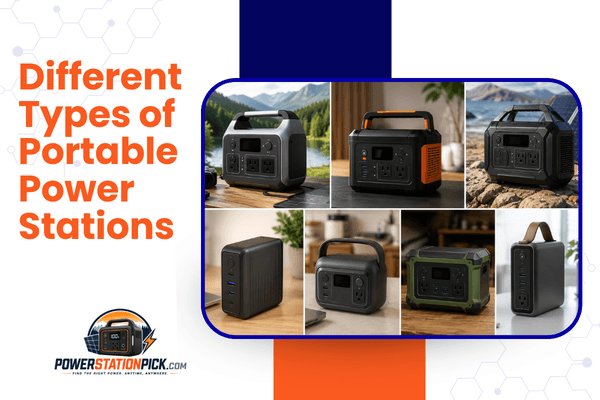
Not all portable power stations are built for the same job. A unit designed to keep a phone and a headlamp charged on a weekend hike has almost nothing in common with one designed to run a fridge through a multi-day outage — even though both get marketed under the same “portable power station” label. Before you compare specific models, it helps to understand the categories those models actually fall into, because the “best” power station changes completely depending on which type you actually need.
This guide breaks portable power stations down four different ways — by capacity, by use case, by battery chemistry, and by charging method — so you can narrow the field before you start comparing individual products.
🔍 Quick Reference: The Four Ways to Categorize a Power Station
| Category | What It Determines | Main Types |
|---|---|---|
| Capacity (Wh) | How much total energy it stores | Ultra-compact, Small/Mid, Mid-Large, Whole-Home |
| Use Case | What it’s optimized to run | Camping, Home Backup, Medical, RV, Off-Grid |
| Battery Chemistry | Lifespan and heat safety | Lithium-ion (NMC), LiFePO4 (LFP) |
| Charging Method | How fast and how flexibly it recharges | AC-Only, AC + Solar Hybrid, Fast-Charging |
Type 1: Portable Power Stations by Capacity
Capacity, measured in watt-hours (Wh), is the most fundamental way these units are categorized. If you’re still getting comfortable with what that number actually means, our What Does Wh Mean on a Battery? explainer covers it in plain terms before you read further.
Ultra-Compact (Under 300Wh)
These are built for portability first, capacity second — phones, small lights, a camera battery, maybe a laptop. Weight typically sits under 10 lbs, making them genuinely pocket-or-backpack friendly. Not built to run appliances with any real draw.
✅ Best for: minimalist backpacking, backup for a single device. ❌ Limitation: can’t run anything with a compressor, motor, or heating element.
Small/Mid-Capacity (500–800Wh)
This tier covers CPAP machines, small compressor fridges, laptops, and short-duration device charging. It’s the sweet spot for weekend camping and light emergency backup — our Bluetti AC70P Review and EcoFlow RIVER 2 Pro Review both fall in this range and illustrate the tradeoffs well.
✅ Best for: CPAP backup, weekend trips, short outages. ❌ Limitation: runs out fast if you add a microwave or power tool to the load.
Mid-Large Capacity (1,000–2,000Wh)
This is where units start comfortably handling microwaves, power tools, and multi-day camping trips without constant recharging. The Jackery Explorer 1000 V2, OUPES Mega 1, and Anker SOLIX C2000 all sit in this category, and we compare them directly against each other in our Jackery Explorer 1000 V2 vs. Bluetti AC70P head-to-head.
✅ Best for: the majority of camping and light home-backup buyers — the most versatile tier overall. ❌ Limitation: starts getting noticeably heavier (20–40+ lbs), less of a true grab-and-go unit.
Whole-Home / High Capacity (3,000Wh+)
Built for extended outages, multiple appliances running simultaneously, or off-grid living. These units are heavier, pricier, and often support expansion batteries to scale capacity further. We break this tier down in detail in our Pecron E3800LFP Review and compare the top contenders in the Portable Power Station Comparison Chart 2026.
✅ Best for: multi-day outages, off-grid setups, running several appliances at once. ❌ Limitation: significant upfront cost and weight — often 60–100+ lbs, closer to a fixed installation than a portable one.
Not sure which capacity tier actually matches your needs? Run your specific device list through our Power Station Sizing Calculator instead of guessing based on category alone.
Type 2: Portable Power Stations by Use Case
Capacity tells you how much power a unit stores — but two units with identical Wh ratings can still be built for very different jobs, based on output design and features.
Camping & Outdoor Use
Prioritizes weight, solar charging compatibility, and enough continuous output for a fridge, lights, and device charging. See Best Portable Power Station for Camping and How Many Watts Do I Need for Camping? for sizing specifics.
Home Backup & Emergency Preparedness
Prioritizes higher continuous wattage (to handle fridges, routers, and lighting simultaneously) and often UPS-style automatic switchover during outages. See Best Portable Power Station for Home and, for a specific high-surge scenario, our Sump Pump Backup guide.
Medical Device Backup
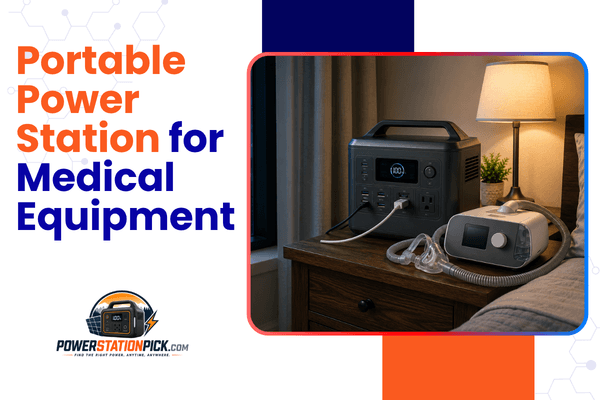
Prioritizes quiet operation and dependable, consistent output for CPAP machines, oxygen concentrators, and similar equipment where a power interruption isn’t just inconvenient. See our Portable Power Stations for Medical Equipment guide and Best Silent Power Station for CPAP Machine.
RV & Vehicle Use
Prioritizes higher AC output for RV appliances and often includes vehicle-specific charging options. See How to Charge a Portable Power Station in an RV.
Off-Grid & Solar-Dependent Living
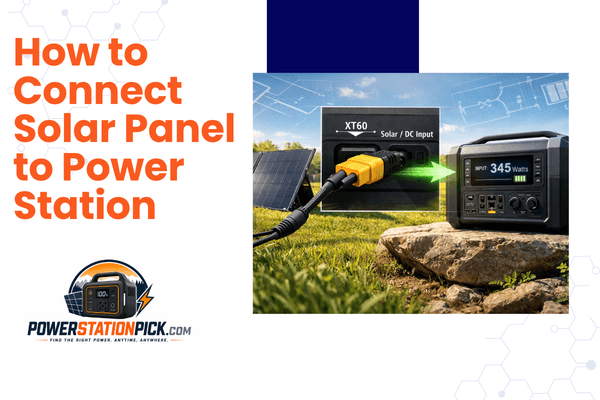
Prioritizes maximum solar input wattage, expansion battery compatibility, and total capacity over portability. See How to Connect Solar Panel to Power Station and Best Time of Day to Charge Power Station With Solar.
Type 3: Portable Power Stations by Battery Chemistry
This is a technical distinction, but it matters more than most buyers realize when it comes to longevity and safety.
Lithium-ion (NMC)
Common in older and cheaper units. Offers a strong energy density-to-weight ratio but carries a lower cycle life (typically 500–1,000 cycles) and a lower thermal runaway threshold than newer chemistries — meaning it’s more heat-sensitive under stress.
✅ Best for: budget-driven purchases where upfront price matters more than long-term cycle count. ❌ Limitation: shorter usable lifespan and reduced safety margin under heat stress.
LiFePO4 (LFP)
The current standard in nearly every modern power station, including every model reviewed on this site. LFP batteries typically rate for 3,000–6,000+ cycles and have a significantly higher thermal stability margin, making them the safer and more cost-effective choice on a per-cycle basis over the unit’s lifespan. Our full comparison in Lithium-ion vs. LiFePO4 covers the tradeoffs in depth, and if you want to understand what heat-related risk actually looks like in practice, see Portable Power Station Overheating: What to Do.
✅ Best for: nearly everyone — daily use, home backup, long-term ownership. ❌ Limitation: slightly heavier per Wh than NMC, and typically a higher upfront price for the same capacity.
Type 4: Portable Power Stations by Charging Method
AC-Only Charging
Basic units that only charge via wall outlet. Less flexible, typically found on older or budget models.
✅ Best for: stationary, purely indoor backup use. ❌ Limitation: no solar recovery during extended outages or off-grid trips.
AC + Solar Hybrid
The current standard for nearly all mid-range and premium units — supports wall charging, car charging, and solar panel input, often with MPPT controllers for charging efficiency. See What Is MPPT Charging in Power Station? for how that technology affects real-world solar charging speed.
✅ Best for: camping, off-grid use, and multi-day outages where wall power isn’t guaranteed. ❌ Limitation: solar input ceilings vary a lot between models — check the max wattage before assuming fast solar recovery.
Fast-Charging Focused
A newer sub-category built specifically around minimizing recharge time — some modern units now hit a full 0–100% charge in under 70 minutes via AC, a dramatic improvement over the 4–7 hour charge times common just a few years ago. Both the Bluetti AC70P and EcoFlow RIVER 2 Pro fall into this category. For general charging method guidance across all types, see How to Charge a Portable Power Station.
✅ Best for: buyers who cycle the unit frequently and want minimal downtime between uses. ❌ Limitation: fast charging can sometimes require an active app toggle rather than being the default behavior — worth checking per model.
How These Categories Overlap in Practice
Real products don’t fit neatly into just one category — a single unit is simultaneously a capacity tier, a use-case fit, a battery chemistry, and a charging type. The practical approach is to narrow by the category that matters most for your situation first (usually capacity or use case), then filter further by chemistry and charging speed once you’ve got a shortlist. For a side-by-side view of how our reviewed models stack up across all of these dimensions at once, the Portable Power Station Comparison Chart 2026 remains the fastest way to compare.
If you’re still deciding whether a power station is the right category of backup solution at all — as opposed to a traditional generator or inverter setup — see Portable Power Station vs. Gas Generator and Power Inverter vs. Portable Power Station.
Frequently Asked Questions
What’s the main difference between a small and large portable power station?
Beyond raw capacity (Wh), larger units typically offer higher continuous AC output, support for expansion batteries, and more robust inverters capable of running larger appliances — but they trade away the portability that makes smaller units easy to carry.
Which type of portable power station is best for beginners?
A mid-capacity unit (500–1,000Wh) with AC + solar hybrid charging and LiFePO4 chemistry is generally the most forgiving starting point — enough capability to be genuinely useful, without the cost or bulk of a whole-home system.
Do all portable power stations use the same battery type?
No. Older and budget units often still use lithium-ion (NMC) chemistry, while most modern mid-range and premium units have shifted to LiFePO4 for its longer cycle life and better thermal stability.
Is a bigger capacity always better?
Not necessarily — bigger units are heavier, more expensive, and often overkill if your actual use case is charging a phone and running a CPAP machine. Matching capacity to real usage, rather than buying the largest option available, usually delivers better value.
How do I know which type I actually need?
Start with your primary use case (camping, home backup, medical device, off-grid living), then check that use case’s typical wattage needs against our sizing calculator before comparing specific models.
Can one power station cover multiple use cases at once?
Often yes — a mid-large capacity (1,000–2,000Wh) LiFePO4 unit with AC + solar hybrid charging typically covers camping, home backup, and medical device use reasonably well simultaneously. The tradeoffs show up mainly at the extremes: ultra-compact units are too limited for home backup, and whole-home units are overkill and impractical to carry for camping.
What’s the real-world difference between AC-only and solar-hybrid charging?
AC-only units are cheaper but leave you stranded once wall power is unavailable for an extended period — a real risk during multi-day outages. Solar-hybrid units cost more but let you sustain power indefinitely as long as there’s sunlight, which matters far more for off-grid or extended-outage scenarios than it does for a single weekend trip.
Does a higher cycle-life battery actually matter for occasional use?
Less than you’d think if you’re only cycling the unit a handful of times per year — but if you plan to use it daily (as a UPS, or for regular off-grid living), the gap between a 500-cycle NMC battery and a 4,000+ cycle LFP battery translates directly into years of usable lifespan difference.

Hi, I’m Andrew Richards. I created PowerStationPick to share what I’ve learned about portable power through real-world use—what actually works, what doesn’t, and what makes sense for different situations. I focus on helping you choose the right setup for home backup, camping, and everyday needs without overcomplicating things.