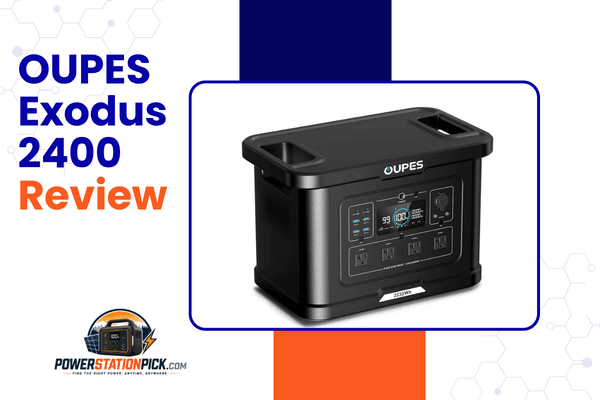
OUPES Exodus 2400 Review: The Budget 2,400W Power Station
We’ve already covered OUPES’s flagship MEGA lineup in depth in our OUPES Portable Power Station lineup review, where the Mega 1 stood out as the brand’s best value pick. The Exodus 2400 is a different branch of the same tree — OUPES’s camping-and-overlanding-focused line, built with a simpler, non-expandable design at a genuinely aggressive price. On paper it looks like a smaller, cheaper cousin of the Mega 2. In practice, several independent testers have found it’s a more interesting unit than that comparison suggests — with a few real tradeoffs worth understanding before you buy.
The OUPES Exodus 2400 packs 2,232Wh of LiFePO4 capacity and a 2,400W continuous inverter (2,600W boost) into a 45-lb unit that regularly sells for $650–$750 against a $1,499 MSRP — a genuinely strong price-to-capacity ratio in this category. Independent testing has confirmed it handles real household loads (microwaves, space heaters, power tools) without issue, and its 3,500+ cycle LiFePO4 battery is backed by a 5-year warranty.
The tradeoffs: it isn’t expandable with add-on batteries the way the Mega 2 and Mega 3 are, its companion app has drawn real criticism in independent testing, and solar charging in practice has come in slower than the spec sheet implies for at least one tester.
✅ Pros
- Strong price-to-capacity ratio
- Real household-appliance capability
- 3,500+ cycle LiFePO4 battery
- 5-year warranty (6 with registration)
- 13 total output ports
- Genuinely fast AC charging with the included adapter
❌ Cons
- Not expandable with add-on batteries
- App quality criticized in independent testing
- Real-world solar input has underperformed spec in at least one test
- At 45 lbs, it’s portable but not lightweight
👍 Who should buy it:
Budget-conscious campers, overlanders, and job-site users who want real 2,400W output without paying flagship prices, and who don’t need future capacity expansion.
👎 Who shouldn’t buy it:
Buyers who anticipate needing more capacity down the road — the Mega 2 or Mega 3 support add-on batteries and the Exodus 2400 does not — or anyone relying heavily on solar as a primary charging method rather than AC.
Technical Specifications
| Specification | OUPES Exodus 2400 Details |
|---|---|
| Battery Capacity | 2,232Wh |
| Battery Chemistry | LiFePO4 |
| Cycle Life | 3,500+ cycles to 80% capacity |
| AC Output (Continuous) | 2,400W (Pure Sine Wave) |
| Surge/Boost Power | 2,600W |
| Solar Input | Up to 800W (11–150V MC4, built-in MPPT) |
| Max Combined Input (AC + Solar) | 2,200W |
| AC Fast Charging | 0–80% in ~1.2 hours (with included 1,400W adapter) |
| Car Charging | Yes, 12V |
| UPS/EPS Function | Yes (instant backup) |
| Total Ports | 13 (5 AC outlets, 2× USB-C 100W, 4× USB-A 18W, 1× 12V car port, 2× DC5521, 1× Anderson 30A) |
| Weight | ~45 lbs (20.5 kg) |
| App Connectivity | OUPES app (Bluetooth) |
| Warranty | 5 years (6 with product registration) |
| Expansion | Not supported |
| Price (MSRP) | $1,499 (frequently discounted to $650–$750) |
Specs cross-referenced across OUPES’s official product listings. One discrepancy worth flagging: OUPES’s own marketing has listed surge power as both “2,600W” (repeated across most listings) and “5,000W” (a single listing) — we’ve used the more consistently repeated 2,600W figure here rather than the outlier.
What Makes the Exodus 2400 Different From the Mega Series
If you’ve read our Mega series coverage, the obvious question is why OUPES runs two separate product lines with overlapping capacity. The answer comes down to a real design tradeoff, confirmed in community discussion among actual owners comparing the two: the Mega 2 supports OUPES’s add-on expansion batteries, while the Exodus 2400 does not. In exchange, the Exodus trades that future-expansion flexibility for a simpler, more affordable, more “grab and go” unit — real owners on deal forums have specifically framed the choice as “buy the Mega 2 if you’ll want expansion batteries later; buy the Exodus if you won’t.”
That’s a genuinely useful way to think about it. The Exodus 2400 isn’t a lesser Mega 2 — it’s a different bet on what you’ll need two or three years from now.
Real-World Performance
Home Backup Essentials
Independent testing that specifically measured runtime found that a combined load of a cycling refrigerator, a router, lights, and phone charging delivered roughly 18–24 hours of runtime on a full charge — a solid result for a 2,232Wh unit running realistic household loads rather than a single steady appliance. At a lighter, steadier 100W continuous draw, the same testing extrapolated to roughly 20 hours, which lines up consistently with the higher figure.
High-Wattage Appliance Testing
One independent tester ran a genuinely demanding battery of appliances through the unit specifically to drain it under real stress — a 1,500W space heater, an 800W microwave, and a constant smaller-device load — confirming the Exodus 2400 handled all of them within its rated output without issue. If you’re specifically sizing a unit around a space heater, our own wattage breakdown in Can a Portable Power Station Run a Space Heater? is worth cross-referencing against these numbers.
Photography and Video Use
An independent reviewer testing the unit specifically for photography and video work found it handled laptops running all day without issue, and separately used it to power a small kitchen blender for an extended stretch (roughly 40 minutes of intermittent blending) without strain — a reasonable proxy for how it handles small motor-driven kitchen appliances more broadly.
RV and Camping Use
At 45 lbs and rated for 1.35 cubic feet of storage space, one OUPES product listing specifically frames the Exodus 2400 as sized to fit RV storage compartments, and the unit’s four charging methods (AC, car, solar, and AC+solar combined) give RV owners flexibility depending on hookup availability. For general RV charging strategy across different power station types, see our guide on How to Charge a Portable Power Station in an RV.
Charging Speed: Fast on AC, Slower Than Expected on Solar
This is the area where independent testing and spec-sheet marketing diverge most, and it’s worth understanding both sides.
AC charging is genuinely fast: with the included 1,400W fast-charge adapter, OUPES rates a 0–80% charge at approximately 1.2 hours, which independent buying guides have consistently repeated as accurate. That’s a strong number for a 2,232Wh unit.
Solar charging is where real-world testing has told a more complicated story. OUPES’s own combined-input spec suggests solar can contribute up to 800W toward the 2,200W combined AC+solar ceiling. But one independent reviewer testing photography-specific use found that with a single 240W solar panel in sunny conditions, real-world input landed around just 150W — well under the panel’s rated output, and slow enough that the same reviewer calculated it would take nearly two full days of peak sun to fully recharge the battery from empty using that single panel. That reviewer’s practical conclusion: treat AC or car charging as the primary method and solar as a supplemental top-up rather than a primary charging strategy, unless you’re running multiple panels.
A separate independent test using two 200W panels wired in series (producing 80V) reported successfully pulling close to 1,200W of combined input — notably higher than the single-panel result, and even above OUPES’s own stated 800W solar ceiling, which suggests real-world solar performance may vary meaningfully based on panel configuration and wiring. Given that discrepancy between OUPES’s own spec and multiple independent test results, we’d treat the solar input ceiling as a “confirm before you rely on it” figure rather than a settled number. For general solar charging guidance across brands, see How to Connect Solar Panel to Power Station and What Is MPPT Charging in Power Station?.
App Experience: The Weakest Link
This is a real, documented weak point rather than a nitpick. One independent reviewer specifically checked the OUPES companion app’s App Store rating during testing and found it sitting at just 1.9 stars — a notably poor score that stood out enough to mention directly in their review. The same reviewer did note the app’s privacy practices were reasonable (the developer states it collects no personal data), which is a fair point in its favor even alongside the low usability rating. If app-based monitoring and control matter a lot to your use case, this is worth weighing seriously — the hardware performance across independent reviews has generally outpaced the software experience.
Build Quality and Portability
At roughly 45 lbs, the Exodus 2400 sits in genuinely portable territory but isn’t a light grab-and-go unit — real owner discussion on deal forums specifically described it as “a chunker to carry around the yard” while also noting that for its capacity class, 45 lbs is actually on the lighter side compared to some 2,000Wh-plus competitors. That’s a fair characterization: it’s portable enough to move between a garage and a campsite, but you’ll notice the weight on repeated trips.
✅ Pros
- Strong capacity-to-price ratio: Especially at typical sale pricing ($650–$750 against a $1,499 MSRP).
- 2,400W continuous output: Handles real household appliances, confirmed in independent stress testing.
- 3,500+ cycle LiFePO4 battery: Backed by a genuinely strong 5-year warranty (6 with registration).
- Fast AC charging: Recharges 0–80% in about 1.2 hours with the included adapter.
- 13 total ports: Covers AC, high-wattage USB-C, USB-A, and 12V needs simultaneously.
- Reasonably lightweight: Manageable for its capacity class relative to some competitors.
❌ Cons
- Not expandable: No add-on battery path, unlike OUPES’s own Mega 2 and Mega 3.
- Subpar companion app: Specifically flagged as a weak point in independent testing.
- Solar input underperforms: Real-world solar input fell short of the spec sheet in at least one independent test.
- Two-handed carry required: At 45 lbs, it remains a two-handed carry for most people.
OUPES Exodus 2400 vs. OUPES Mega 2
| Specification | OUPES Exodus 2400 | OUPES Mega 2 |
|---|---|---|
| Capacity | 2,232Wh (Slightly higher base capacity) | 2,048Wh |
| AC Output | 2,400W (2,600W boost) | 2,500W |
| Expandable | No | Yes (With add-on batteries) |
| Weight | ~45 lbs (10 lbs lighter) | ~55 lbs |
| Typical Sale Price | $650–$750 | Comparable range |
The real decision here isn’t about raw specs — the two units are close enough in capacity and output that either handles similar loads. It’s about expansion. If you’re confident this unit covers your needs indefinitely, the Exodus 2400’s lighter weight and lower typical price make it the more efficient buy. If there’s a real chance you’ll want more capacity in a year or two, the Mega 2’s expansion path avoids a full re-purchase down the line — a tradeoff real owners on deal forums have weighed explicitly when choosing between the two.
OUPES Exodus 2400 vs. Pecron E2400LFP
Independent reviewers who’ve tested both have specifically positioned the Pecron E2400LFP as the more rugged alternative in a similar capacity and price class, for buyers who want a comparable feature set with a build quality leaning slightly more heavy-duty. If ruggedness matters more than OUPES’s lighter, more consumer-oriented design, this is the comparison worth researching further before you decide.
For a full side-by-side of every model we’ve reviewed across brands, see the Portable Power Station Comparison Chart 2026.
What Real Buyers Are Saying
Cross-referencing Trustpilot reviews and deal-forum discussion around OUPES more broadly, the sentiment is generally positive but not uniform. One verified buyer specifically praised the fast delivery and called the Exodus 2400 a great value for the money, and would recommend it. OUPES’s customer support has come up favorably in broader brand discussion — one long-time customer with multiple OUPES purchases specifically credited support as extremely responsive, even while acknowledging that a portion of orders had experienced some technical issue at some point.
On community deal forums, the recurring theme echoes what independent reviewers found in testing: the Exodus 2400 is well-regarded for what it is, with the expansion limitation (versus the Mega 2) being the most consistently cited reason a buyer might choose a different model instead — not a complaint about the Exodus 2400’s own performance.
Frequently Asked Questions
Is the OUPES Exodus 2400 worth buying?
At its typical sale price of $650–750, yes — independent testing confirms it delivers real 2,400W household-appliance capability with a strong warranty and battery cycle life. At the full $1,499 MSRP, the value proposition is less compelling relative to competitors, so it’s worth waiting for a sale if possible.
Can the Exodus 2400 run a refrigerator?
Yes — independent testing with a cycling refrigerator combined with other household loads (router, lights, phone charging) recorded 18–24 hours of runtime on a full charge.
Is the OUPES Exodus 2400 expandable?
No. Unlike OUPES’s own Mega 2 and Mega 3, the Exodus 2400 does not support add-on expansion batteries. If future capacity growth matters to you, the Mega 2 is the better starting point.
How fast does the Exodus 2400 charge?
Very fast via AC with the included 1,400W adapter — OUPES rates 0–80% in about 1.2 hours. Solar charging has performed less consistently in independent testing; treat it as supplemental rather than primary if fast recharge matters.
Is the OUPES app good?
This is a documented weak point — one independent reviewer found the companion app held just a 1.9-star App Store rating during testing, though the developer does state it collects no personal data.
How does the Exodus 2400 compare to the OUPES Mega 2?
They’re close in capacity and output. The main difference is expandability — the Mega 2 supports add-on batteries, the Exodus 2400 does not — along with the Exodus 2400 being somewhat lighter.
Is the Exodus 2400 good for camping?
Yes — its combination of real appliance-level output, multiple charging methods, and RV-storage-friendly sizing make it well suited to camping and overlanding use, and our Best Portable Power Station for Camping guide covers general sizing for this use case.
Can it run a microwave?
Yes — independent stress testing specifically included an 800W microwave as part of a combined high-wattage load test, and the unit handled it within its rated output.
Does the Exodus 2400 support solar charging?
Yes, up to a manufacturer-rated 800W via MC4 connectors with a built-in MPPT controller, though independent testing has found real-world results varying meaningfully by panel configuration — worth confirming with your specific setup before relying on it as a primary charging method.
What’s the warranty on the Exodus 2400?
5 years standard, extendable to 6 years with free product registration — a genuinely strong warranty term for this price class.
Final Verdict
The OUPES Exodus 2400 earns its reputation as a strong budget pick in the 2,000Wh-plus category, backed by independent testing that confirms it handles real household and camping loads without drama. Its 3,500+ cycle battery and 5-year warranty are the kind of specs that matter more after year two of ownership than they do on the spec sheet at purchase time.
The honest caveats — no expansion path, a genuinely weak companion app, and solar performance that’s underdelivered relative to spec in independent testing — are worth weighing against the price. For a buyer who wants real 2,400W capability at a fraction of flagship pricing and doesn’t need future expansion, the Exodus 2400 is a legitimately smart buy, especially at its common sale price well under MSRP. For a buyer who anticipates growing power needs, OUPES’s own Mega 2 is the more future-proof choice.
Disclosure: This review is based on OUPES’s official specifications and independent testing and reporting from outlets including BatterySkills, Fstoppers, and The Gadgeteer, along with buyer feedback from Trustpilot and public deal-forum discussion. We did not purchase or independently test a physical unit for this review. Some links in this article may be affiliate links, which means we may earn a small commission if you purchase through them — at no additional cost to you. This does not influence our ratings or recommendations.

Hi, I’m Andrew Richards. I created PowerStationPick to share what I’ve learned about portable power through real-world use—what actually works, what doesn’t, and what makes sense for different situations. I focus on helping you choose the right setup for home backup, camping, and everyday needs without overcomplicating things.