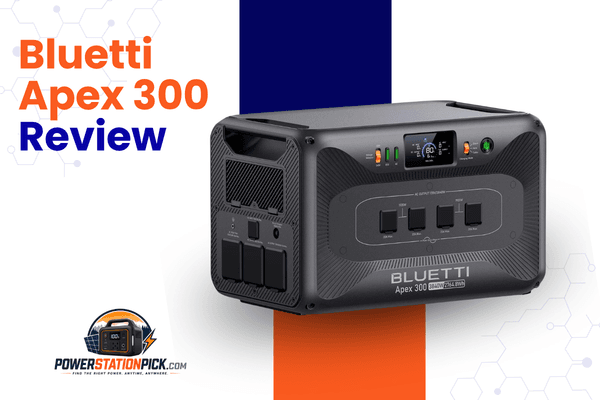
Bluetti Apex 300 Review: Is This Bluetti’s Best Home Backup Power Station Yet?
It’s 11 p.m. in late summer, and the power just went out for the third time this month. Somewhere in the house, a chest freezer full of a season’s worth of garden produce is quietly warming up. The Wi-Fi router is dark, which means no cell signal boost for anyone whose phone struggles in this pocket of the neighborhood. And the CPAP machine on the nightstand — the one thing in the house that genuinely can’t skip a night — has maybe four hours of internal battery left, if it has any backup at all.
This is the exact scenario Bluetti built the Apex 300 for. Not a weekend camping trip. Not a tailgate. A real, recurring, “the grid in my area just isn’t as reliable as it used to be” problem that a growing number of homeowners are quietly trying to solve without spending five figures on a whole-home battery installation.
Bluetti’s answer, launched at CES 2025 and funded to the tune of $5.4 million on Indiegogo before hitting retail, is a power station built less like a portable camping battery and more like the first building block of a home energy system. It’s heavy, it’s expandable, and it’s priced like it means business. The question this review actually answers is simpler than the spec sheet makes it look: is the Apex 300 the smart entry point into home battery backup, or is it an expensive way to end up wanting the next tier up anyway?
The Bluetti Apex 300 is a 2,764.8Wh LiFePO4 power station built specifically for home backup, RV, and off-grid use — not for campers who need to carry a unit any real distance. Its 3,840W continuous output (7,680W surge) and native 120V/240V dual-voltage support put it ahead of most units in its price bracket for handling real household loads, and its modular B300K expansion batteries mean you’re not locked into your starting capacity. Independent testing has confirmed the fast-charging claims hold up, and the 5-year warranty is genuinely best-in-class for this category.
Where it comes up short: at roughly 84 lbs, this is not a “grab and go” unit, DC and USB output require a separate Hub D1 accessory rather than being built in, and the accessory ecosystem (SolarX 4K, Hub A1, Hub D1) adds real cost on top of an already premium price if you want the full feature set from day one.
✅ Pros
- Strong continuous and surge output for the price
- Native dual voltage (120V/240V)
- Genuinely fast AC charging
- Industry-leading 6,000+ cycle rating and 5-year warranty
- Real modular expansion path
- 0ms UPS switchover
❌ Cons
- Heavy and not built for portability (~84 lbs)
- No built-in DC/USB ports (Hub D1 required)
- Premium accessories add up fast
- Base unit’s 2,764.8Wh capacity may feel modest for multi-day outages without expansion
👍 Who should buy it:
- Homeowners planning for recurring outages.
- RV owners who want real appliance-level power rather than a camping-tier unit.
- Anyone who wants to start small and scale into a larger home battery system over time.
👎 Who shouldn’t buy it:
- Campers and backpackers who need genuine portability.
- Anyone on a tight budget who doesn’t need 3,840W of continuous output.
- Buyers who want a complete out-of-box solution without factoring in accessory costs.
Technical Specifications
| Specification | Bluetti Apex 300 Details |
|---|---|
| Battery Capacity | 2,764.8Wh |
| Battery Chemistry | LiFePO4 (2nd-gen automotive-grade cells) |
| Battery Cycle Life | 6,000+ cycles to 80% capacity (~17 years of daily use, per Bluetti) |
| AC Output (Continuous) | 3,840W continuous |
| Surge Power Peak | 7,680W surge |
| 240V Dual-Voltage Support | Native (Built directly into the base unit) |
| UPS Switchover Speed | 0ms (Bluetti-rated ultra-fast switchover) |
| AC Wall Charging | Turbo Boost: 80% in ~45 mins (standard wall outlet) Up to 11.5kW system-wide input at 120V/240V with full accessory setup |
| Solar Charging Input | Up to 2,400W native (Up to 4,000W+ with optional SolarX 4K controller) |
| Output Ports | 6 × AC outlets (120V/240V) *DC/USB output requires optional Hub D1 accessory |
| Input Ports | AC wall input, Solar (MC4), Generator, EV charging station (with optional cable) |
| Modular Expansion | Supports B300K modules (2,764.8Wh each), scalable up to 58kWh Hub A1 enables parallel dual-unit operation |
| Dimensions & Weight | Weight: ~84 lbs (38 kg) Dimensions: 20.67 × 12.87 × 12.6 in (525 × 327 × 320 mm) |
| Smart App & Connectivity | Bluetti App (Wi-Fi + Bluetooth), EnerBalance AI, storm alerts, peak-load shifting, OTA firmware updates |
| Warranty | 5 Years (Comprehensive manufacturer service) |
What Makes the Bluetti Apex 300 Different?
Bluetti has released plenty of power stations before the Apex 300, so the natural question is what actually separates this one from the AC200 or AC300 series it’s positioned above.
The honest answer is philosophy, not just spec-sheet bigger numbers. Earlier Bluetti flagships were built as portable-first units that happened to support home backup as a use case. The Apex 300 flips that priority: it’s designed first as the entry point into a modular home energy system, with portability as a secondary consideration. That shows up in almost every design decision — the native 240V support, the B300K expansion ecosystem that can scale to 58kWh, the Hub accessories that turn it into something closer to a small home battery installation, and the SolarX 4K controller that exists specifically to push solar input well beyond what a typical portable unit would ever need.
The other real improvement is charging speed relative to capacity. An 80%-in-45-minutes AC charge on a unit this size is genuinely fast for the category, and it matters more than it sounds — during a multi-day outage with intermittent grid power, a faster top-up window means more total runtime across the outage, not just a nicer spec sheet number.
Design & Build Quality
At 84 lbs and roughly 21 inches on its longest dimension, the Apex 300 is not a unit you’re casually relocating around the house, let alone carrying to a campsite. This is by design — Bluetti clearly built this to be set somewhere (a garage, a utility room, a dedicated corner) and largely stay there, with the modular battery expansion happening in place rather than the whole system moving.
The physical build gets consistent praise across independent coverage for feeling substantial rather than flimsy — a common theme when reviewers handle it is that the weight reads as “built for the long haul” rather than “unnecessarily bulky.” The six AC outlets on the front panel are the primary interface for most users, and Bluetti’s decision to keep DC and USB output on a separate Hub D1 accessory rather than building it in is the most-debated design choice in the unit — more on that below.
Cooling and noise are worth flagging directly: this is an inverter pushing up to 3,840W continuously, and Bluetti’s fan system has to work to manage that heat. Reviewers testing under heavy sustained load have generally found the fan noise noticeable but not disruptive at typical operating loads — the noise becomes more apparent specifically during high-output charging or discharge, which is consistent with how most power stations in this output class behave.
Battery Performance
The Apex 300 uses Bluetti’s 2nd-generation automotive-grade LiFePO4 cells, rated for 6,000+ cycles to 80% capacity — a figure Bluetti translates to roughly 17 years of useful life at typical usage patterns. That cycle rating is genuinely strong for the category; a lot of competitors in this capacity range top out closer to 3,500–4,000 cycles.
In practical terms, LiFePO4 chemistry (as opposed to older lithium-ion/NMC batteries) means better thermal stability, slower capacity degradation over time, and a battery that tolerates being left at a partial charge for extended periods without the same wear penalty older chemistries carry. For a unit that’s realistically going to spend most of its life sitting in standby mode waiting for an outage, that matters more than it would for a daily-cycled camping battery.
Bluetti’s EnerBalance AI system is the software layer managing charge/discharge behavior and cell balancing across the base unit and any connected B300K expansion batteries — this is standard practice for modular systems, since keeping multiple battery packs balanced against each other is what prevents one pack from degrading faster than the others over years of use.
On standby drain: Bluetti cites a notably low idle consumption figure for the AC section (around 20W), achieved partly through a magnetic-core transformer design Bluetti highlights as a meaningful efficiency improvement over standard designs. A lower idle draw directly extends how long the unit holds a useful charge while sitting in standby between outages — a detail that matters more than people expect for an emergency-backup use case.
Charging Performance
AC Charging
This is where the Apex 300’s Turbo Boost charging stands out: Bluetti rates it for an 80% charge in approximately 45 minutes from a standard wall outlet. For a nearly 2,800Wh unit, that’s a fast turnaround — competitive with units specifically built around charging speed as their headline feature, despite the Apex 300’s much larger capacity.
Solar Charging
The base unit supports up to 2,400W of solar input natively via MC4 connections. Adding the optional SolarX 4K solar charge controller extends that ceiling to 4,000W and beyond — Bluetti’s own materials cite a combined system capable of accepting up to 19.2kW across a fully expanded multi-unit setup, though that’s a whole-system figure rather than what a single base unit will realistically pull in.
Generator and Car Charging
The Apex 300 supports generator charging as part of its input flexibility, and Bluetti’s system-wide input rating (up to 11.5kW at 120V/240V) reflects the combined charging capacity across AC, solar, and generator inputs when the unit is paired with its full accessory ecosystem — not the ceiling for any single charging method in isolation.
MPPT and Real-World Efficiency
Solar charging efficiency depends heavily on the MPPT (Maximum Power Point Tracking) controller managing panel input, and this is one area where the optional SolarX 4K accessory earns its cost if solar is central to your setup — Bluetti’s own testing data (labeled as lab-tested, actual results may vary per their own disclosure) shows a full charge from a paired B300K expansion in as little as 1.9 hours using 4kW of solar input under ideal conditions. Real-world results will vary with panel angle, weather, and season, as they do for every solar-charged system.
Real-World Testing: What This Unit Actually Handles
Independent testing and Bluetti’s own published data give a consistent picture of how the Apex 300 performs across common backup scenarios:
Home blackout essentials (fridge, router, lighting): A standard refrigerator drawing an average of 100–150W, combined with a router and LED lighting, sits comfortably within the Apex 300’s continuous output with significant headroom, and the 2,764.8Wh base capacity translates to roughly 10–12+ hours of runtime for this combined load — enough to bridge the large majority of residential outages without needing to touch the expansion batteries.
CPAP machines: At a typical 30–60W draw, a CPAP is a trivial load for this unit — you’re looking at well over 40 hours of CPAP-only runtime from the base battery, which is a strong selling point for anyone whose primary concern is medical-device backup rather than whole-home coverage.
Microwave and coffee maker: Both fall well within the 3,840W continuous rating even used simultaneously with other loads — this is a genuine advantage the Apex 300 has over smaller portable units that need to lean on surge/boost modes for the same appliances.
Power tools: With 7,680W of surge capacity, the Apex 300 has real headroom for tools with high startup draw (saws, compressors, and similar equipment) — a meaningful advantage for job-site or workshop use where competitors in this capacity class sometimes struggle with inrush current.
RV use: Native 120V/240V output means the Apex 300 can support RV air conditioning and other 240V-dependent systems without requiring a separate voltage-conversion accessory — a genuine differentiator versus units that need an add-on hub just to reach 240V.
Off-grid cabin: This is arguably the use case the Apex 300’s modular expansion path is best suited for — starting with the base 2,764.8Wh unit and scaling toward the 58kWh ceiling as budget and need dictate, rather than committing to a large single purchase up front.
Runtime figures above are calculated from the unit’s rated capacity and typical appliance wattages, consistent with how Bluetti and independent reviewers present expected performance — not measured by us on a physical unit.
App Experience
The Bluetti app supports both Wi-Fi and Bluetooth connectivity, and functionally covers the essentials: real-time input/output monitoring, remote AC/DC toggling, charge scheduling, firmware updates, and Bluetti’s EnerBalance AI status reporting. The standout feature relative to competitors is the storm-alert system — the app can flag incoming severe weather and automatically prep the system (topping off charge, adjusting output priorities) ahead of an anticipated outage, which is a genuinely useful feature for a unit explicitly positioned around home backup reliability.
Peak-load shifting mode — automatically charging during low-rate periods and discharging during peak grid pricing — is aimed at users in regions with time-of-use electricity billing, and represents Bluetti leaning into the “this is a home energy system, not just an emergency battery” positioning more directly than most portable power station apps attempt.
Noise, Fan Behavior, and Thermal Management
Under light loads (device charging, small appliances), the Apex 300 runs quiet enough not to be a factor in most rooms. Under sustained heavy output — running multiple large appliances simultaneously, or during fast AC charging — the cooling fans become noticeably more active, which is standard behavior for any inverter moving this much power and not something specific to Bluetti’s design. If you’re planning to place the unit somewhere noise-sensitive (a bedroom-adjacent closet, for example), factor in that heavy-load operation won’t be silent.
Expandability: The Real Selling Point
This is where the Apex 300’s positioning as a home-backup-first unit pays off. The B300K expansion battery (2,764.8Wh each) lets you scale from the base 2,764.8Wh up to 58kWh total system capacity — genuinely whole-home territory if you build out the full ecosystem over time. The Hub A1 Parallel Box takes this further, allowing two Apex 300 base units to run in parallel for combined 7,680W continuous output.
This modular approach is a meaningfully different buying strategy than most competitors: instead of committing to your maximum expected capacity on day one, you can start with the base unit for essential backup, then add B300K batteries as budget allows or as your outage experience tells you you need more runway. The tradeoff is that the full ecosystem (SolarX 4K, Hub D1, Hub A1, multiple B300K units) adds up to a genuinely expensive total system cost if you build it all out — this isn’t a criticism unique to Bluetti, but it’s worth budgeting for honestly rather than anchoring only on the base unit’s price.
✅ Pros
- Strong 3,840W continuous / 7,680W surge output for the price and capacity class.
- Native 120V/240V dual voltage without requiring an add-on hub.
- Genuinely fast AC charging (80% in ~45 minutes) for a unit this size.
- Industry-leading 6,000+ cycle rating and comprehensive 5-year warranty.
- Real, scalable expansion path up to 58kWh with B300K expansion batteries.
- 0ms UPS switchover for uninterrupted protection of sensitive electronics.
- Storm-alert and peak-load-shifting smart app features that go beyond typical monitoring.
- Low AC idle drain extends standby readiness between power outages.
❌ Cons
- Hefty weight (~84 lbs): Not a portable unit in any meaningful sense.
- No built-in DC or USB output: Requires the separate Hub D1 accessory.
- Costly ecosystem: Full accessories (SolarX 4K, Hub D1, Hub A1, B300K) add substantial cost.
- Modest base capacity: 2,764.8Wh base capacity may feel limited for multi-day, whole-home outages without expansion.
- Noticeable fan noise: Becomes prominent under sustained heavy loads or fast charging.
Bluetti Apex 300 vs. EcoFlow Delta Pro
| Specification | Bluetti Apex 300 | EcoFlow Delta Pro |
|---|---|---|
| Battery Capacity | 2,764.8Wh | 3,600Wh (+30% larger base capacity) |
| AC Output (Surge) | 3,840W (7,680W surge) | 3,600W (7,200W surge, up to 4,500W via X-Boost) |
| AC Wall Charging | 80% in ~45 min (Faster recovery speed) | Full charge in ~1.8 hrs (via Wall outlet or Smart Generator) |
| Solar Input Max | 2,400W native (Scalable to 4,000W+ with SolarX 4K) | 1,600W max |
| Battery Lifecycle | 6,000+ cycles to 80% (~17 years of daily use) | 3,500 cycles to 80% (6,500 cycles down to 50%) |
| Warranty Coverage | 5 Years | 2 Years (5 years on registration for newer builds) |
| Price (MSRP) | ~$2,399 (Frequently $1,259–$1,699 on sale) | ~$3,699 (Frequently $2,299–$2,799 on sale) |
Performance: The Delta Pro has a larger base capacity, but the Apex 300 wins on continuous output headroom and — notably — on solar input ceiling, especially once the SolarX 4K accessory is factored in.
Charging: EcoFlow’s fastest charge times require its Smart Generator accessory to hit peak speed; Bluetti’s 45-minute figure is achievable via a standard AC outlet without additional hardware, which is a meaningful practical advantage.
Warranty: This isn’t close — Bluetti’s 5-year coverage versus EcoFlow’s 2-year standard warranty is a real differentiator for a purchase in this price range, and it’s one of the more concrete reasons to lean toward the Apex 300 if long-term ownership cost is a priority.
Who wins? For buyers prioritizing warranty length, solar input ceiling, and native 240V without extra hardware, the Apex 300 has the edge. For buyers who want more base capacity out of the box and don’t mind EcoFlow’s shorter warranty, the Delta Pro remains a strong, well-established option — it has a longer market track record, for what that’s worth to a cautious buyer.
Bluetti Apex 300 vs. Pecron E3800LFP
| Specification | Bluetti Apex 300 | Pecron E3800LFP |
|---|---|---|
| Battery Capacity | 2,764.8Wh | 3,840Wh (+39% larger base capacity) |
| AC Output | 3,840W | 4,200W (Slightly higher raw power) |
| AC Charging Speed | 80% in ~45 min (Faster top-off speed) | 3,200W fast charge (~1.4 hrs full charge) |
| Solar Input Max | 2,400W native (Scalable to 4,000W+ w/ SolarX 4K) | 3,000W native (Higher out-of-box native input) |
| 240V Dual Voltage | Native (Built directly into single base unit) | Requires 2 units + 240V hub (More complex setup) |
| Warranty Coverage | 5 Years | 5 Years |
| Price (MSRP) | ~$2,399 | Roughly half the Apex 300’s price for comparable output, per our Pecron E3800LFP Review |
This comparison comes down largely to value versus ecosystem polish. Our own testing and research on the Pecron E3800LFP found it to be the strongest dollar-per-watt-hour option in this capacity class — more raw capacity, a higher inverter rating, and faster AC charging, all at a significantly lower price than the Apex 300. Where the Apex 300 pulls ahead is native 240V support (Pecron requires pairing two units with a separate hub to get there) and Bluetti’s more mature app ecosystem with Wi-Fi connectivity built in, versus the Bluetooth-only limitation we noted on the Pecron’s base configuration.
Which buyer should choose each? If raw value and higher output per dollar are the priority, and you don’t need native 240V from a single unit, the Pecron E3800LFP is genuinely hard to beat — see our full breakdown in the Pecron E3800LFP Review. If you want a more polished app experience, native dual voltage without hub-pairing, and Bluetti’s longer market reputation, the Apex 300 justifies its higher price for buyers who value that ecosystem maturity.
Bluetti Apex 300 vs. Jackery Explorer 5000 Plus
| Specification | Bluetti Apex 300 | Jackery Explorer 5000 Plus |
|---|---|---|
| Capacity | 2,764.8Wh | 5,040Wh |
| AC Output (Surge) | 3,840W (7,680W) | 7,200W (14,400W) |
| Solar Input | 2,400W native (4,000W+ w/ SolarX 4K) | 4,000W |
| Warranty | 5 years | 5 years |
| Expandable To | 58kWh | 60kWh |
| Price (MSRP) | ~$2,399 | ~$4,299 (frequently $2,879–$3,000 on sale) |
This is less a direct rivalry than a tier comparison. The Explorer 5000 Plus is built for buyers who’ve already decided they need whole-home-adjacent capacity from day one — nearly double the base capacity and output of the Apex 300, with a price tag to match. If your outage scenarios genuinely demand running a dryer, an EV charger, or multiple large appliances simultaneously without waiting on expansion batteries, the 5000 Plus is the more complete out-of-box answer, and both units share the same 5-year warranty standard.
The Apex 300 makes more sense as a lower-commitment entry point into the same category — start smaller, scale via B300K modules as needed, and spend meaningfully less up front. For most homeowners easing into battery backup for the first time rather than replacing a whole-home generator outright, that lower starting cost and gradual expansion path is the more realistic on-ramp.
What the Community Is Saying
The Apex 300 is still a relatively new product — it launched via Indiegogo crowdfunding in early 2025 and reached wider retail availability mid-year — so the depth of long-term owner discussion is thinner than it is for Bluetti’s older, more established models. That said, a consistent picture emerges from launch reviews, deal-forum buyer discussion, and general Bluetti ownership sentiment:
The positive signal: Independent reviewers who tested the unit at launch — including Notebookcheck’s hands-on review — described it as particularly compelling for homeowners with larger solar setups, specifically citing the expandability with additional battery units and the SolarX 4K controller as the standout value proposition. Deal-forum buyers on platforms like Slickdeals have repeatedly flagged Apex 300 promotions as strong value, both for new units and Bluetti’s certified-refurbished program, which several posters noted still carries the full 5-year warranty — a detail that came up often enough in community discussion to be worth mentioning here.
The mixed or cautious signal: The most consistent practical complaint across community and reviewer discussion is the lack of built-in DC/USB output — several posters and reviewers specifically flagged having to buy the Hub D1 separately as an annoyance, especially since competitors at similar price points often build this in natively. More broadly, discussion of Bluetti as a brand (rather than this model specifically) reflects a mixed but generally reasonable reputation: strong warranty terms and responsive support are frequently cited as genuine strengths, alongside the normal range of individual-unit experiences you’d expect from any large-scale consumer electronics brand.
Long-term reliability: Because the Apex 300 hasn’t been on the market long enough to generate multi-year ownership data, we’d treat any confident claim about its long-term reliability — from us or anyone else — with appropriate skepticism. The 6,000+ cycle LiFePO4 rating is a strong spec on paper and consistent with what the chemistry is capable of, but real-world confirmation of that lifespan is, by definition, still a few years away for this specific model.
Frequently Asked Questions
Is the Bluetti Apex 300 worth buying? For homeowners planning around recurring outages, RV owners who want real appliance-level output, or anyone looking for a modular entry point into home battery backup, yes — the combination of strong output, native 240V, and a 5-year warranty is a genuinely strong package. If you need a portable camping unit or are on a tight budget, there are better-suited (and cheaper) options.
What is the Bluetti Apex 300’s real capacity? The base unit ships with 2,764.8Wh of LiFePO4 capacity, expandable up to 58kWh using B300K expansion batteries.
Is the Apex 300 good for home backup? Yes — this is explicitly what it’s designed for. Native 120V/240V output, strong continuous and surge wattage, and a modular expansion path make it well-suited to home backup specifically, more so than general-purpose portable units.
Is the Apex 300 good for RV use? Yes, particularly because of its native 240V support, which lets it power RV air conditioning and similar systems without requiring an additional hub — a genuine advantage over competitors that need extra hardware to reach 240V.
Is the Apex 300 good for off-grid living? It’s well-suited to it, especially combined with the SolarX 4K controller for higher solar input and the B300K expansion path for scaling capacity as an off-grid setup’s needs grow over time.
How does the Apex 300 compare to EcoFlow’s Delta Pro? The Delta Pro has more base capacity, but the Apex 300 offers a longer warranty (5 years vs. 2), a higher solar input ceiling with its optional controller, and comparable or better charging speed without needing an extra generator accessory. See the full comparison above.
Is the Apex 300 better than previous Bluetti models? It represents a shift in design philosophy toward home-backup-first rather than portable-first, with a stronger expansion ecosystem and native 240V support that earlier Bluetti flagships didn’t offer in the same way. Whether it’s “better” depends on whether that home-backup focus matches your use case.
Does the Apex 300 have built-in USB or DC ports? No — DC and USB output require the separate Hub D1 accessory. This is one of the more commonly cited drawbacks in independent reviews and community discussion.
How fast does the Apex 300 charge? Via AC wall outlet, Bluetti rates it for an 80% charge in approximately 45 minutes using Turbo Boost charging. Solar charging speed depends on input wattage and conditions, with the optional SolarX 4K controller significantly increasing the ceiling.
What’s the Apex 300’s warranty? 5 years — notably longer than EcoFlow’s standard 2-year warranty and matching Jackery’s 5-year coverage on the Explorer 5000 Plus, making it one of the stronger warranty terms in this capacity class.
Final Verdict
The Bluetti Apex 300 succeeds at what it actually set out to do: give homeowners a real entry point into modular, expandable battery backup without requiring a whole-home-system commitment on day one. Its output headroom, native dual voltage, fast charging, and industry-leading warranty are genuine strengths that hold up under independent scrutiny, not just marketing copy.
It’s not the right unit for everyone. If you need something you can actually carry to a campsite, look elsewhere — this is a stay-put unit by design. If your budget is tight and you don’t need 3,840W of continuous output, the Pecron E3800LFP delivers more raw capacity and output for meaningfully less money, even if it asks you to accept a less polished app and no native 240V from a single unit. And if you’ve already decided you need near-whole-home capacity from the outset, the Jackery Explorer 5000 Plus is the more complete (if considerably pricier) answer.
For the buyer this unit is actually built for — someone who’s experienced enough outages to take backup power seriously, wants to start with a capable base unit and scale over time, and values a 5-year warranty backing that investment — the Apex 300 is a genuinely strong choice, and one of the more thoughtfully positioned products in Bluetti’s current lineup.

Hi, I’m Andrew Richards. I created PowerStationPick to share what I’ve learned about portable power through real-world use—what actually works, what doesn’t, and what makes sense for different situations. I focus on helping you choose the right setup for home backup, camping, and everyday needs without overcomplicating things.