Best Portable Power Stations 2026: Top Picks for Every Need
Choosing a portable power station is harder than just looking for the biggest battery capacity or the highest wattage printed on the box. Two models can share nearly identical capacity and still perform completely differently once you factor in inverter output, charging speed, battery chemistry, and the specific devices you actually need to run. So instead of asking “which power station has the biggest battery,” the better question is: which one gives you the right amount of reliable electricity for how you actually use it?
We’ve spent this year testing and researching across the current lineup from Jackery, Bluetti, Anker, EcoFlow, OUPES, and Pecron — the picks below are pulled directly from that work, not a generic list assembled from spec sheets alone.
Methodology note: Each pick below includes a “What Real Owners Say” section synthesized from independent lab testing (TheSolarLab, Notebookcheck, TechRadar), community deal forums (Slickdeals), and public owner discussion. We’ve included genuine complaints alongside the praise — a product with zero reported issues anywhere online is usually a sign no one has used it long enough to find any, not that it’s flawless.
🔍 Quick Answer
For most people, the best portable power station isn’t the largest one available. A 500Wh–1,000Wh unit is a practical starting point for camping, travel, laptops, and small appliances. For home backup, look at 1,000Wh–2,500Wh or more, especially if you want to keep a refrigerator, CPAP machine, and networking equipment running through an extended outage. For high-power appliances — microwaves, space heaters, power tools — the inverter’s continuous output rating matters just as much as total capacity.
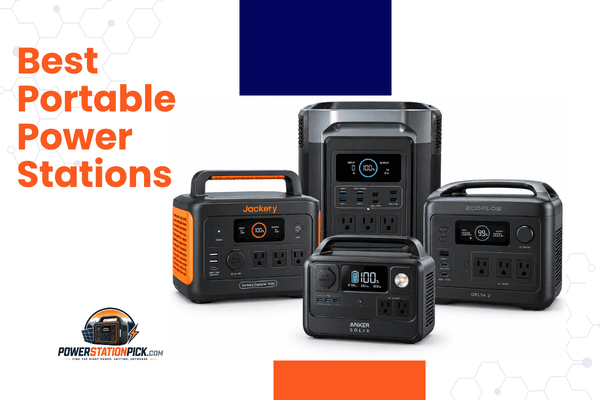
Our top picks at a glance:
- Best Overall: Jackery Explorer 1000 V2
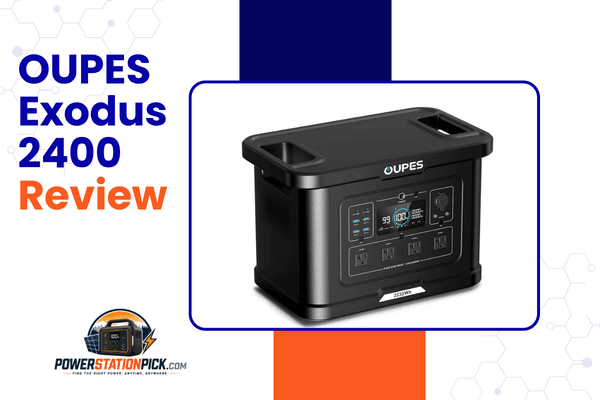
- Best Budget Value: OUPES Exodus 2400
- Best for Camping: EcoFlow RIVER 2 Pro
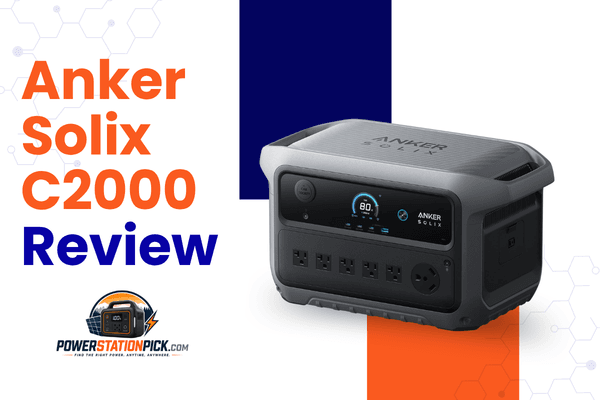
- Best for Home Backup: Anker SOLIX C2000 Gen 2
- Best for Whole-Home/Extended Backup: Pecron E3800LFP
- Best Premium/Modular System: Bluetti Apex 300
- Best Fast Charging: Bluetti AC70P
Top Picks: The Best Portable Power Stations We’ve Reviewed
🏆 Best Overall: Jackery Explorer 1000 V2
At 1,070Wh with 1,500W continuous output (3,000W surge), the Explorer 1000 V2 sits in the sweet spot most buyers actually need — enough headroom for a microwave or power tool, light enough to still be genuinely portable, and backed by 4,000 LiFePO4 charge cycles. A small but genuinely useful detail: it has a built-in lamp on the unit itself, which comes in handy faster than you’d expect the first time you’re fumbling for a flashlight during an actual outage. In our own head-to-head testing against the Bluetti AC70P, it consistently had more real-world runway for anything beyond simple device charging — a finding echoed in Popular Mechanics’ own standardized load testing, which clocked it running a full-size refrigerator for over 18 hours. Read the full Jackery Explorer 1000 V2 Review or see how it stacks up directly in Jackery Explorer 1000 V2 vs. Bluetti AC70P.
What real owners say: TechRadar awarded it a 4.5-star, “Highly Recommended” badge, specifically praising the rapid charging speed and calling it “one of the most robust and reliable options available.” Real-world runtime reports back that up — owners have logged roughly 18 hours powering a router/modem and about 20 hours on a small fridge from a single charge. The most consistent friction point across owner discussion: the advertised 1-hour charge only happens if you manually enable Emergency Charging Mode in the app before each session — leave it on default and you’re looking at closer to 1.7 hours. A smaller but real complaint from long-time Jackery users: older solar panels using the DC7909 connector don’t reliably charge the unit without buying a DC7909-to-DC8020 adapter, since Jackery moved to a new connector standard. A handful of owners have also reported units developing charging quirks or needing a reset after several months of use — not the norm, but common enough to show up repeatedly in synthesized owner feedback.
🗣️ What Real Owners & Tech Editors Say
TechRadar awarded it a 4.5-star, “Highly Recommended” badge, specifically praising the rapid charging speed and calling it “one of the most robust and reliable options available.”
Real-world runtime reports back that up — owners have logged roughly 18 hours powering a router/modem and about 20 hours on a small fridge from a single charge.
⚠️ Reported Friction Points & Drawbacks
- Hidden Fast-Charge Toggle: The advertised 1-hour charge only happens if you manually enable Emergency Charging Mode in the app before each session — leave it on default and you’re looking at closer to 1.7 hours.
- Solar Connector Adapter Required: Older solar panels using the DC7909 connector don’t reliably charge the unit without buying a DC7909-to-DC8020 adapter, since Jackery moved to a new connector standard.
Best for Camping: EcoFlow RIVER 2 Pro
At 17.2 lbs with a 70-minute full AC charge and a 1,600W surge ceiling, the RIVER 2 Pro is built for exactly the kind of trip where you need real capability without wanting to carry a 40-lb unit to the campsite. It comfortably handles a CPAP machine, a mini fridge, and device charging for a weekend trip. See our full EcoFlow RIVER 2 Pro Review and our dedicated Best Portable Power Station for Camping guide for sizing across a full trip.
🗣️ What Real Owners & Lab Testers Say
Verified Performance: The charging speed claim holds up under independent lab testing, and eBay buyer reviews consistently describe the unit as high quality and worth buying again.
Surge Capacity: One long-term owner using it as sump pump backup specifically praised its ability to handle demanding startup surges without tripping.
⚠️ Reported Friction Points & Drawbacks
- Separate AC Power Switch: The 120V AC output bank must be toggled on separately from the main power button — an owner discovered their pump didn’t run during an outage simply because this secondary switch hadn’t been flipped.
- Slightly Lower Usable Capacity: Independent lab tests measured actual usable capacity slightly below the advertised 768Wh specification.
Best for Home Backup: Anker SOLIX C2000 Gen 2
2,048Wh, expandable to 4,096Wh with an add-on battery, and a 58-minute full recharge — the C2000 is built for buyers who want meaningful home backup capacity now with room to scale later. Full details in our Anker SOLIX C2000 Review, and see our broader Best Portable Power Station for Home guide for sizing your specific essential loads.
🗣️ What Real Owners & Lab Testers Say
Genuine Gen 2 Redesign: Independent hands-on testing found the redesign a major improvement — it is nearly 38% lighter than its predecessor (the F2000) while providing 9 outlets and 2,400W of continuous output.
Quiet & Fast: Reviewers and testers consistently praised its remarkably quiet operation and fast charging capabilities.
⚠️ Reported Friction Points & Drawbacks
- Removed LED Light Bar: Anker removed the built-in light bar found on older SOLIX models, a absence owners notice immediately during an actual power outage.
- Slippery Rubber Feet: The rubber feet don’t grip well on smooth surfaces, causing the unit to slide around when plugging in cables (unfavorably compared to the Pecron E2400LFP).
Best for Whole-Home/Extended Backup: Pecron E3800LFP
At 3,840Wh with a 4,200W inverter, the E3800LFP is the strongest dollar-per-watt-hour option we’ve reviewed in the whole-home tier — more raw capacity and output than many premium competitors at a meaningfully lower price. One small build-quality detail independent reviewers have specifically praised in side-by-side comparisons: genuinely grippy anti-slip feet, which sounds minor until you’ve had a lighter competitor slide across a desk or garage floor mid-use. Read the full Pecron E3800LFP Review.
🗣️ What Real Owners & Reviewers Say
Outstanding Value Proposition: Value is the primary theme across independent comparisons — reviewers consistently highlight that it delivers significantly more capacity and output per dollar than flagship alternatives from competitors like Bluetti and EcoFlow.
⚠️ Reported Friction Points & Drawbacks
- Bluetooth-Only Base Connectivity: The app relies solely on Bluetooth in its base configuration, omitting Wi-Fi for long-range remote monitoring.
- External 240V Setup: Native 240V output is not built into a single standalone unit; achieving 240V requires pairing two units together via a separate hub.
Best Premium/Modular System: Bluetti Apex 300
Built specifically for home-backup-first use rather than portability, the Apex 300 pairs 2,764.8Wh of capacity with native 120V/240V output and a modular expansion path up to 58kWh — plus an industry-leading 5-year warranty. It’s the right choice for buyers who want to start with a capable base unit and scale into a larger home energy system over time. Full review: Bluetti Apex 300 Review.
🗣️ What Real Owners & Reviewers Say
High Solar & Expansion Capacity: Notebookcheck’s hands-on coverage called out the expansion battery ecosystem and high solar input ceiling as standout value for homeowners with larger solar setups.
Strong Deal Pricing: Slickdeals buyers repeatedly highlight Apex 300 promotions — including certified-refurbished offers that still retain the full 5-year warranty.
⚠️ Reported Friction Points & Drawbacks
- Separate Accessory Required for DC/USB: DC and USB outputs require purchasing the separate Hub D1 accessory rather than being built natively into the base unit.
- Thinner Reliability Track Record: As a 2025-launched flagship, multi-year community discussion and long-term reliability data are still limited compared to older units.
Best Fast Charging: Bluetti AC70P
768Wh with a consistent ~1-hour full recharge, no toggling required — the AC70P remains one of the fastest-charging units in its capacity class, and a strong pick for CPAP backup or short-trip use. Full details in our Bluetti AC70P Review.
🗣️ What Real Owners Say
Transformative Fast Charging: Owner discussion consistently cites the 1-hour recharge speed as the single biggest reason for choosing this unit, with many describing the jump from older 5–6 hour charge times as genuinely game-changing for day-to-day use.
⚠️ Reported Friction Points & Drawbacks
- 1,000W Output Ceiling: The continuous wattage ceiling feels limiting immediately once you attempt to power anything beyond basic laptops or a refrigerator.
- Power Lifting Limitations: The featured Power Lifting mode is not designed to handle sustained heavy loads over longer periods.
For a full spec-by-spec comparison of every model above (and more), see our Portable Power Station Comparison Chart 2026.
Honorable Mentions: Other Brands Worth Knowing
Jackery, Bluetti, Anker, EcoFlow, OUPES, and Pecron cover most of what we recommend, but they’re not the entire market. A few other brands come up often enough in independent testing that they’re worth knowing about, even though we haven’t put them through our own full review process yet:
- Goal Zero Yeti 1500X — Independent standardized load testing (Popular Mechanics ran every unit through an identical 450W test load of lights, a fan, and a small heater) found the Yeti held up well for extended fridge backup, and specifically praised its built-in cable storage compartment — a small feature that solved a real annoyance nearly every other tested unit shared.
- BioLite BaseCharge 1500 — Roughly 40% lighter than the Yeti 1500X at a similar capacity, with a wireless charging pad built into the top. The tradeoff: no companion app, so all monitoring happens on the unit’s own display.
- Geneverse HomePower Two Pro — Frequently bundled with solar panels specifically for van life and RV setups. In the same standardized testing, it delivered one of the longest fridge-backup runtimes recorded, extending further with cyclical on/off power conservation.
- Duracell Power 1000 — Notable purely on price-per-watt — independent testing found its performance per watt matched or beat pricier competitors in the same capacity range, though it skips Wi-Fi/Bluetooth connectivity entirely to hit that price.
- Lion Energy Safari — Built for rougher handling, with rubber-protected corners and a dedicated 30-amp RV outlet. Independent testing clocked a genuinely fast ~2 hour 40 minute AC recharge for its capacity class.
If any of these end up on our formal review schedule, we’ll link the full breakdown here. Until then, treat the summaries above as a starting point for further research, not a substitute for reading a full review.
How to Choose: What Actually Matters
Once you’ve narrowed down a category above, here’s what separates a good match from a poor one within that category.
Battery Capacity: What Wh Actually Means
Capacity is measured in watt-hours (Wh) — how much energy the battery stores. In real-world use, you won’t get the full advertised capacity out of the AC outlets, since the inverter itself consumes some energy converting stored DC power into usable AC. A reasonable estimate: Runtime = Battery Capacity × ~0.85 (efficiency) ÷ Device Wattage. For a deeper explanation of what this number means and how to use it, see What Does Wh Mean on a Battery?
| Capacity | Best Use | Example Devices |
|---|---|---|
| 150–300Wh | Basic portable power | Phone, tablet, camera, LED lights |
| 300–800Wh | Weekend camping, CPAP | Laptop, lights, camera gear, small cooler |
| 800–1,500Wh | General camping and light backup | TV, router, small fridge, laptops |
| 1,500–2,500Wh | Serious home backup | Refrigerator, CPAP, networking gear |
| 2,500Wh+ | Extended/whole-home backup | Multiple appliances, high-energy loads |
Battery Chemistry: LiFePO4 vs. Lithium-Ion
Nearly every unit worth buying today — including every model in our Top Picks above — uses LiFePO4 (lithium iron phosphate) rather than older lithium-ion (NMC) chemistry. LFP offers a much longer cycle life (3,000–6,000+ cycles vs. 500–1,000) and significantly better thermal stability. Our buying rule: if two otherwise-similar units differ mainly in chemistry and the price gap is reasonable, choose LiFePO4 for long-term ownership. Full comparison: Lithium-ion vs. LiFePO4
Inverter Power: Don’t Confuse Watts With Watt-Hours
This is the single most common buying mistake. Watt-hours measure stored energy; watts measure how much power the inverter can deliver at one time. A 1,000Wh battery with only a 500W inverter still can’t run a 1,200W appliance, no matter how much energy is stored. Always check both: capacity (how long) and continuous output (how powerful a device it can actually run).
Continuous vs. surge output matters especially for motor-driven appliances — refrigerators, sump pumps, and power tools briefly draw more than their normal running wattage on startup. We cover this in detail, with real appliance-specific numbers, in Can a Portable Power Station Run a Microwave?, Can a Portable Power Station Run a Space Heater?, and our Sump Pump Backup guide.
Charging Speed and Solar Input
Look at three charging methods: AC wall charging (fastest, most convenient at home), solar charging (valuable for camping and off-grid use, but limited by the unit’s maximum input rating — connecting 400W of panels to a 200W-rated input won’t get you 400W), and 12V car charging (slower, but useful on the road). For setup specifics, see How to Connect Solar Panel to Power Station, What Is MPPT Charging in Power Station?, and general charging guidance in How to Charge a Portable Power Station.
Build Quality, Portability, and Noise
A power station you’ll actually move around needs strong handles, protected ports, and stable footing — weight distribution matters more than raw weight, since a well-balanced 30-lb unit can feel easier to carry than a poorly balanced 20-lb one. On noise: cooling fans activate under heavy load or fast charging, and a unit that’s silent at idle can get noticeably louder mid-charge. If fan noise is a dealbreaker for your use case (bedroom-adjacent CPAP use, for example), see Why Does My Portable Power Station Fan Make Noise?
UPS Functionality
If you want a unit to back up a router, modem, or desktop computer, look specifically for UPS (uninterruptible power supply) support — this lets the unit stay connected to mains power and switch to battery automatically the instant the grid drops, rather than requiring you to manually plug in after an outage starts.
Decision Matrix: Match Your Need to a Pick
| Your Main Need | Recommended Capacity | Our Pick |
|---|---|---|
| Phone/laptop/light camping | 500–1,000Wh | EcoFlow RIVER 2 Pro |
| CPAP or medical equipment | 500–1,000Wh, quiet operation | Bluetti AC70P — see also Medical Equipment guide |
| All-around camping/backup | 1,000–1,500Wh | Jackery Explorer 1000 V2 |
| Home emergency backup | 1,500–2,500Wh, expandable | Anker SOLIX C2000 Gen 2 |
| Maximum capacity per dollar | 2,000Wh+ | OUPES Exodus 2400 |
| Whole-home/extended outage | 3,000Wh+ | Pecron E3800LFP |
| Long-term modular home system | 2,500Wh+, scalable | Bluetti Apex 300 |
Not sure where your specific device list lands? Run the numbers through our Portable Power Station Sizing Calculator instead of guessing.
Common Buying Mistakes
- Buying the biggest battery available. Extra capacity adds weight, size, and cost you may never use.
- Ignoring inverter output. A large battery is useless for an appliance if the inverter can’t deliver enough continuous wattage.
- Ignoring surge requirements. Motor-driven equipment needs startup headroom beyond its running wattage.
- Assuming solar panels will charge at their full rated wattage. The power station’s input ceiling is the real limit, not your panel’s output rating.
- Choosing too few ports. Running out of USB-C, USB-A, AC, and DC connections simultaneously is a common frustration.
- Skipping the warranty check. This is a significant purchase — manufacturer support matters over a multi-year ownership period.
Is a Portable Power Station Right for You?
A portable power station makes sense for campers, RV owners, road trippers, remote workers, and anyone preparing for occasional power outages. It’s a poor fit if your primary need is running central air conditioning, electric water heaters, or large ovens continuously for hours — those loads belong to a properly installed generator or a permanent home battery system instead. For the full breakdown of tradeoffs, see Are Portable Power Stations Worth It? and Portable Power Station Pros and Cons. If you’re weighing it against a traditional generator specifically, see Portable Power Station vs. Gas Generator.
Frequently Asked Questions
What is the best portable power station overall? For most buyers, the Jackery Explorer 1000 V2 offers the best balance of capacity, output, and portability. For specific use cases — camping, home backup, budget, or premium modular systems — see the Top Picks section above.
Is a 1,000Wh power station enough? For most camping and light emergency use, yes — it can run smaller electronics for extended periods and provide useful refrigerator backup. For whole-home or multi-day backup, size up to 2,000Wh or more.
How long will a portable power station last? Service life depends heavily on battery chemistry. LiFePO4 units (used in every model recommended here) typically rate for 3,000–6,000+ charge cycles — see How Long Does a Portable Power Station Last? for the full breakdown.
Can a portable power station run a refrigerator? Many appropriately sized units can — check both the fridge’s running wattage and startup surge. See Can Jackery 1000 Power a Refrigerator? for real numbers.
What size power station do I need for a power outage? It depends on which devices you consider essential. A 500Wh unit covers communication devices and lights; a 1,500–2,500Wh+ unit is more appropriate for refrigerator backup and multiple essential devices simultaneously.
Is LiFePO4 always better than lithium-ion for a power station? For most users planning years of ownership, yes — see our full comparison in Lithium-ion vs. LiFePO4.
Final Verdict
The best portable power station is the one that matches your actual electricity needs — not the one with the biggest number on the box. For most people, a LiFePO4 unit in the 1,000–1,500Wh range, like our overall pick the Jackery Explorer 1000 V2, covers the widest range of real use cases. If you’re preparing for extended outages or running a refrigerator and multiple essentials, step up to the 2,000Wh+ tier and pay close attention to inverter rating and expandability — our Anker SOLIX C2000, Pecron E3800LFP, and Bluetti Apex 300 reviews cover that tier in depth.
Don’t buy based on watt-hours alone. Think about what you need to power, for how long, and how often you’ll need to move the unit — then use the comparison chart and calculator linked throughout this guide to confirm your pick before you buy.
For a complete spec-by-spec view of every model mentioned here, see the Portable Power Station Comparison Chart 2026.

Hi, I’m Andrew Richards. I created PowerStationPick to share what I’ve learned about portable power through real-world use—what actually works, what doesn’t, and what makes sense for different situations. I focus on helping you choose the right setup for home backup, camping, and everyday needs without overcomplicating things.